Your specialised partner in LED vehicle lighting
Definition
The E-mark is a type-approval mark for vehicle components, including vehicle lighting. In the context of lighting, this usually refers to UN/ECE approval: a capital letter ‘E’ within a circle, followed by a country code such as E1, E4 or E9. This mark indicates that the product has been approved in accordance with the relevant UN/ECE regulation for that specific function.
E-markings are the official approval marks on lighting products that confirm a product complies with the applicable ECE standard. In this video, TRALERT® explains what the numbers and letters on an E-mark mean and why you should look out for this mark when choosing certified lighting for your truck, trailer or semi-trailer.
An E-mark is often seen as an indication that a light is suitable for use within the vehicle industry. However, it is important to interpret the mark correctly. It indicates the approval of the product itself, but does not automatically cover every possible mounting or application on a vehicle. The final application also depends on the vehicle category, the light function, the mounting position, the wiring and the applicable legislation.
For vehicle lighting, correct approval is of the utmost importance. Consider light output, light image, electromagnetic compatibility, visibility and the recognisability of the light function. A rear light, indicator, marker light, driving light or flashing light must comply with the regulations applicable to that specific function.
With approved vehicle lighting, you will therefore often find not only an E-mark but also additional codes. These codes indicate, amongst other things, the function for which the light has been approved. A light with an E-mark is therefore not automatically permitted for every application. Always check that the approval matches the function for which the lighting is being used.
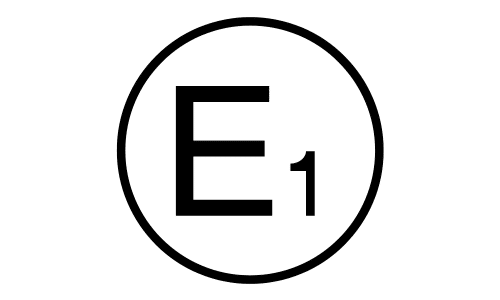
An ‘E’ mark, with a capital ‘E’ inside a circle, indicates UN/ECE type approval. The country code indicates the country in which the approval was issued, not that the product is intended solely for that country.
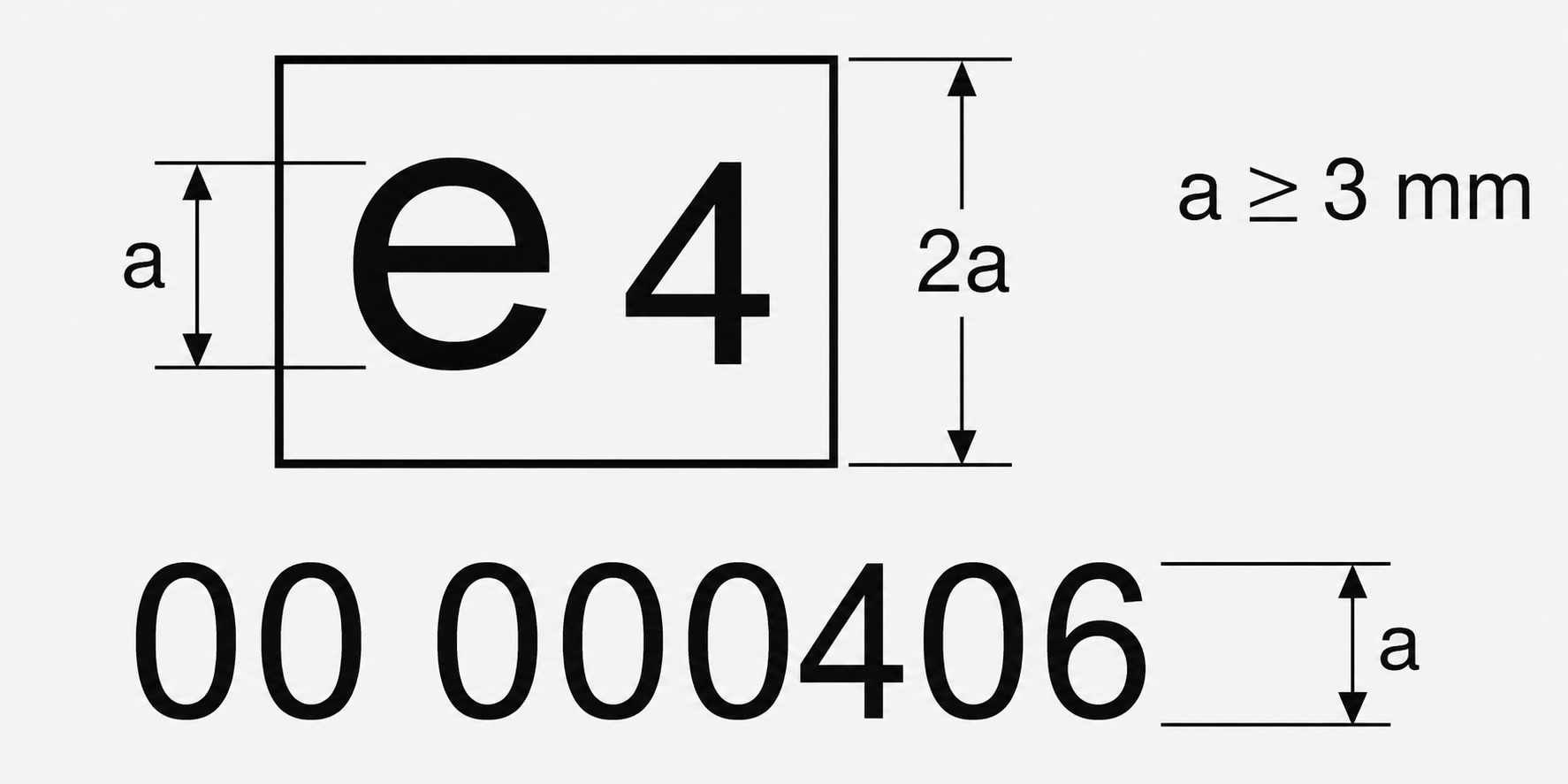
There is an important difference between a mark with a capital E and one with a lower-case e. Both marks may be official, but they belong to different approval systems.
| Marking | System | Shape | Example | Meaning |
|---|---|---|---|---|
| E | UN/ECE type approval | Capital letter E in a circle | E4 | Approval in accordance with a UN/ECE regulation, issued by the Netherlands |
| e | EU/EC type approval | Small ‘e’ in a rectangle | e4 | EU type approval, issued by the Netherlands |
In practice, when referring to vehicle lighting, the marking with a capital ‘E’ is usually meant. This marking is commonly found on lights, lenses and housings. The small ‘e’ in a rectangle is less commonly seen on individual vehicle lights, but this marking does indeed exist within the EU type-approval system.
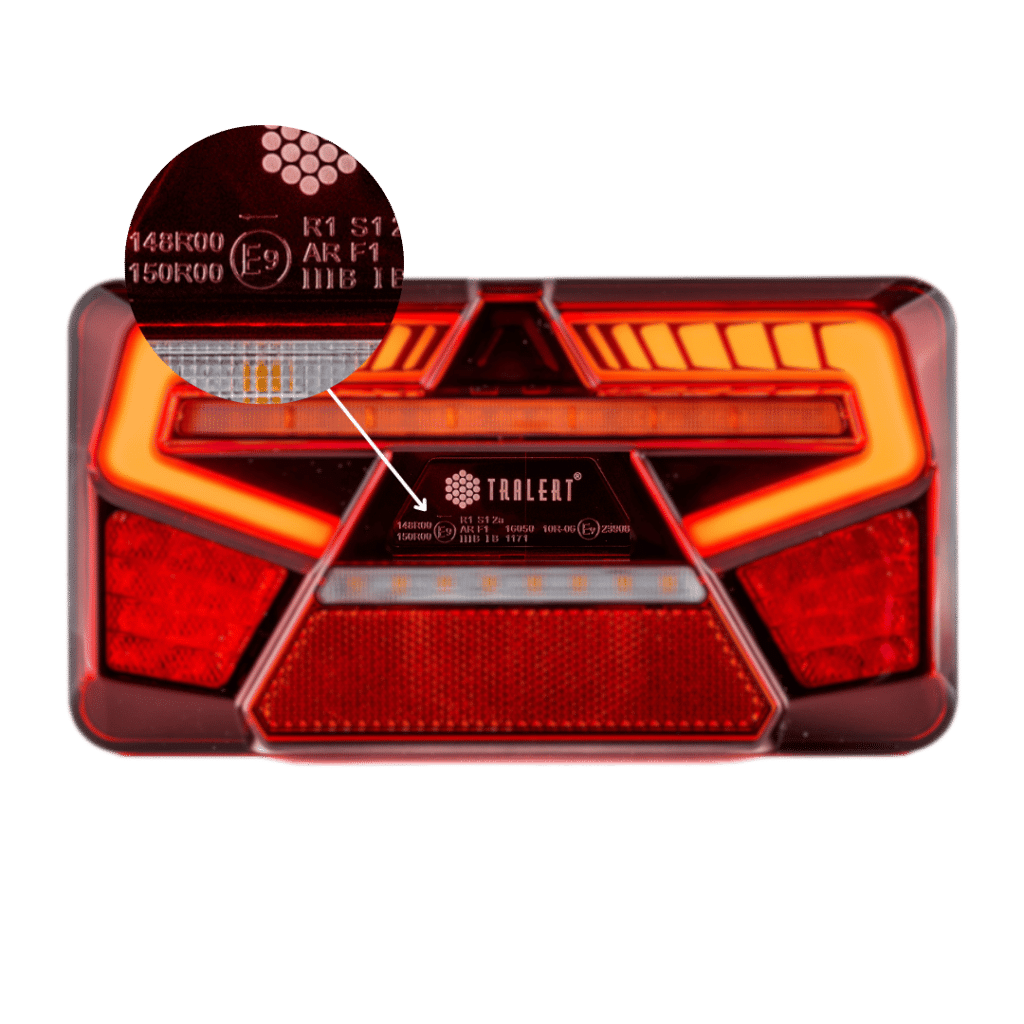
Until now, the focus has mainly been on the marking you see on the product: the capital letter E in a circle or the lower-case e in a rectangle. Behind such a marking there is always a type approval. This approval is issued on the basis of technical regulations. In the case of vehicle lighting, these are often ECE regulations.
Regulations relevant to vehicle lighting include ECE R10, ECE R65, ECE R48, ECE R148, ECE R149 and ECE R150, amongst others. Each regulation covers a specific topic, such as electromagnetic compatibility, warning lights, installation requirements or specific light functions.
Not every ECE regulation works in the same way. Some regulations concern the approval of the product or the light function itself. Other regulations, such as ECE R48, focus primarily on the installation of lighting on the vehicle. When it comes to lighting, it is therefore important to look not only at the E-code, but also at the additional markings on the light and the way in which the lighting is used.
A German approval number, such as E1, means that the approval has been issued by Germany. It does not mean that the lighting has been assessed solely in accordance with German national regulations.
Every country authorised to issue approvals within the UN/ECE system has its own country code. This code appears immediately after the capital letter E. The country code indicates where the approval was granted. It is therefore neither a quality ranking nor an indication of the country in which the product may be used.
| E1 - Germany | E11 - United Kingdom |
| E2 - France | E12 – Austria |
| E3 - Italy | E13 - Luxembourg |
| E4 - Netherlands | E17 - Finland |
| E5 - Sweden | E20 - Poland |
| E6 - Belgium | E24 - Ireland |
| E7 – Hungary | E26 - Slovenia |
| E8 – Czech Republic | E27 - Slovakia |
| E9 - Spain | E37 - Turkey |
| E43 – Japan | E45 – Australia |
Please note: the UN/ECE system extends beyond the European Union. Consequently, countries outside the EU may also have an E-code, such as Japan or Australia.
Before a product is permitted to bear a type-approval mark, it must be assessed in accordance with the requirements of the relevant regulation. This process consists of the following steps:
In Germany, for example, the Kraftfahrt-Bundesamt (KBA) is a well-known approval authority. In the Netherlands, the RDW is involved in vehicle type approvals and related approval processes.
For lighting used as official vehicle lighting on public roads, the correct approval is essential. If the required approval is missing, this may have consequences for the vehicle’s registration, roadworthiness truck or use. Furthermore, incorrectly fitted lighting can lead to glare, insufficient visibility or confusion amongst other road users.
This does not mean that every light without an E-mark is automatically prohibited in every situation. Work lights or off-road lights, for example, may serve a different purpose to mandatory road lighting. The question is always: what is the light used for, where is it fitted, and is it permitted to switch on this function on public roads?
The E-mark relates to type approval of vehicles and vehicle components. In the case of vehicle lighting, it concerns technical requirements for the specific light function. The CE mark serves a different purpose. CE indicates that a product complies with the applicable European requirements in areas such as safety, health and the environment, but is not a substitute for E-type approval for vehicle lighting.
For legally required light functions on public roads, the lighting must comply with the relevant requirements and approvals. Examples include indicators, brake lights, rear lights, marker lights and certain headlight or warning functions. As a general rule, lighting without the correct approval is not suitable for this purpose.
For supplementary lighting, such as work lights, the assessment depends on the function and intended use. A work light may be technically suitable for use around a vehicle, but must not simply be used as road lighting or be switched on whilst driving on public roads.
Check whether the light is marked with a capital letter ‘E’ inside a circle, followed by a country code and additional approval codes. Also, consult the manufacturer’s or supplier’s documentation. This usually specifies the function for which the lighting is approved and the relevant regulations.
Are you unsure whether a light is suitable for a specific application? Then check not only the approval mark, but also the function, mounting position, vehicle category and the way in which the light is switched on and off.

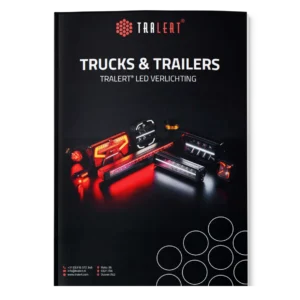
A selection of LED lighting for trucks and trailers.
A comprehensive overview of our LED vehicle lighting and accessories.
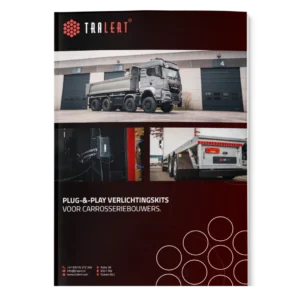
Plug-&-play lighting kits, cabling and lighting for bodybuilders.
What TRALERT® can do for you as a partner in LED vehicle lighting.
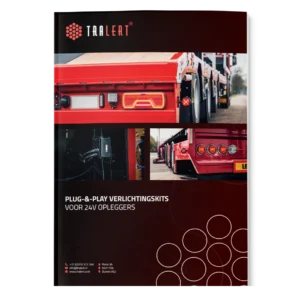
Plug-&-play kits, cabling and lighting for 24V semi-trailers.
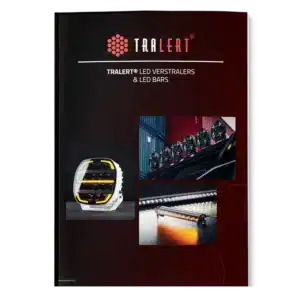
A selection of high-quality LED driving lights and LED bars.
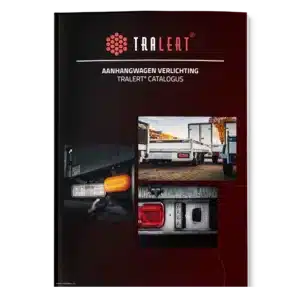
Lighting, wiring harnesses and accessories for trailers.
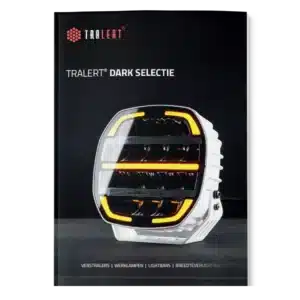
The TRALERT® DARK LED range.
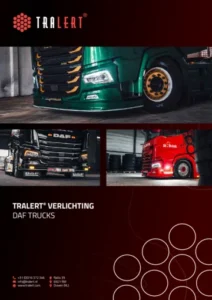
Work lights, rear lights, driving lights, beacor bars and more for DAF Trucks.
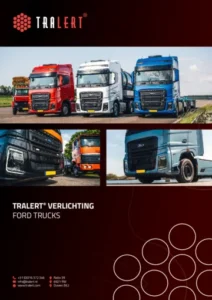
Work lights, rear lights, driving lights, beacor bars and more for Ford Trucks.
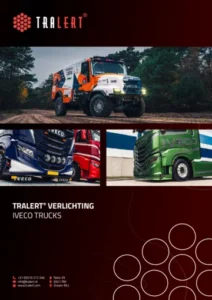
Work lights, rear lights, driving lights, beacon bars and more for Iveco.
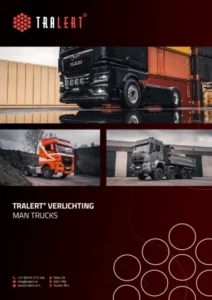
Work lights, rear lights, driving lights, beacon bars and more for MAN.
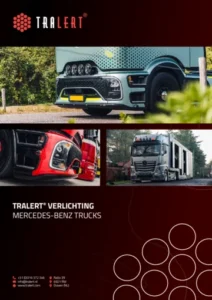
Work lights, rear lights, driving lights, beacon bars and more for Mercedes-Benz Trucks.
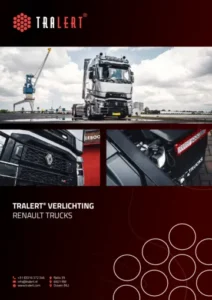
Work lights, rear lights, driving lights, beacor bars and more for Renault Trucks.
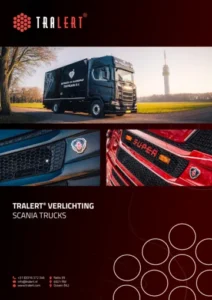
Work lights, rear lights, driving lights, beacor bars and more for Scania.
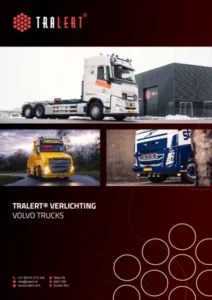
Work lights, rear lights, driving lights, beacon bars and more for Volvo Trucks.
The catalogue opens in a new tab. Can’t see it?
Open the catalogue (PDF)Two questions, in 30 seconds.
TRALERT® works with a dealer network. Dealers can view current stock levels, place orders online on account and receive a product feed for their online shop or system. We assess each enquiry internally and will let you know within 1 to 2 working days whether a partnership is possible.
You can purchase TRALERT® lighting through our partners, either locally or online. Simply provide your details, and we’ll find the partner best suited to help you.
Would you prefer to find a stockist yourself?We will assess your enquiry internally. You will hear from us within 1 to 2 working days to let you know whether a partnership is possible.
We’ll let you know within 1 to 2 working days which partner will be able to assist you further.