Specialised partner in LED vehicle lighting
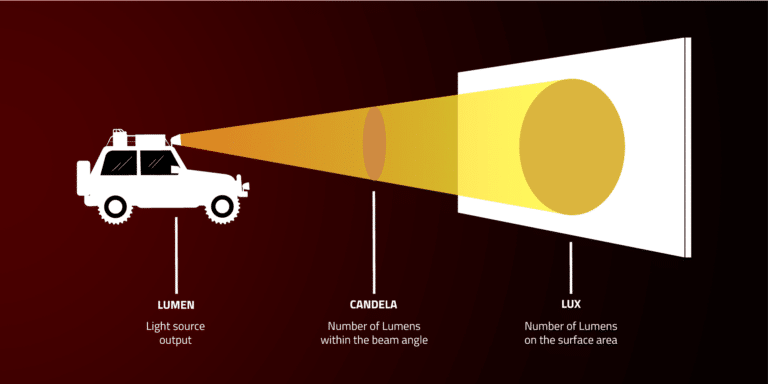
Definition
A lumen (lm) is the unit of measurement for the total amount of visible light emitted by a light source. The abbreviation lm stands for lumen . The higher the number of lumens, the more light a lamp produces. However, the number of lumen s alone does not tell the whole story about usable light output: the light beam, lens optics and light distribution also determine how useful it is in practice. Below, you can read what lumen s mean, how lumen s relate to lux and candela, how to convert lumens to watts, and how many lumen s you need for vehicle lighting.
Watch the short video Below for an explanation of lumen and why it is important in lighting. Prefer reading? Scroll further down for all the details.
The video is Dutch spoken, with subtitles available in German, English, French and Italian.
Lumen measures the total amount of light emitted by a particular light source in all directions. It enables you to evaluate the brightness of a light and compare it with other light sources. A higher lumen rating indicates brighter lighting, whilst fewer lumen indicate dimmer lighting. Understanding the lumen output helps you ensure that the lighting meets the requirements of your application. If you want to know how much light falls on a surface, you look at the number of lux.
Visibility and safety: a higher lumen output means the light produces more light. This is particularly important in dark or poorly lit conditions. That is why a driving light usually has a high lumen output.

Lumen, lux and candela all measure light, but in different ways. Lumen indicates the total amount of light produced by a lamp. Candela and lux indicate how that light is distributed.
Two lamps with the same number of lumen s can therefore produce very different beam patterns. A driving light concentrates its lumen s and achieves a high level of candela and lux at a distance. A work light spreads the same number of lumen s over a wide flat area: fewer lux per point, but a larger illuminated area. To find out which beam pattern suits which application, read our guide: flood beam, driving lights or combo beams – which beam pattern will you choose?
There is no fixed formula for converting lumen to watts. Watts represent the power consumption, whilst lumen represent the light output. The ratio between the two is known as luminous efficacy ( lumen per watt) and varies depending on the type of lamp. An incandescent bulb achieves approximately 10 to 15 lumen per watt, whilst an LED bulb achieves a multiple of that.
The calculation is: lumen ÷ lumen per watt = watts. For a lamp producing 100 lumen per watt, you would therefore need approximately 40 watts to produce 4,000 lumen . By way of comparison, here is the light output of incandescent bulbs and the power consumption of a comparable LED lamp:
| Light bulb | Light output (approx.) | LED power (approx.) |
|---|---|---|
| 25 watts | 250 lumen s | 2 to 3 watts |
| 40 watts | 400 to 450 lumen s | 4 to 5 watts |
| 60 watts | 800 lumen s | 7 to 9 watts |
| 75 watts | 1,100 lumen s | 10 to 12 watts |
| 100 watts | 1,600 lumen s | 14 to 17 watts |
Professional LED work lights offer higher efficiency. Here are a few examples from the TRALERT® range:
| Model | Power | Light output | Lumens per watt (approx.) |
|---|---|---|---|
| WF-3617ADRD ADR work light | 13.5 watts | 1,700 lumen s | 126 |
| SL200BM corner work light | 11.5 watts | 1,980 lumen s | 172 |
| WF-4041 work light | 40 watts | 4,100 lumen s | 103 |
| WF-6062 work light | 60 watts | 6,200 lumen s | 103 |
Want to know more about the difference between power and light output? Then read ‘Watt vs lumen: what’s the difference?’ or the explanation of wattage.
That depends on what you want to illuminate and at what distance. More lumen isn’t automatically better: it’s about the right amount of light in the right place. By way of comparison, a 60-watt incandescent bulb produces around 800 lumen. For vehicle lighting, you can use this guideline:
Are you unsure which of two models to choose? Then take a look at the light beam (narrow or wide), the mounting height and the distance to the work area. You can find more help on choosing a beam pattern for your vehicle in our blog.
Are you looking for lighting with high light output? Then it is good to know that different types of lights utilise their lumen in their own way. Some focus the light far ahead, whilst others spread it widely. Below, you can read how this works for the three types of work lights with the highest light output.
A driving light concentrates its lumen into a focused light beam that reaches far ahead. At TRALERT®, you will find powerful driving lights with a light output of over 15,000 lumen, ideal for maximum visibility and range on truck, 4x4s or tractors.
An LED bar distributes its lumen evenly across a wide flat area, thereby illuminating a large area uniformly. The most powerful models achieve a light output of up to around 30,000 lumen, making them suitable for wide visibility in off-road, agricultural work and heavy transport.
A work light provides clear, wide illumination in the immediate vicinity of the vehicle. With a light output of over 8,000 lumen and an even beam pattern, you can work comfortably and without glare whilst loading, unloading and working in the dark.
When purchasing lighting, it is wise to look at more than just the number lumen. Units such as wattage, Volts and amps also provide valuable insights into a light. It is important not to focus on a single term, but to weigh up all factors together. A light with high lumen but poor lens optics produces a bright spot in the centre with dark edges, whilst a well-designed light distributes that same light effectively across the road or worksite.
The abbreviation ‘lm’ stands for lumen: the unit measuring the total amount of visible light emitted by a light source.
This varies depending on the light. An incandescent bulb produces approximately 10 to 15 lumen per watt. TRALERT®’s LED work lights achieve around 100 to 170 lumen per watt. See the tables for converting lumen to watts.
That depends on the application. 1,000 lumen s is equivalent to an incandescent bulb of approximately 75 watts. For a work light on a vehicle, that is modest: TRALERT®’s work lights deliver up to well over 8,000 lumen s and the most powerful LED bars up to around 30,000 lumens.
No. It’s all about how the light is distributed. A light with a high lumen output but poor lens optics produces a bright spot with dark edges. Furthermore, lighting for public roads is subject to legal requirements to ensure that oncoming traffic is not dazzled.
A lumen is the total amount of light emitted by a light. A lux is the amount of light falling on a surface. Read more about lux and candela.
Our technical team is on hand to advise you on choosing the most suitable lighting for your situation. Please feel free to contact us for tailored advice.

A selection of LED lighting for trucks and trailers.
A comprehensive overview of our LED vehicle lighting and accessories.
Plug-&-play lighting kits, cabling and lighting for bodybuilders.
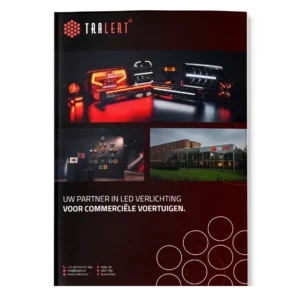
What TRALERT® can do for you as a partner in LED vehicle lighting.
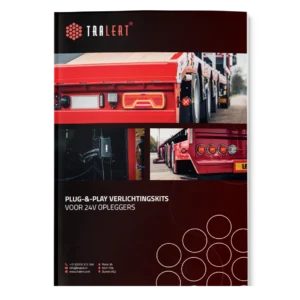
Plug-&-play kits, cabling and lighting for 24V semi-trailers.
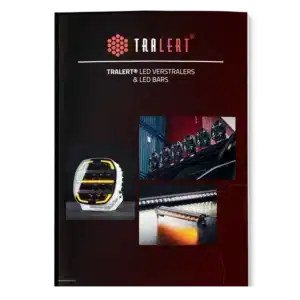
A selection of high-quality LED driving lights and LED bars.
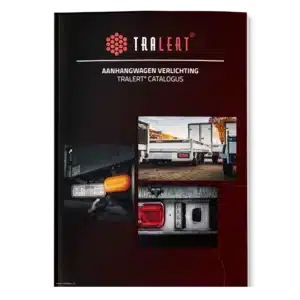
Lighting, wiring harnesses and accessories for trailers.
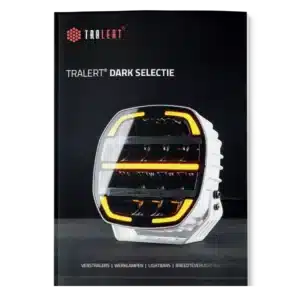
The TRALERT® DARK LED range.
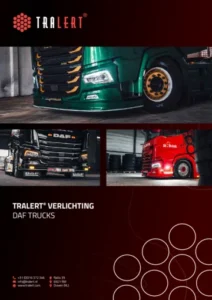
Work lights, rear lights, driving lights, beacor bars and more for DAF Trucks.
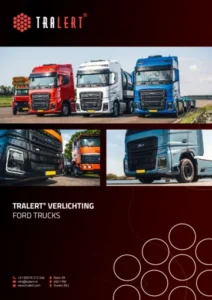
Work lights, rear lights, driving lights, beacor bars and more for Ford Trucks.

Work lights, rear lights, driving lights, beacon bars and more for Iveco.
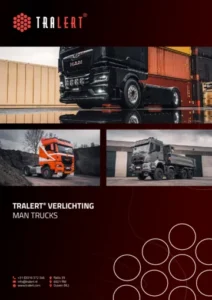
Work lights, rear lights, driving lights, beacon bars and more for MAN.

Work lights, rear lights, driving lights, beacon bars and more for Mercedes-Benz Trucks.
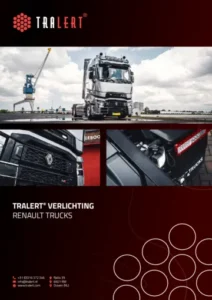
Work lights, rear lights, driving lights, beacor bars and more for Renault Trucks.

Work lights, rear lights, driving lights, beacor bars and more for Scania.
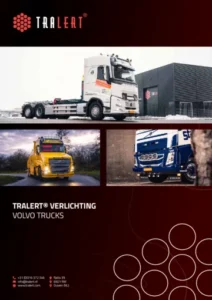
Work lights, rear lights, driving lights, beacon bars and more for Volvo Trucks.
The catalogue opens in a new tab. Can’t see it?
Open the catalogue (PDF)Two questions, in 30 seconds.
TRALERT® works with a dealer network. Dealers can view current stock levels, place orders online on account and receive a product feed for their online shop or system. We assess each enquiry internally and will let you know within 1 to 2 working days whether a partnership is possible.
You can purchase TRALERT® lighting through our partners, either locally or online. Simply provide your details, and we’ll find the partner best suited to help you.
Would you prefer to find a stockist yourself?We will assess your enquiry internally. You will hear from us within 1 to 2 working days to let you know whether a partnership is possible.
We’ll let you know within 1 to 2 working days which partner will be able to assist you further.