What is Ampere?
Definition
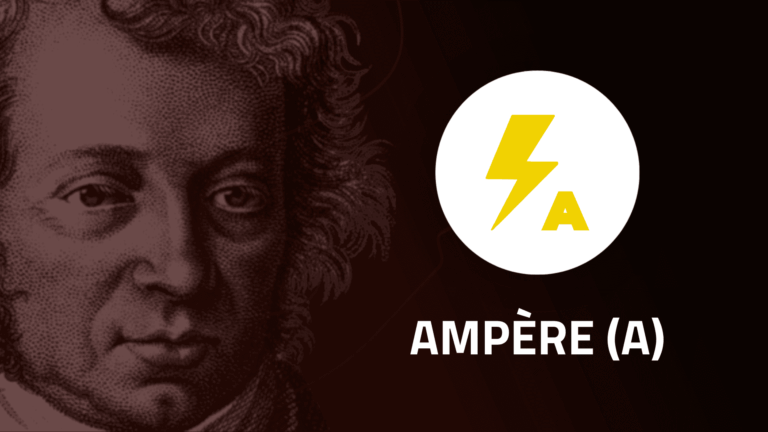
An ampere (A) is the unit of electrical current. It indicates how much current flows through a conductor, such as a cable or LED light, per second. In vehicle lighting for trucks, trailers and trailers and off-road applications, this often determines whether systems operate reliably: too little capacity leads to dimming lights or a drop in voltage, whilst too much leads to overheating or interference. The number of amperes indicates the current, not the light output: this is measured in lumens.
The unit is named after André-Marie Ampère. On products and data sheets, you will see the symbol “A” (e.g. 0.5 A per light or 15 A max. per circuit).
Definition of current
According to the SI system, 1 ampere corresponds to just over 6 × 10¹⁸ electrons per second. In practical terms, a magnetic field is generated around a current-carrying wire: two parallel wires 1 metre apart, carrying exactly 1 A, attract each other with a force of 2 × 10⁻⁷ newtons per metre.
The difference between volts and watts
These three units measure different aspects of electricity:
- Ampere (A) = Current (quantity of electrons per second)
- Volt (V) = voltage (the "pressure" that drives the current)
- Watt (W) = power (work per second)
Formula: P = U × I (Watts = Volt × Ampere)
Conversely: I = P / U (Amps = Watts / Volt)
Example: a 6 W 12 V LED light draws 0.5 A. For further explanation, see Volts and wattage.
Power and lighting on trucks & trailers
When installing lighting systems on trucks, trailers and caravans, a proper electrical installation is crucial for safety, reliability and light output.
Important to keep an eye on:
- Voltage & current: Add up the total wattage of all lights and consumers and calculate the current (amps) with: Current (A) = Wattage / Voltage.
- Cable thickness: Always choose the cable thickness according to both current rating (amps) and cable length. Cables that are too thin cause voltage drop, making lights dull, and can overheat under load. With vehicle lighting, take voltage drop into account.
- Mass (earth): For longer cable runs or when maximum reliability is required, we recommend always pulling back a separate ground wire.
- Reserve & protection Keep 20-30% reserve on total consumption. Use the right fuses and never exceed the maximum load of the connector (usually 15-25 A).
- CAN-bus: In modern trucks , LED lights can cause error codes. A CAN-bus module often solves this.
You can find more tips in our article on resolving and preventing lighting faults in heavy goods vehicles.
Tips for vehicle construction and bodybuilding
In vehicle construction and bodybuilding, the amperage (amps) determines how reliable and efficient the lighting system becomes. Whether LED rear lights, marker lights, work lights, warning lights or interior lighting: the total consumption controls the choice of cables, fuses, junction boxes and any CAN-bus modules.
A few practical points of interest:
- Calculate the total ampere consumption of all lights and keep 20-30% reserve for peaks or future expansions.
- Use sufficient cable cross-section: minimum 1.5 mm² for signal pins, 2.5-6 mm² for power (constant plus, PIN 9/10) to avoid voltage drop.
- Check the maximum load of the junction box (usually 15-25 A) and install separate fuses for additional consumers such as refrigerator or battery charger.
- For modern vehicles with CAN-bus: avoid error codes by simulating the correct load or using a CAN-bus module.
This prevents problems with inspections (RDW, EMC), dimming lighting or interference in heavy transport. At TRALERT® we are happy to help with complete calculations and customised solutions.
Want to know more about lighting solutions specifically for bodybuilding? Take a look at our overview: Lighting for bodybuilding. Or get in touch for bespoke advice.
Practical questions on amperage with LED lighting
How many amperes does an average LED rear light set draw on a trailer?
A standard set (left and right rear lights, brake lights, indicators, licence plate lights) usually draws 1.5 to 3 A at 12 V or 0.8 to 1.5 A at 24 V. Always calculate the exact power consumption from the datasheet and allow for a 20–30 per cent margin.
Why do my LED lights dim when I apply brake or turn on the indicators?
Usually due to voltage drop: cable too thin, line too long or total current too high. Use at least 2.5 mm² for power pins and measure the voltage at the end of the wiring harnesses (should be at least 11.5 V at 12 V system under load).
How do I calculate the right fuse for a complete lighting system?
Count the total ampere consumption of all lights + 20-30% margin. Example: 10 A total consumption → choose a 15 A fuse (slow or slow). Always install separate fuses for constant plus (PIN 9/10) and signal pins.
Can I connect a 12 V light to a 24 V system?
No, unless the light is explicitly rated for 12–24 V. At 24 V, a 12 V light receives twice the voltage and will usually burn out. Always use 24 V-compatible LEDs or a DC-DC converter for 12 V components.
Modern vehicles with CAN-bus detect abnormal loads. The tractor thinks there is a short circuit or lamp defect. Solution: use a CAN-bus module or simulate the right resistance (load resistor) on the right PINs.
How do I prevent overheating in wiring harnesses under high ampere loads?
Ensure sufficient cable cross-section (min. 2.5 mm² for 10-15 A, 4-6 mm² for >20 A) and good connections (no loose terminals). Consider ambient temperature and do not bundle cables too tightly - heat accumulates.
What is the difference in amperage between halogen and LED for the same light output?
LED consumes 70-90% less power. A halogen rear light often draws 4-6 A, while a comparable LED version uses 0.4-1 A. This not only saves energy, but also thicker cables and higher fuses.
Do I always have to connect mass separately or can I use chassis mass?
Always use a clean, separated mass (PIN 3/13) via a thick wire back to the tractor. Chassis mass can cause corrosion or ground loop, leading to flickering LEDs or interference with electronics.