

Blog
In Germany, an additional side indicator is mandatory for O3 and O4 trailers and all long lorries. According to Section 5(2) of the German LKWÜberlStVAusnV, the towing vehicle and the trailer must each comply separately with UNECE R48 Section 6.5.3.1. For O3 and O4 trailers, this means a total of three Category 5 side direction indicators on each side. For towing vehicles in categories N2 or N3, this applies if the individual vehicle is longer than 9 metres. Alternatively, a minimum of three amber coloured side marker lights per side may suffice for each vehicle section.
In this article, you will learn:
- Is blinking marker lights with indicator function mandatory in germany?
- The LKWÜberlStVAusnV regulation
- Which lighting is approved for use as side markings on long lorries in Germany?
- Explanation of the ‘Lang-Lkw’ programme in Germany
Is blinking marker lights with indicator function mandatory in germany?
Yes, but not in all cases.
For long-load vehicles (LZVs) on the German Lang-Lkw network, marker lights with indicator function are compulsory. Germany stipulates in Section 5(2) of the LKWÜberlStVAusnV that both the towing vehicle and the trailer must comply with paragraph 6.5.3.1 of UNECE Regulation 48, regardless of when the vehicle was type-approved. This means that this requirement also applies to foreign combinations operating on this network.
Legislation on lighting for long lorries explained in detail
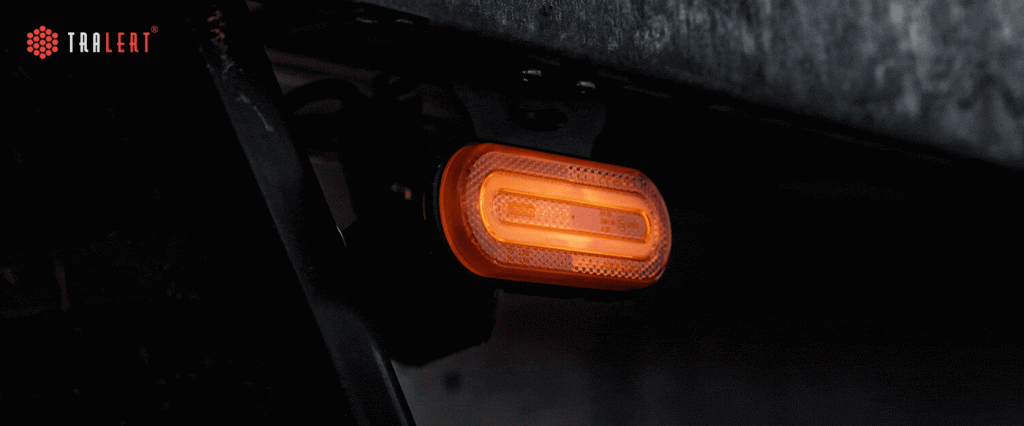
Side marker lights on trucks in Germany are subject to clear regulations, and it is precisely with marker lights with indicator function that problems frequently arise. In this video, TRALERT® explains what German regulations stipulate regarding side marker lighting on long vehicle combinations, and when a flashing function is or is not permitted. This way, you’ll know in advance whether your truck, trailer or semi-trailer complies before the lighting is fitted.
Requirements that side markings must meet
Paragraph 6.5.3.1 of UNECE R48 regulates side-marker lights for long vehicles and sets out two options.
The main rule: trailers and semi-trailers in categories O3 and O4 must have three Category 5 side indicators on each side, distributed as evenly as possible along the length of the vehicle. For towing vehicles in categories N2 and N3 longer than 9 metres, the same requirement applies: three additional Category 5 indicators on each side.
The alternative: this requirement is waived if the vehicle has at least three amber side marker lights on the same side that flash in phase and simultaneously with the indicators on that side. As semi-trailers and trailers almost always opt for this alternative, the German LZV requirement effectively amounts to marker lights with indicator function.
If you opt for marker lights with indicator function, you must comply with the following requirements:
- Type approval: the side marker lights must be approved in accordance with UNECE R148 or the older R91. They must also bear an E-mark with function code SM1. The lighter SM2 type is only permitted on passenger cars.
- Colour: all flashing side marker lights must be amber . A red rear side marker light must therefore not flash.
- Number and operation: a minimum of three lights are required per side. These must flash in phase and at the same frequency as the indicators on that side of the vehicle.
- Mounting height: the lights must be fitted between 250 and 1,500 mm above the road surface. Only if the body shape makes this impossible may the height be increased to 2,100 mm.
- Longitudinal positioning: at least one light must be situated in the middle third of the vehicle. The front light may be positioned no more than 3 metres from the front. The distance between lights must not exceed 3 metres, or 4 metres if the vehicle’s design does not allow for any other solution. The rear light must be positioned no more than 1 metre from the rear of the vehicle.
- Cannot be combined with Category 5 indicators: if Category 5 side direction indicators are fitted on one side, the side marker lights on that side must not be indicators. You must therefore choose one of the two solutions for each side of the vehicle.
If an O3 or O4 trailer is first registered on or after 7 July 2024, it must comply with the current UNECE R48 requirements. For older vehicles, please check the original type approval. If the vehicle is used as part of a ‘Lang-Lkw’ in Germany, it must always comply with §6.5.3.1, regardless of its age.
Lighting for long and heavy haulage
TRALERT® supplies various amber coloured lights that are approved for use both as side marker lights and as Category 5 side direction indicators.
See our lighting for heavy transport →
LKWÜberlStVAusnV: the specific regulation in Germany
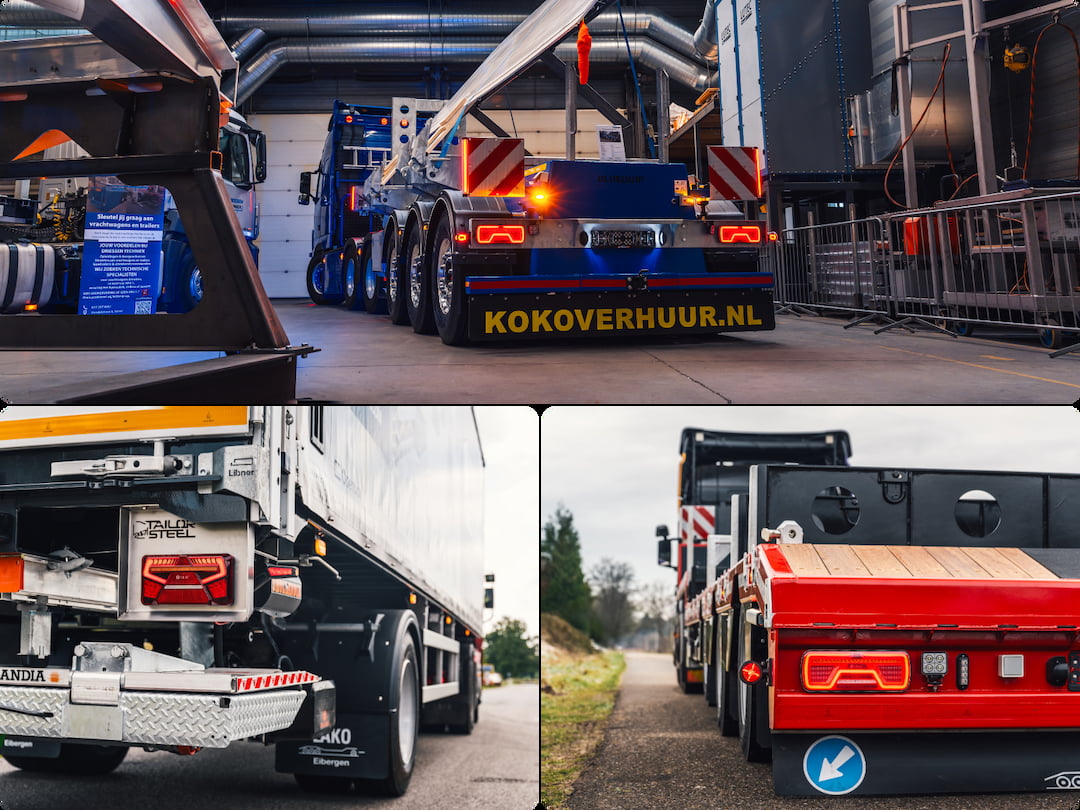
The LKWÜberlStVAusnV is the German regulation governing the conditions under which vehicles and vehicle combinations exceeding the standard length (Lang-Lkw) are permitted to use German roads. In addition to the general requirements set out in UNECE R48, this regulation stipulates the following additional requirements.
The lighting requirement is set out in §5(2): both the towing vehicle and the trailer must comply with paragraph 6.5.3.1 of UNECE Regulation R48, “regardless of when the vehicle was type-approved”. In other words, regardless of when the vehicle was type-approved. In doing so, Germany is taking a unique approach: R48 paragraph 6.5.3.1 normally applies only to new type approvals, but for long lorries, Germany is making this requirement a condition of use for all vehicles, including existing and foreign combinations. Furthermore, the regulation refers to the section of R48 in which this is specified as one of the two permitted configurations, as we have already explained above.
Other useful facts about the German regulations
Effective dates (§13(2)): new long vehicles had to comply from 1 July 2020; existing vehicles were given until 1 July 2022 to adapt their lighting. Since then, the requirement has applied without exception to every LZV, regardless of year of manufacture or country of origin.
- Five permitted combinations (§3): the regulation permits five types of vehicle combinations with excess length, ranging from the extended semi-trailer (Type 1) to the truck with trailer (Type 5). The lighting requirement set out in §5(2) applies to all types.
- Maximum lengths (§4): the extended semi-trailer may have a total length of up to 17.88 metres; combinations of Types 2 to 4 up to 25.25 metres; and a truck with a trailer (Type 5) up to 24.00 metres.
- Also mandatory: contour marking and the ‘Lang-Lkw’ sign (§5(1)): in addition to the side marking requirement, the regulation stipulates retro-reflective contour markings in accordance with UNECE R48 and, at the rear, a retro-reflective sign bearing the inscription “Lang-Lkw” (letter height 130 mm), as a connection to UNECE R70. Furthermore, §5(1) sets out other technical requirements, including a lane departure warning system.
- Only on the Positivnetz (§2 and annex): Long lorries may only travel on the routes listed in the annex to the regulation. This list of routes was last expanded by the thirteenth amending regulation (BGBl. 2025 I No. 25, in force since 31 January 2025).
- Type 1 is temporary (§13(1)): the provisions for extended semi-trailers (§3, sentence 1, No. 1 and the corresponding dimensions in §4(1)) will cease to apply with effect from 31 December 2026.
In addition to the requirements for long vehicles, there are also regulations governing the maximum width of a truck.
What are Lang-Lkw and Positivnetz?
The road network for ecocombis operates via a so-called ‘positive list’: unlike standard trucks, which are permitted to drive anywhere unless a prohibition sign prohibits it, long-Lkw’s may only travel on roads that have been explicitly approved by the government and set out in the annex to the LKWÜberlStVAusnV. This network of officially authorised motorways and federal roads (Bundesstraßen) together shapes the Positivnetz. The network is continuously updated via official amending regulations (Änderungsverordnungen), whereby new routes are added to the list on the basis of infrastructure and safety assessments.
You can find out more about long lorries on the information page of the Federal Ministry of Transport, and here you can view the current map of the Positivnetz road network.
When is a vehicle classified as an LZV?
A vehicle is considered a Long Heavy Goods Vehicle (LHV), also known as an 'Ecocombi' or 'Gigaliner', when it is longer than the standard length of 18.75 metres and meets national admission requirements for extra-long vehicle combinations. In most European countries, including the Netherlands, an LHV is allowed a maximum length of 25.25 metres. The maximum permitted weight differs from country to country: in the Netherlands it is 60 tonnes, while in Germany the limit is 40 tonnes, or 44 tonnes for intermodal transport.
Long-load vehicles (LZVs) are used to transport more cargo per journey: two LZV journeys replace three journeys with a standard truck. According to the German Federal Ministry of Transport, this results in efficiency gains and fuel savings of 15 to 25 per cent, depending on the route and load. In Germany, LZVs are categorised into five approved vehicle combinations (Types 1 to 5). Under the German Lang-Lkw programme, additional safety features are mandatory, including a lane departure warning system and side marker lights that flash in sync with the indicator.
LZV according to the Dutch classification (please note: in Germany, Types 1 to 5 apply according to the official Bundesministerium für Verkehr).
LHV transport between the Netherlands and Germany
Please note: for Dutch long-haul vehicle (LZV) combinations, the same technical requirements apply in Germany as for German vehicles. This means that Dutch LZVs must also comply with the technical requirements set out in §5 of the LKWÜberlStVAusnV. Without these modifications, a foreign LZV will not be permitted on the German road network. The German regulation makes no distinction based on the country of registration: the requirements apply to every LZV on the German Lang-Lkw network.
European regulations for heavy trailers weighing 3,500 kilograms or more
The regulations governing long vehicles (LZVs) in Germany under the LKWÜberlStVAusnV now also apply to standard heavy trailers and semi-trailers via European type approval. UNECE Regulation R48 (07 series of amendments, paragraph 6.5.3.1) requires that trailers in categories O3 and O4 be fitted with side direction indicators: three Category 5 side indicators on each side, or at least three amber side marker lights that flash in phase with the indicators. Under Regulation (EU) 2019/2144, this requirement applies to new vehicle types from 6 July 2022 and to all newly registered vehicles from 7 July 2024. Existing trailers do not need to be modified.
The difference compared with the German LZV regulations lies in their scope: the EU requirement applies only via type approval and therefore affects new vehicles exclusively, whilst Germany imposes the same R48 provision on all vehicles for long-haul lorry traffic, regardless of age. You can read more about the general requirements in the article on trailer lighting regulations.
See the ECE-approved side markings from TRALERT®
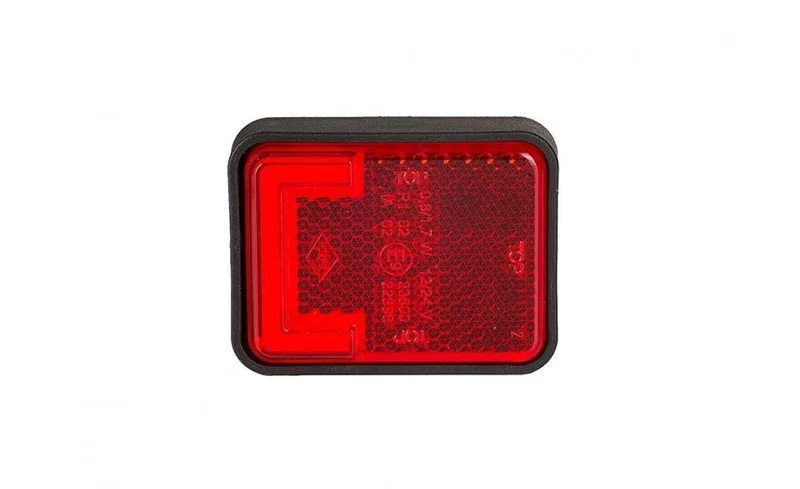
LED marker light neon red with bracket | 12-24v | 50cm. cable | MV-3500R
Available on backorder
SKU:
MV-3500R
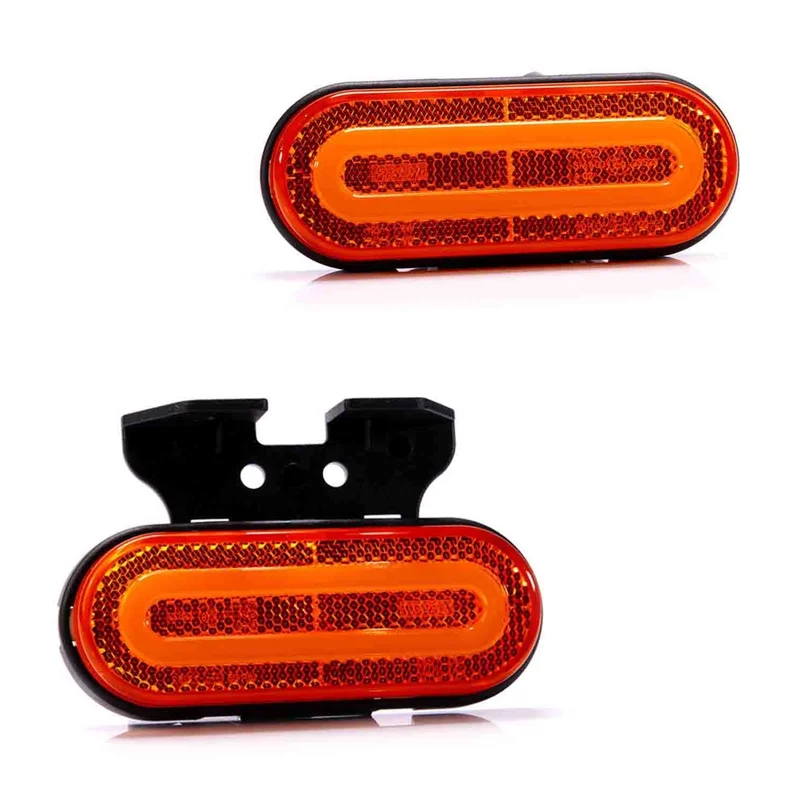
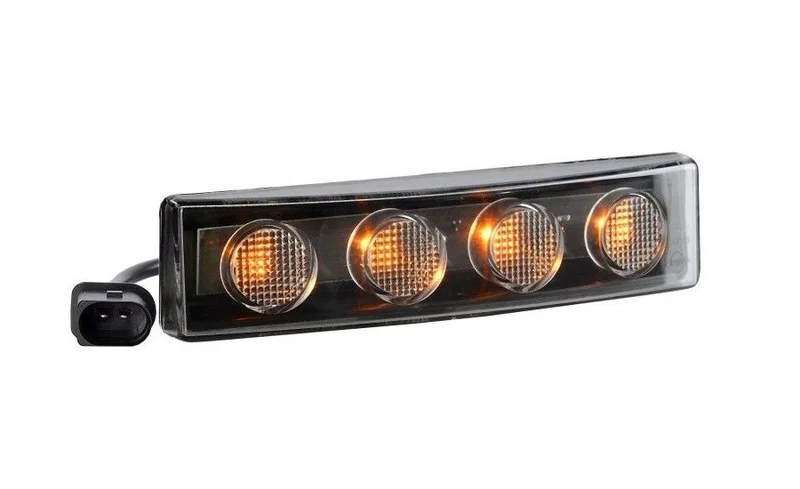
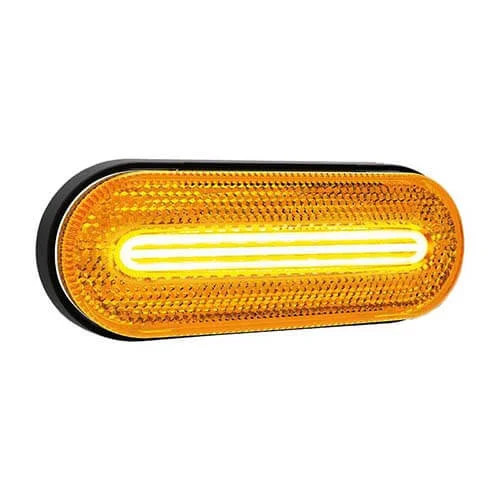
LED side-marker with flashing light function | 12-24v | 50cm cable | M10ZK-100A
In our stock
SKU:
M10ZK-100A

Disclaimer:
At TRALERT®, we do our best to keep the information in this article as accurate and up-to-date as possible, including the regulations surrounding vehicle lighting. However, legislation can change regularly, and although we make every effort to implement these changes in a timely manner, it is possible that certain updates or adjustments have not yet been incorporated into this article. We therefore always advise our readers to check the current legislation with their local government or regulatory bodies, especially when it comes to exceptions or specific national regulations. TRALERT® is not liable for any damages or fines resulting from outdated or incomplete information in this article.
If in doubt, always contact the competent authority to ensure that your vehicle meets all legal requirements.