Specialised partner in LED vehicle lighting


The short answer
In the bodywork and vehicle construction sectors, connecting lighting is a task that looks simple on paper. In practice, however, it can sometimes present challenges, as the TRALERT® lighting experts know from experience. It is precision work and the margin for error is quite high.

An important distinction to note from the outset: a professional semi-trailer or towed vehicle behind a truck is not a light trailer with a 7-PIN or 13-PIN connector and a fixed wiring diagram. With 24V trailer lighting, the cabling runs the full length, multiple light functions are integrated, and there are stricter requirements regarding waterproofing and vibration resistance. Anyone who approaches the wiring of a semi-trailer as if it were a standard trailer job is underestimating the cable lengths, the load and the number of connections.
Sometimes there are set protocols in the way they work. There are also plenty of workshops where mechanics make their own choices on a vehicle-by-vehicle basis and there they lean entirely on the experience and skill of the professionals.
Particularly in locations where heavy equipment is surface mounting, customisation is just around the corner. Improvisation therefore occurs regularly. Partly because of this, it can be extra challenging for newcomers.
Because there is still relatively little standardisation in the processes, a lot of variation and improvisation takes place when connecting lighting in bodybuilding.
Despite there being many repetitive parts when connecting, there should always be a strong focus on avoiding mistakes, as in:
They seem like details, but these very details cause the most interference later on.
The risks involved during mounting can be categorised into a number of groups. The table below links each risk to its potential consequence and the corresponding preventative measure.
| Risks during mounting | Possible consequence | Prevention |
|---|---|---|
| Risk during installation: Incorrect wire or function connected | Possible consequence: The lamp malfunctions or fails to work | Prevention: Unambiguouscable coding and a fixed installation plan |
| Risks during installation: Poor crimp or splice connections | Possible consequence: Contact resistance and failure | Prevention: Suitable connector and inspected tools |
| Risk during installation: Inadequate sealing | Possible consequences: Moisture, corrosion and subsequent interference | Prevention: Correctly fitted, waterproof connector |
| Risks during installation: Incorrect cable cross-section or long cable run | Possible consequence: Voltage drop | Prevention: Calculate load and cable length in advance |
| Risks during installation: Unprotected or incorrectly routed cables | Possible consequences: Wear and tear and cable breakage | Prevention, cable routing, strain relief and mechanical protection |
| Risks during installation: Many manual connections | Possible consequence: Variations and additional testing | Prevention: Pre-assembledmodular wiring harness |
We explore the connection technology in more detail in the article on connecting 24V trailer lighting.
Finished connecting? Then truck off. A light not working: how can that be fixed?
Sometimes the problem is found in no time, but it can also take a whole morning. Experienced fitters recognise patterns and know where to look. New mechanics will often check everything to make a diagnosis:
Our lighting experts have also written a separate article on interference with lorry and semi-trailer lighting. There you’ll find tips on how to diagnose the problem.

Connections that appear perfect in the workshop can still fail when used outdoors. Moisture can seep into the light housing through a slightly loose grommet, a poorly sealed connector or a cable gland. After a few washes or a journey in the rain, a light may start to flash or an entire circuit may fail. The connector determines how reliable the installation ultimately is. A good electrical connection starts with the right connector. SuperSeal connectors are therefore often used in modern lighting systems for trucks and trailers , as they are protected against moisture, dirt and vibrations.
New fitters soon learn that ‘sealed is sealed’ sounds simple in theory, but in practice often means extra tape, sealant or another connector. Unfortunately, this only becomes apparent once the trailer is already with the customer.
A trailer has to endure a lot: constant vibrations, jolts and temperature fluctuations.
A heat-shrink connector that hasn’t been crimped quite deep enough, or a connector with a millimetre of play, may work fine in the workshop, but will come loose after 5,000 km.
With long semi-trailers, voltage drop plays a greater role than with a short trailer. As the cable gets longer and the cross-section narrower, the voltage drops at the end of the line. This leads to dimmer lights or unreliable operation. You should therefore calculate the load and cable length in advance, and select the cable cross-section accordingly. A good mass connection is just as crucial, as a poor mass causes similar problems to a positive wire that is too thin. Further background information can be found in our guide to cabling for vehicle lighting.
A small mistake is easily made. During testing, it may turn out that a light does not work or a function fails. Then precious time goes into finding and repairing the problem.
Even after delivery, interference can occur due to vibrations, weather and load during use. A single connection then often requires the removal of floor panels, panels, cable ducts or seals. This leads to long-term downtime, extra technician hours and logistical costs.

A customer wants work lights at the rear, an extra flashing light or a different type of licence plate light. This means:
What starts as "just adding a light" often ends in hours of extra work. This is particularly difficult for new fitters: they do not yet know the standard routing and have to improvise at the same time, while experienced colleagues have little time to do everything for them.
“Semi-trailers are becoming increasingly complex from a technical point of view. This requires a level of expertise that is becoming increasingly scarce. It therefore pays to simplify the process of connecting the lighting.”
Semi-trailers are being fitted with more light points, an increasing number of CAN-bus applications, and face stricter requirements regarding water resistance and EMC (ECE R10). At the same time, there is a chronic shortage of experienced fitters. Bringing in new staff is urgently needed, but the learning curve proves particularly steep when it comes to lighting.
Connecting lighting therefore takes more time and energy than many companies expect in advance. It requires patience, precision and routine. These are features that new fitters still need to surface mount, while experienced colleagues are already overloaded.
The current way of working requires new ways of working due to staff shortages. More standardisation, as we see in construction, is necessary for operations.
Switching to modular, pre-assembled lighting systems with connectors precisely tailored to the vehicle type can save a lot of time here.
Instead of having to run, splice and truck cables time and time again, a mechanic simply needs to connect and check. This not only saves hours per trailer, but also makes the work more accessible to new colleagues: less improvisation, fewer errors and less reliance on scarce skilled workers.
So a smarter approach not only means faster completion, but also a workshop that is future-proof and gets new mechanics up and running faster.
Many challenges when connecting semi-trailer lighting stem from loose wiring: incorrect connections, moisture in solder joints and interference that is difficult to trace. A plug-and-play system minimises these problems with pre-assembled, waterproof connectors that significantly reduce the number of error-prone, loose connections.
In the video below, you can see how a standardised connection reduces the risk of wiring errors and why this enhances long-term reliability.
Errors mainly occur at the connections and in cable routing: incorrectly connected wires, poorly crimped or inadequately sealed connectors, cables that are too thin or too long, and weak mass connections. A lack of final inspection is also a factor. A clear installation plan and properly maintained tools significantly reduce these risks.
Voltage drop occurs when the cable is too long or too thin for the connected load. At the far end of a long semi-trailer, the voltage may be too low, causing lights to glow dimly or operate unreliably. A poor earth connection exacerbates this effect. You should therefore calculate the cable length, cross-section and load in advance.
Moisture can penetrate connectors that are not fully closed or have not been sealed. Choose waterproof connectors that match the wire cross-section, fit them in accordance with the instructions and check the seal. Furthermore, do not position connections in areas where water collects. This ensures the installation remains reliable even in the presence of brine and vibrations.
A light trailer usually uses a 7-PIN or 13-PIN connector and a fixed wiring diagram. A professional semi-trailer has longer cable runs, more light functions and more stringent requirements regarding waterproofing and vibration resistance. As a result, connecting 24V trailer lighting is more complex and prone to errors than with a DIY trailer.
Curious to find out what this could look like for your business? Take a look at the plug-&-play trailer lighting and discover how it offers the perfect solution for smooth and time-saving mounting.


A selection of LED lighting for trucks and trailers.

A comprehensive overview of our LED vehicle lighting and accessories.
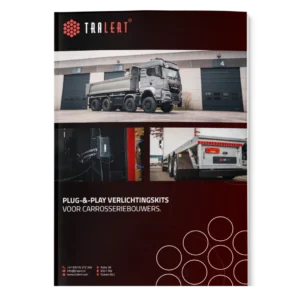
Plug-&-play lighting kits, cabling and lighting for bodybuilders.
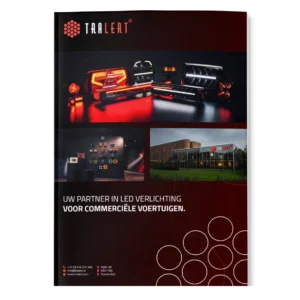
What TRALERT® can do for you as a partner in LED vehicle lighting.
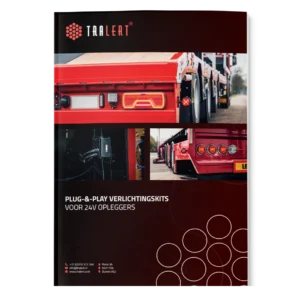
Plug-&-play kits, cabling and lighting for 24V semi-trailers.

A selection of high-quality LED driving lights and LED bars.
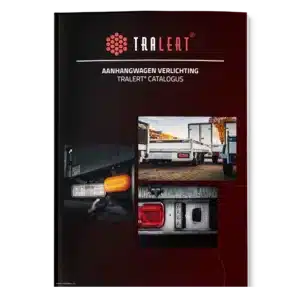
Lighting, wiring harnesses and accessories for trailers.

The TRALERT® DARK LED range.
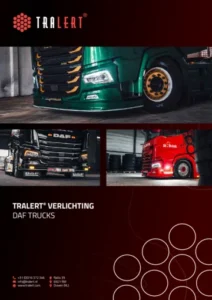
Work lights, rear lights, driving lights, beacor bars and more for DAF Trucks.
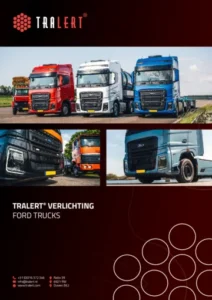
Work lights, rear lights, driving lights, beacor bars and more for Ford Trucks.
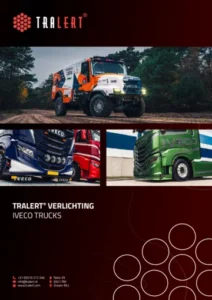
Work lights, rear lights, driving lights, beacon bars and more for Iveco.
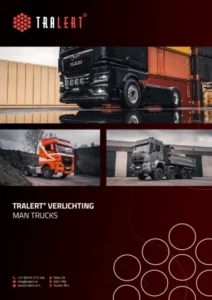
Work lights, rear lights, driving lights, beacon bars and more for MAN.
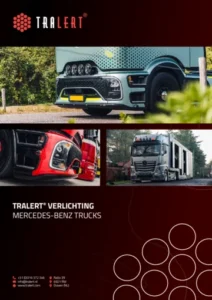
Work lights, rear lights, driving lights, beacon bars and more for Mercedes-Benz Trucks.
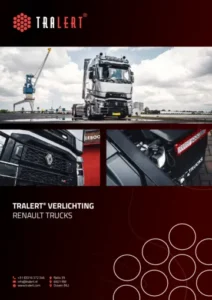
Work lights, rear lights, driving lights, beacor bars and more for Renault Trucks.
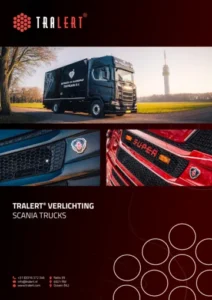
Work lights, rear lights, driving lights, beacor bars and more for Scania.
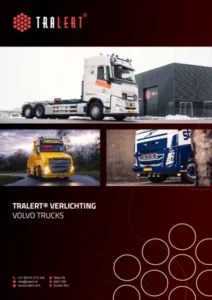
Work lights, rear lights, driving lights, beacon bars and more for Volvo Trucks.
The catalogue opens in a new tab. Can’t see it?
Open the catalogue (PDF)Two questions, in 30 seconds.
TRALERT® works with a dealer network. Dealers can view current stock levels, place orders online on account and receive a product feed for their online shop or system. We assess each enquiry internally and will let you know within 1 to 2 working days whether a partnership is possible.
You can purchase TRALERT® lighting through our partners, either locally or online. Simply provide your details, and we’ll find the partner best suited to help you.
Would you prefer to find a stockist yourself?We will assess your enquiry internally. You will hear from us within 1 to 2 working days to let you know whether a partnership is possible.
We’ll let you know within 1 to 2 working days which partner will be able to assist you further.
New
The Trailerkit Configurator is now live
Put together your ‘ trailer ’ and receive the complete lighting kit packaged as a single set: lighting, marker lights and wiring harnesses, all coordinated and ready for mounting. Includes a mounting diagram and mounting instructions.
Launch the configurator