Your specialised partner in LED vehicle lighting

The short answer
A reliable trailer lighting kit consists of more than just a few individual lights. The connector, wiring harness, connectors, light functions and system voltage must all work together as a single, integrated unit. Choosing the wrong component can lead to extra installation time, interference or repair work after delivery.
In this guide, you’ll learn how to put together a complete trailer lighting kit as a professional. You’ll be guided step by step through the key decisions, from the application and required light functions to the connection, cabling and final inspection.
In this article, you will read:
A complete trailer lighting kit forms the electrical and mechanical link between the towing vehicle and all the light functions on the trailer. The system starts at the vehicle plug and runs via the main wiring harness, branch cables and connectors to the various lights.
The quality of the system is determined not only by the individual components, but above all by their mutual compatibility and the way in which everything is connected, protected and fitted. A logically structured system reduces installation time, simplifies diagnostics and makes it easier to replicate the same configuration in series production.
Don’t start with the light, but with the trailer and its intended use. The type of vehicle, its size, its application and the preferred mounting method determine which configuration is suitable. You should therefore establish the key parameters in advance.
When replacing parts, also inspect the existing installation. Check the connector, cable lengths, connection points, connectors and the condition of the cabling. Existing wires may contain hidden cable breaks, corrosion or damaged insulation. Where several components are obsolete or have unclear connections, replacing the entire wiring harness is often more efficient and reliable than carrying out a partial repair.
The system voltage forms the basis of the entire installation. Standard light trailers are usually connected to a 12V on-board electrical system. A 24V system is mainly found in trucks, trailers and semi-trailers. Although many lights are suitable for both 12V and 24V, this does not automatically apply to all components of the installation.
| System | Typical applications | Important focus |
|---|---|---|
| System12V | Typical application: Light trailers towed by passenger cars and commercial vehicles | Important consideration: Compatibility with the vehicle’s electronics and the chosen plug connection |
| System24V | Typical applications: Trailers, semi-trailers and other applications towed by trucks | Important point to note: Components, connections and cabling must be suitable for the entire 24V system |
| System12/24V components | Typical application: Suitable for use in both voltage environments | Important point to note: Also check the voltage compatibility of control boxes and other system components |
This guide focuses primarily on 12V trailers. For each configuration, determine the voltage supplied by the towing vehicle and then check each electrical component for suitability. This will prevent malfunctions and unnecessary diagnostic work.
The type of lighting required on a trailer depends, amongst other things, on the vehicle category, dimensions, date of first registration and intended use. You should therefore first determine the required light functions and only then decide which lights are needed to fulfil these functions. The key components of a trailer lighting system are:
For the final configuration, always refer to the requirements applicable to the specific trailer. In our overview, you can read more about the regulations governing trailer lighting. The practical requirements for positioning and mounting are covered in more detail in ECE R48.
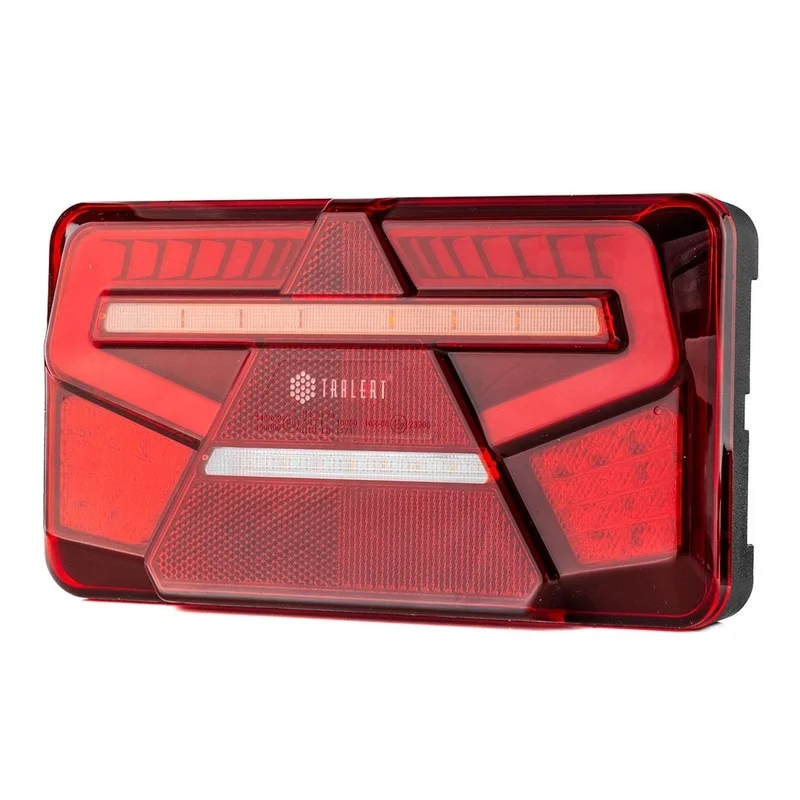
Rear lights play a major role in the surface mounting of the set. Don’t just look at the design and available mounting space, but focus above all on the functions and connections. A model that integrates multiple functions can reduce the number of individual components and connections.
When making your selection, please check:
For product selection, view the overview of trailer rear lights. Match the chosen connection directly to the wiring harness. This prevents the need to adjust connectors or make loose connections during mounting.
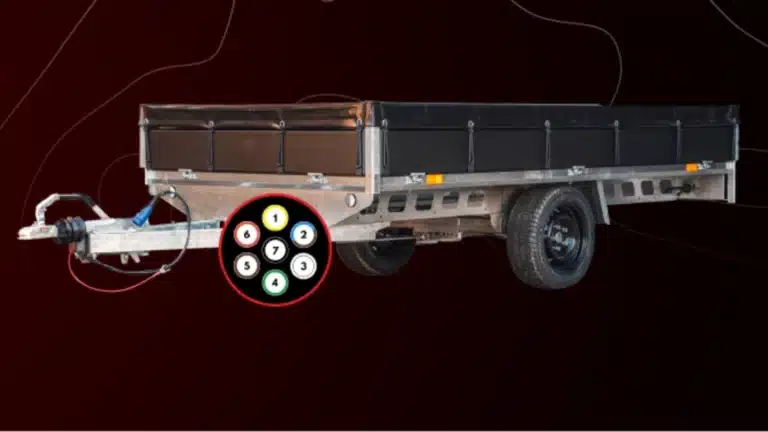
The connector determines which electrical functions can be transmitted between the towing vehicle and the trailer. A 7-PIN connector supports the basic functions for standard trailer lighting. A 13-PIN connector offers additional connection options, for example for reversing lights and supplementary power supply.
| Connection | Suitable for | Selection criteria |
|---|---|---|
| Connection7-PIN | Suitable for: Basiclight functions on simple trailers | Selection criterion: Suitablewhen only the functions of the 7-PIN connection are required |
| Connection13-PIN | Suitable for more complextrailer configurations | Selection criterion: Moreterminals available for additional functions and power supplies |
Make this choice before specifying the wiring harness. Check the required pin configuration, the connection to the towing vehicle and the functions that actually need to be controlled. For the wiring diagram, please refer to the explanation of the 7-PIN connector or the 13-PIN connector.
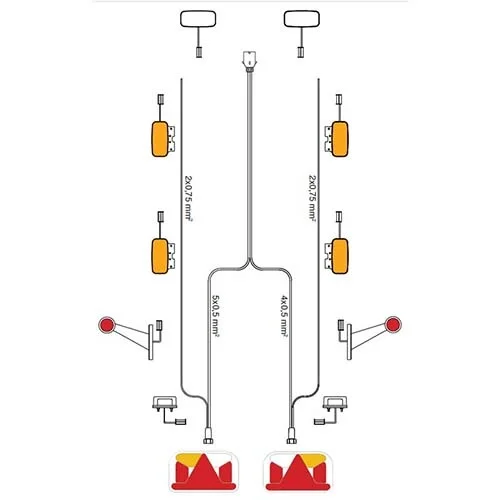
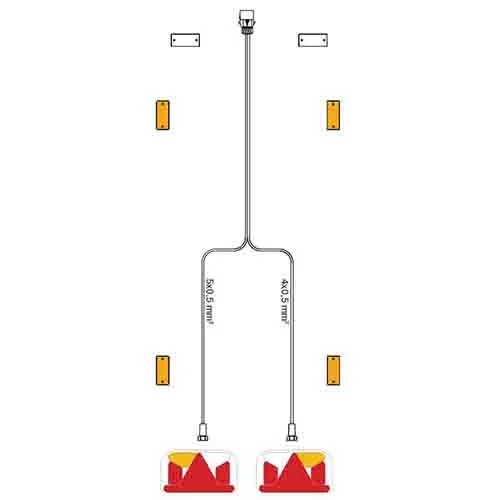
The wiring harness connects all the components and largely determines how quickly, neatly and reliably the kit can be fitted. A suitable wiring harness has the correct connector, sufficient length, branch connections in the right positions and connectors that match the chosen lights.
When specifying, please ensure you include at least the following:
When making a connection to the towing vehicle, ensure there is sufficient cable length to accommodate steering and articulation movements. The additional length required depends on the drawbar, the mounting position and the range of movement of the combination. Avoid both a cable that is too tight and excess cable that could drag along the ground.
For auxiliary lighting, pre-assembled branch cables or dedicated plug-in connectors can speed up mounting. Use these exclusively within a wiring system for which they are designed and fit them in accordance with the manufacturer’s instructions. The quality of the seal is determined by the entire connection, not just the connector itself. View the available 12V wiring harnesses for trailers, as well as connectors and adaptor plugs.
A trailer lighting system can be built from individual components or as a pre-configured plug-&-play lighting system for the trailer. The right choice depends primarily on the level of customisation required, the production volume and the desired installation time.
| Individual components | Plug-and-play system |
|---|---|
| Individual components: plentyof flexibility for unique vehicle configurations | Plug-&-play system: Components and connections are pre-matched |
| Individual components: Suitablefor occasional replacement or bespoke solutions | Plug-and-play system Suitablefor repeatable production |
| Individual components| Additional wiring and connections on site | Plug-&-play system: Shorterand more predictable installation time |
| Individual components: Need more control over compatibility? | Plug-and-play system: Reduced risk of mixed-up connections |
| Individual components: Flexible when every trailer is different | Plug-&-play systemConsistent design and quality for every vehicle |
For vehicle builders who frequently produce the same configuration, a standardised plug-&-play set usually offers the greatest benefit. Fewer manual connections reduce the risk of errors and make mounting and final inspection more reproducible. For unique vehicles or specific installation scenarios, however, individual components can actually offer greater configuration flexibility.
LED lighting generally consumes less power than halogen lighting. Some towing vehicles use the electrical load to detect lamp failure or the presence of a trailer. If the measured load deviates from what the vehicle’s electronics expect, this can result in error messages, flashing lighting or malfunctions.
The term ‘canbus proof’ alone is therefore no guarantee that every combination will function without issues. Operation depends on the towing vehicle, the trailer module, the lighting used and the complete electrical configuration. It is therefore advisable to truck a new or standardised set using representative towing vehicles.
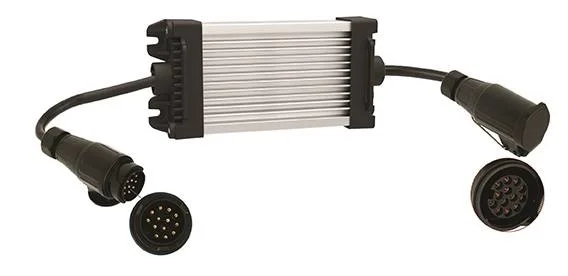
If the vehicle’s electronics detect insufficient load, a suitable control box or other vehicle-specific solution may be required. Such a module simulates an appropriate electrical load or adjusts the signals to match the LED system. Select the solution based on the vehicle, the plug connection and the functions causing problems. Take a look, for example, at the 13-PIN 12V LED control box.
Interference often does not originate in the light itself, but somewhere in the electrical or mechanical assembly. The points below therefore deserve special attention during design and mounting.
When used in rain, mud or cleaning environments, lights and connections must be suitable for the expected conditions. An IP rating describes the protection of the tested housing against dust and water under specified truck conditions. IP68 relates to dust-tightness and immersion in accordance with the conditions specified by the manufacturer. IP69K relates to cleaning with water under high pressure and at high temperatures.
A high IP rating for the light does not automatically make the entire installation waterproof. Cable exits, connectors, seals and the method of installation must also be carried out correctly. Where possible, position connections away from direct exposure to water, prevent water from running along cables towards a connector , and follow the manufacturer’s installation instructions.
A lighting system is only ready for use once its operation, mounting and connection have been systematically checked. Do not limit the final check to simply ensuring that all lights are working. Also check that the configuration has been set up correctly and remains reliable under real-world conditions.
By making this check an integral part of the handover, faults are identified earlier and the risk of recurring interference and repair work is reduced.
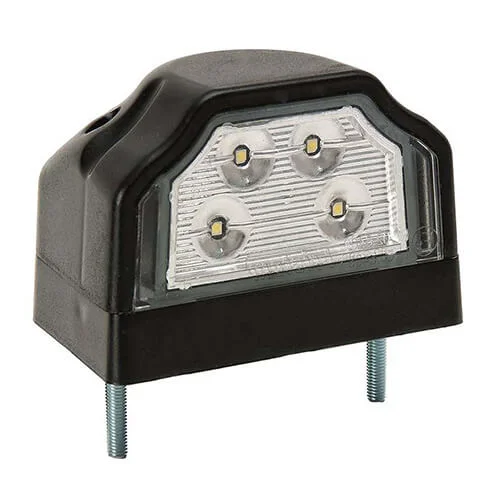
A complete set usually consists of a vehicle plug, wiring harness, connectors, rear lights and the necessary auxiliary lighting. Depending on the trailer, this may also include marker lights, side marker lights, licence plate lights, reflectors and a control box.
A 7-PIN connector is suitable for basic light functions. A 13-PIN connection offers connection options for additional functions, such as reversing lights and an extra power supply. The trailer’s functions and the towing vehicle’s connection determine which version is suitable.
12V is commonly used for light trailers towed by passenger cars and commercial vehicles. 24V is mainly used for trailers and semi-trailers towed by trucks. Lighting and other electrical components must be suitable for the voltage of the entire system.
No. Furthermore, the designation ‘canbus proof’ does not mean that a light will work without any problems with every towing vehicle. Compatibility depends on the vehicle’s electronics, the trailer module, power consumption and the overall configuration. Sometimes a suitable control box or other solution is required.
A plug-&-play kit is particularly useful when installation time, a low risk of error and a reproducible setup are important. This applies, for example, to mass production. Individual components offer greater flexibility for unique trailers and non-standard installation scenarios.
Many interferences are caused by a poor earth connection, moisture or corrosion in a connection, damaged cabling, incorrect pin configuration or incompatibility with the towing vehicle. You should therefore check the entire circuit, not just the light that is malfunctioning.
A suitable trailer lighting kit starts with a clear system specification. When the application, voltage, light functions, connection and cable routing are defined in advance, the components can be selected specifically and mounting becomes more predictable.
TRALERT® supports vehicle builders, engineers, buyers and distributors in putting together complete trailer lighting solutions. View the overview of professional trailer lighting or contact us for assistance with a specific configuration.

A selection of LED lighting for trucks and trailers.
A comprehensive overview of our LED vehicle lighting and accessories.
Plug-&-play lighting kits, cabling and lighting for bodybuilders.
What TRALERT® can do for you as a partner in LED vehicle lighting.
Plug-&-play kits, cabling and lighting for 24V semi-trailers.
A selection of high-quality LED driving lights and LED bars.
Lighting, wiring harnesses and accessories for trailers.
The TRALERT® DARK LED range.
Work lights, rear lights, driving lights, beacor bars and more for DAF Trucks.
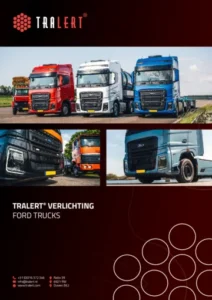
Work lights, rear lights, driving lights, beacor bars and more for Ford Trucks.
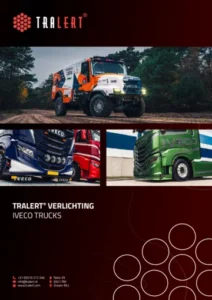
Work lights, rear lights, driving lights, beacon bars and more for Iveco.
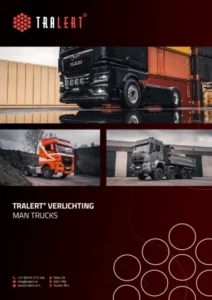
Work lights, rear lights, driving lights, beacon bars and more for MAN.
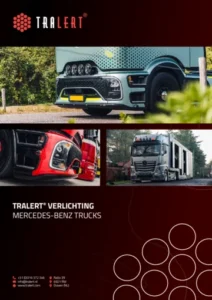
Work lights, rear lights, driving lights, beacon bars and more for Mercedes-Benz Trucks.
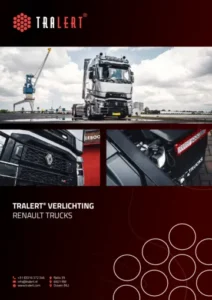
Work lights, rear lights, driving lights, beacor bars and more for Renault Trucks.
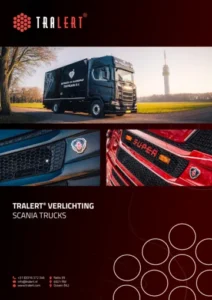
Work lights, rear lights, driving lights, beacor bars and more for Scania.
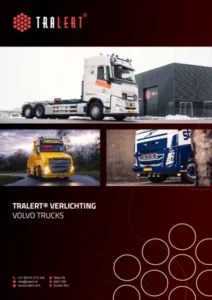
Work lights, rear lights, driving lights, beacon bars and more for Volvo Trucks.
The catalogue opens in a new tab. Can’t see it?
Open the catalogue (PDF)Two questions, in 30 seconds.
TRALERT® works with a dealer network. Dealers can view current stock levels, place orders online on account and receive a product feed for their online shop or system. We assess each enquiry internally and will let you know within 1 to 2 working days whether a partnership is possible.
You can purchase TRALERT® lighting through our partners, either locally or online. Simply provide your details, and we’ll find the partner best suited to help you.
Would you prefer to find a stockist yourself?We will assess your enquiry internally. You will hear from us within 1 to 2 working days to let you know whether a partnership is possible.
We’ll let you know within 1 to 2 working days which partner will be able to assist you further.
TRALERT® operates through a dealer network. Prices, stock levels and online ordering are therefore only available to business customers with an account.
We assess every enquiry internally and will let you know within 1 to 2 working days whether a partnership is possible.
For your own use?Find a stockist
Would you prefer a quote first?Add this product to your quotation request and send it off when you’re ready.