Specialised partner in LED vehicle lighting

The short answer
Connecting 24V lorry lighting seems simple: connect the power supply, connect the mass, and the light works. In practice, however, there is more to it than that. The correct cable cross-section, connector, fuse and mass connection all determine how reliable the installation will remain. Vehicle control systems and the approval of the light function also play a role. In this blog, you can read about what you need to bear in mind when connecting 24-volt lorry lights.
In this blog you will read:
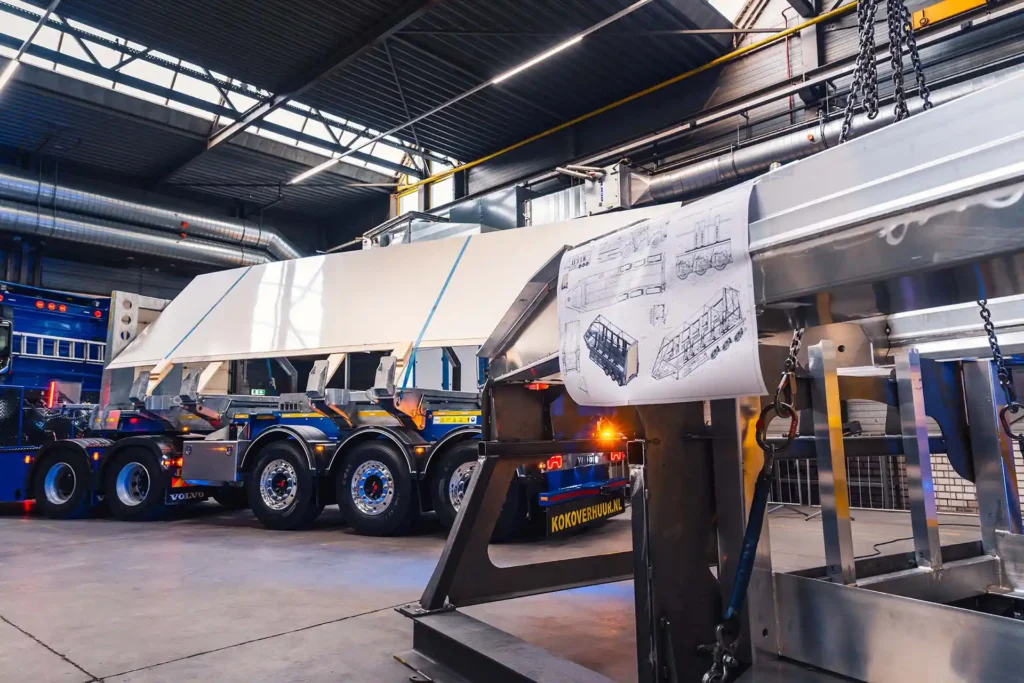
An example of a flatbed trailer fully equipped with 24-volt lighting from the TRALERT® ‘ plug -and-play’ range.
Heavy commercial vehicles usually use a 24V system. This allows the same electrical power to be delivered using less current. If the voltage doubles, the current required is halved whilst maintaining the same power output.
This is particularly important on a truck. Cables often run over long distances through the chassis. A lower current limits voltage loss and heat build-up in the wiring. Furthermore, a smaller cable cross-section is often sufficient to achieve the same power output.
In a tractor-trailer combination, the cable runs become even longer. This is where the advantage of a 24-Volt system really comes into its own.
For lighting, this primarily means that every component must be suitable for the voltage supplied. Much of the LED lighting used in transport therefore operates within a wide voltage range, for example 12–24V or 9–36V. A light designed exclusively for 12V should not be fitted directly to a 24V system.
The power consumption and the length of the circuit then determine which cable you need. Would you like to work this out exactly? Then take a look at our guide on calculating cable thickness for vehicle lighting.
24V lighting is not a separate light function. The designation primarily indicates the supply voltage for which the lighting is suitable. On a truck, this includes:
These lights can all operate on a 24-volt system, but the requirements vary depending on the light function. For example, different regulations apply to a work light than to a rear light.
Since 2005, TRALERT® has specialised in ECE-approved LED lighting for all brands of trucks. It offers a wide range of lighting that is resistant to vibrations, moisture and intensive daily use.
Fitting a light is usually the easy part. The quality of the connection determines whether the lighting will continue to work trouble-free even after thousands of kilometres. You should therefore always check the following components.
First, check whether the light is suitable for 24V or a multi-voltage range that includes 24V. Refer to the product specifications for this. Also take into account the charging voltage when the engine is running, as the actual on-board voltage is then higher than the nominal 24V.
Cable length, current and cable cross-section are interdependent. A cable that is too thin causes additional voltage drop over long distances. As a result, LED lighting may be less bright or operate erratically.
You should therefore select the cable cross-section based on the actual power consumption and the length of the circuit, rather than simply choosing whatever cable is left over in the workshop. You’ll find various options in our overview of cabling for trucks and semi-trailers.
A poor earth connection causes a surprising number of interference problems. The lighting may flash, provide less light or only fail whilst driving.
Therefore, ensure that the mass point is clean and free from corrosion. Also check connections for play and contamination. Avoid sharing a mass connection unnecessarily between components with significantly different power consumption.
Connectors fitted underneath a truck are exposed to water, dirt, de-icing salt and vibrations on a daily basis. A reliable 24V connection therefore requires connectors that can withstand these conditions.
Sealed systems such as Deutsch and SuperSeal are widely used for this purpose. Deutsch is often found in work lights and driving lights subject to heavier loads. SuperSeal is more compact and is frequently used in truck and trailer installations.
There are also standardised connections for linking to a trailer or semi-trailer. A well-known example is the 7-PIN connector.
Match the fuse to the power consumption and the chosen cable cross-section. This is because the fuse primarily protects the wiring. A fuse that is too large can cause the cable to become overloaded before the fuse trips.
Also, pay close attention to the cable routing. Along chassis rails and cross-members, sharp edges and vibrations can gradually damage the cable sheath. Provide extra protection at such points where necessary.
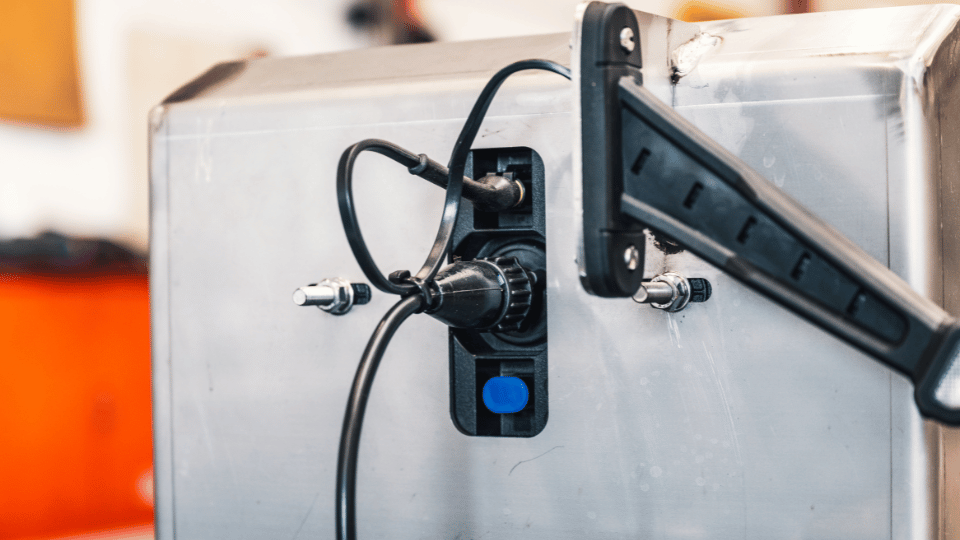
The tractor unit has its own 24 Volt electrical system. In the case of a semi-trailer, the power supply and light signals must then be transferred to the second vehicle. As tractors and semi-trailers are frequently swapped, this is done via standardised plug connections.
A commonly used solution is the 15-PIN connection in accordance with ISO 12098. This transmits various lighting and signalling functions. In addition, 7-PIN N and S connections are also used. Which connection is fitted depends, amongst other things, on the model and age of the vehicle.
The type of connector fitted determines which functions are available between the tractor and the semi-trailer. You can find the pin configuration on our page about the 15-PIN connector in accordance with ISO 12098.
Important: this connector merely serves as the connection between the two vehicles. The lighting and cabling on the semi-trailer then form their own separate installation.
‘24V’ or ‘24 volts’ merely refers to the supply voltage. It does not automatically mean that a light is approved for use on public roads.
The specific requirements depend on the light function and the application on the vehicle. Consequently, a light that is electrically compatible may still be unsuitable for the location where you wish to fit it.
The following topics, amongst others, play an important role in modern lorry lighting:
In addition, there are specific requirements for each light function. For example, rear lights, driving lights and warning lights are not all subject to the same regulations. You can read more about this in our overview of ECE standards and legislation for vehicle lighting.
ADR regulations only apply when the vehicle is used for transport subject to these regulations. It is therefore not a general requirement for every truck with a 24V lighting system. You can find more information in our article on ADR lighting and regulations.
Practical example: a 96-watt light draws approximately eight amps at 12V. At 24V, this is approximately four amps. As a result, less current flows through the cabling for the same power output. Over long cable runs, this helps to minimise voltage drop and heat build-up.
If the lighting does not work as expected after mounting, do not immediately assume that a light is faulty. Problems often arise in the connection, the vehicle’s control system or the cabling.
Modern trucks control many light functions electronically. For example, the vehicle monitors how much power a light is using. LED lighting consumes significantly less power than a traditional filament bulb.
As a result, a functioning LED light may still be identified as faulty. You may notice this, for example, through an error message, rapidly flashing indicators or lighting that switches off unexpectedly.
You can read more about the causes and possible solutions in our article on CAN-bus interference in LED lighting.
Is a light dimmer than usual or does it fail whilst driving? If so, first check the wiring leading to the light. An insufficient cable cross-section, poor mass connection, corroded connector or a loose connection can cause the same issues as a faulty light.
If in doubt, measure the voltage at the light whilst the circuit is under load. This will give you a clearer picture of what is actually reaching the lighting.
Do you experience radio interference as soon as you switch on the lighting? Or does the DAB, GPS or on-board communication deteriorate at the same time? If so, the electronics in the LED driver may be causing electromagnetic interference.
You can read about how to recognise and tackle such a problem in our article on radio interference when switching on LED lighting.
In a complete truck or semi-trailer installation, the number of connections can quickly mount up. Every manually made connection takes time and may later become a potential point of failure.
Pre-assembled wiring harnesses and plug-&-play kits minimise the number of loose connections. Cables, connectors and lighting are pre-matched to ensure compatibility. This makes mounting more straightforward and reduces the risk of connection errors.
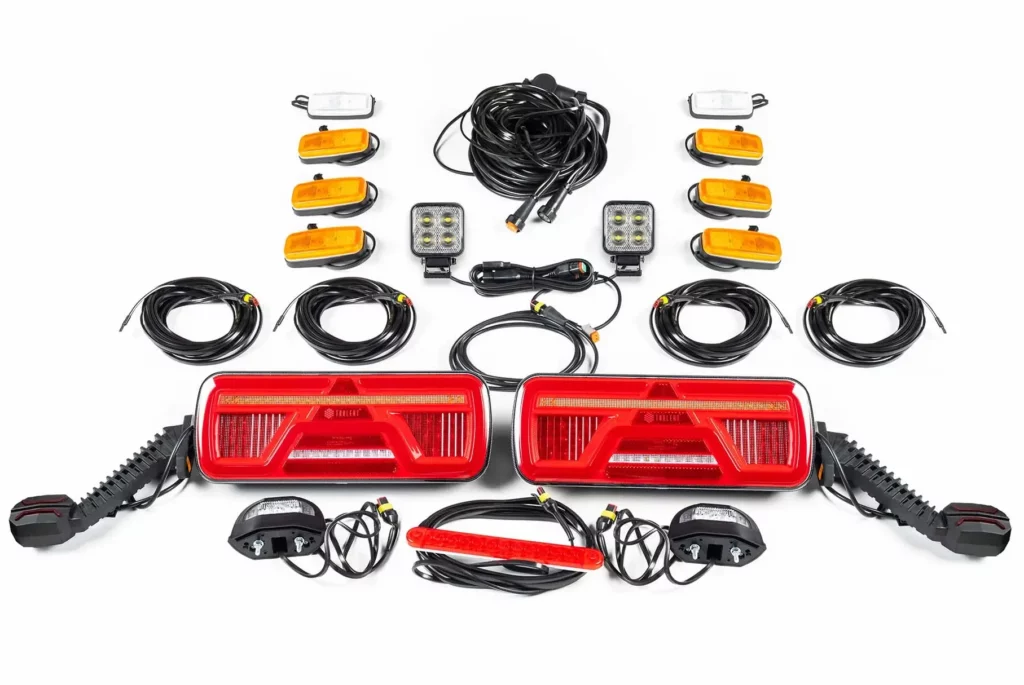
This method of connection is widely used on trailers and semi-trailers. You can read more about this on our page about 24V plug-&-play trailer lighting.
Before you connect the lighting, it is advisable to perform a short check of the entire circuit. This will prevent a minor error from resulting in hours of troubleshooting later on.
How do you connect 24V lorry lighting?
First, check whether the light is suitable for 24V. Then select the correct cable cross-section, connector and fuse. Ensure a clean earth connection and protect the cabling from moisture, vibrations and sharp edges. After mounting, check that the lighting is working correctly with the vehicle’s control system.
Can 12V LED lighting be fitted to a 24-volt truck?
Not directly. Lighting designed exclusively for 12V may be damaged when connected to a 24V system. You should therefore use lighting that is suitable for 24V or choose a multi-voltage version, for example 12–24V.
What type of connection is used between the truck and the semi-trailer?
In heavy goods transport, the 15-PIN connection in accordance with ISO 12098 is used, amongst others. In addition, 7-PIN N and S connections are also used. The type of connection present determines which lighting and signalling functions can be transmitted between the tractor and the semi-trailer.
Why does 24V LED lighting display an error message after connection?
A truck may electronically monitor the power consumption of a light function. LED lighting uses less power than a traditional filament bulb. As a result, the system may still recognise a functioning LED as faulty. This can, for example, trigger a dashboard warning or cause the light to flash rapidly.
A reliable 24-volt installation starts with more than just the light. Cabling, connectors, mass and vehicle control must work together as a single system. A well-coordinated surface mounting is quicker to fit and prevents a lot of troubleshooting should a fault occur later on.
Are you working on a new surface mounting or looking to upgrade an existing installation? Then take a look at our wiring harnesses at truck and trailer, or discuss your specific application with our technical specialists.
Become a TRALERT® dealer
A selection of LED lighting for trucks and trailers.
A comprehensive overview of our LED vehicle lighting and accessories.
Plug-&-play lighting kits, cabling and lighting for bodybuilders.
What TRALERT® can do for you as a partner in LED vehicle lighting.
Plug-&-play kits, cabling and lighting for 24V semi-trailers.
A selection of high-quality LED driving lights and LED bars.
Lighting, wiring harnesses and accessories for trailers.
The TRALERT® DARK LED range.
Work lights, rear lights, driving lights, beacor bars and more for DAF Trucks.
Work lights, rear lights, driving lights, beacor bars and more for Ford Trucks.

Work lights, rear lights, driving lights, beacon bars and more for Iveco.
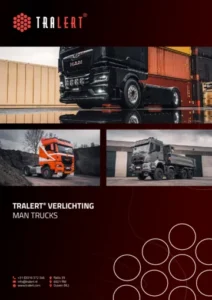
Work lights, rear lights, driving lights, beacon bars and more for MAN.

Work lights, rear lights, driving lights, beacon bars and more for Mercedes-Benz Trucks.
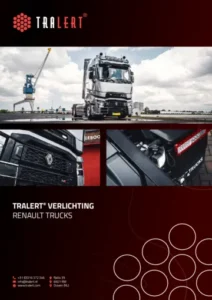
Work lights, rear lights, driving lights, beacor bars and more for Renault Trucks.
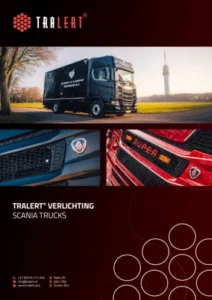
Work lights, rear lights, driving lights, beacor bars and more for Scania.
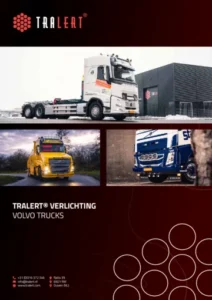
Work lights, rear lights, driving lights, beacon bars and more for Volvo Trucks.
The catalogue opens in a new tab. Can’t see it?
Open the catalogue (PDF)Two questions, in 30 seconds.
TRALERT® works with a dealer network. Dealers can view current stock levels, place orders online on account and receive a product feed for their online shop or system. We assess each enquiry internally and will let you know within 1 to 2 working days whether a partnership is possible.
You can purchase TRALERT® lighting through our partners, either locally or online. Simply provide your details, and we’ll find the partner best suited to help you.
Would you prefer to find a stockist yourself?We will assess your enquiry internally. You will hear from us within 1 to 2 working days to let you know whether a partnership is possible.
We’ll let you know within 1 to 2 working days which partner will be able to assist you further.
Trailerkit Configurator
All the lighting for your trailer in a single set
Use our Trailer Kit Configurator to put together a complete 24V lighting kit, section by section. You choose the lights, marker lights and licence plate lights, and see your trailer rendered in realistic 3D straight away. Everything comes as a single set, complete with wiring harness, fitting diagram and fitting instructions.