Specialised partner in LED vehicle lighting

The short answer
The correct cable gauge depends on the total power you are connecting, not on the type of light or the external dimensions of the cable. Using a formula and a safe margin of error, you can determine which cable you need for, for example, additional work lights, driving lights, LED bars or a rotating beacon bar/flashing beacon bar.
This article is intended for vehicle builders who fit additional lighting. It provides you with the basic knowledge, calculations and key considerations for determining the correct cable gauge. For more general considerations regarding the complete lighting system, from connectors to fuses, please refer to our best practices for 24V lighting.
TRALERT® has been a specialist in certified LED vehicle lighting for bodywork and semi-trailer construction since 2005. From cable sets to plug-and-play solutions for professional 24V vehicle bodies.
See what we do for bodybuilding →
Power, voltage and current hang together via the formula P = U x I. Expressed in terms of current, this becomes:
The higher the voltage, the lower the current for the same power output. A 24V system therefore draws roughly half the Amperes of a 12V system when using the same lights.
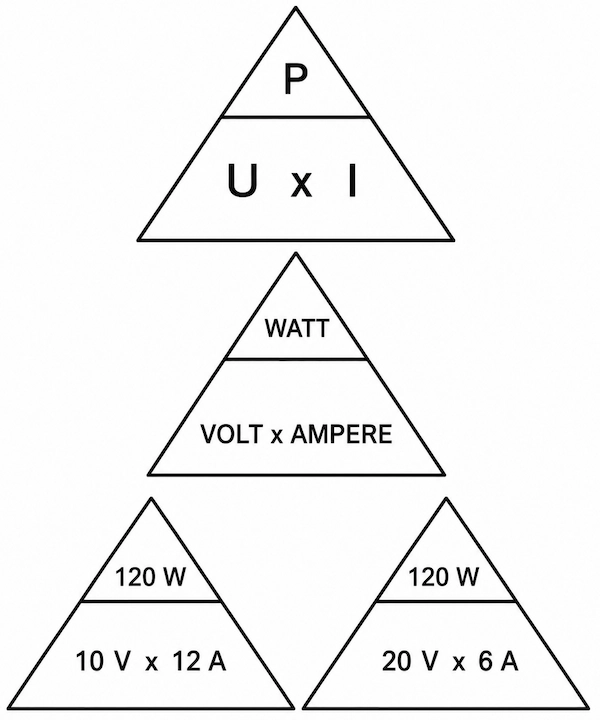
The relationship between power (P), voltage (U) and current (I).
Always add up the power of all loads connected to the same cable. Two 35-watt work lights on one cable add up to 70 watts.
Do not divide the power by 12 or 24, but by 10 (12V system) or by 20 (24V system). This way, you take into account the most unfavourable scenario in practice:
In many cases, you’ll find that 12 or 24 Volts is sufficient, but this leaves you with less of a safety margin. With 10 or 20 Volts, you deliberately build that margin in. A 120-watt light thus draws 12 Amperes in a 12V system and 6 Amperes in a 24V system, as in the example above.
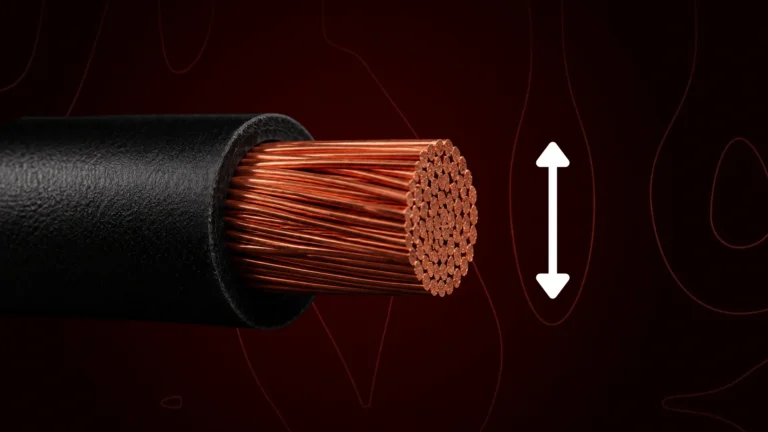
Cable thickness is specified in square millimetres (mm²), which represents the cross-sectional area of the copper. The larger the cross-sectional area, the more current the cable can carry and the lower the resistance. The outer diameter or stiffness does not indicate the cable’s capacity. Two cables of 1.5 mm² may look different – one thin and flexible, the other thicker and stiffer – but both must be able to handle the same 15 Amperes.
The values below are practical rules of thumb for short, direct connections. For longer cable runs, multiple transitions or higher ambient temperatures, it is advisable to allow for an extra margin.
| Cable cross-section (mm²) | Maximum current (A) | Fuse rating (A) |
|---|---|---|
| Cable cross-section (mm²)0,75 | Maximum current (A)10 | Fuse rating (A)10 |
| Cable cross-section (mm²)1,0 | Maximum current (A)13 | Fuse rating (A)10 |
| Cable cross-section (mm²)1,5 | Maximum current (A)15 | Fuse rating (A)15 |
| Cable cross-section (mm²)2,5 | Maximum current (A)25 | Fuse rating (A)20 |
| Cable cross-section (mm²)4 | Maximum current (A)30 | Fuse rating (A)30 |
| Cable cross-section (mm²)6 | Maximum current (A)40 | Fuse rating (A)40 |
Always size a cable to its own maximum rating and never higher. A fuse that is too high means the cable can overheat before the fuse blows, resulting in a fire hazard. A 1.5 mm² cable should be rated at 15 Amperes, not 20 or 30 Amperes.
There is no universal table. The correct choice of cable always depends on cable length, connection points and the overall circuit. Every metre of cable, every connector and every switch creates resistance, and resistance costs voltage. This is known as a voltage drop. The longer the cable and the more components there are in between, the greater the voltage drop. As a result, you are left with less reserve voltage in practice. That is precisely why it is wise to allow for extra margin in the case of longer runs or multiple connections.
In practice, be aware of these weak points:
A short connection with a good-quality cable may be closer to 15 Amperes. If there is a long distance involved, allow for a greater margin.
A frequently asked question is whether you can connect ten work lights to a 1.5 mm² cable. Suppose these are ten 18-watt work lights, totalling 180 watts.
A 120-watt driving light operating at 24 Volts draws 120 / 20 = 6 Amperes. A 1.5 mm² cable is more than sufficient for this.
If you are connecting to an existing connection point on the truck, you can rely on the fuse fitted there by the manufacturer or dealer. If that point is fused at 15 Amperes, you can generally use that value as the upper limit. However, always check that this connection point is intended for additional loads and is not already being used by other functions.
After all, you only know your own wiring from the connection point backwards. You do not know the cable thickness or the switches inside the vehicle. You can rely on the manufacturer to have carried this out correctly.
For surface mounting with multiple functions, a wiring harness – a cable with multiple wires – is often used. The designation 12 x 1.5 means twelve wires of 1.5 mm². The mass wire in such cables is usually thicker, for example 2.5 mm², as the return current from all functions converges there.
When it comes to body-mounted lighting, little changes with an electric truck. The vehicle lighting usually still operates on a 12V or 24V on-board electrical system, which is recharged whilst driving, just as with a diesel vehicle fitted with an alternator. The high-voltage battery for the drive system is separate from this.
The difference is that the on-board electrical system in EVs is often more tightly regulated. The same trend is also evident in newer diesel vehicles. In modern vehicles with sensitive on-board electronics, a CAN-bus solution may also be required.
Once you have determined the correct cable thickness, you will find the corresponding cabling at TRALERT®:
How many Amperes can a 1.5 mm² cable handle?
Approximately 15 Amperes. You’ll definitely need a 1.5 mm² cable, so rate it at 15 Amperes and never higher.
What cable gauge do I need for work lights?
Add up the power of all the lights, divide that by 10 (12V) or 20 (24V) and ensure the result remains below the cable’s maximum current rating. For many individual work lights, 1.5 mm² is sufficient, provided the cable run remains short and the total load falls within the safe margin.
Can I connect ten work lights to a 1.5 mm² cable?
At 24 Volts, this is generally sufficient: approximately 9 Amperes at 180 watts. At 12 Volts, you’ll need around 18 Amperes, and a 1.5 mm² cable is too thin. In that case, distribute the lights across multiple connections or choose a thicker cable.
Choosing the right cable is, in part, a matter of expertise. You need an understanding of the entire process, from the battery to the light. If you need tailored advice for a project, please contact your TRALERT® specialist. We’d be happy to work with you to find the right lighting solution.


A selection of LED lighting for trucks and trailers.

A comprehensive overview of our LED vehicle lighting and accessories.

Plug-&-play lighting kits, cabling and lighting for bodybuilders.

What TRALERT® can do for you as a partner in LED vehicle lighting.

Plug-&-play kits, cabling and lighting for 24V semi-trailers.

A selection of high-quality LED driving lights and LED bars.

Lighting, wiring harnesses and accessories for trailers.

The TRALERT® DARK LED range.

Work lights, rear lights, driving lights, beacor bars and more for DAF Trucks.

Work lights, rear lights, driving lights, beacor bars and more for Ford Trucks.

Work lights, rear lights, driving lights, beacon bars and more for Iveco.

Work lights, rear lights, driving lights, beacon bars and more for MAN.

Work lights, rear lights, driving lights, beacon bars and more for Mercedes-Benz Trucks.

Work lights, rear lights, driving lights, beacor bars and more for Renault Trucks.

Work lights, rear lights, driving lights, beacor bars and more for Scania.

Work lights, rear lights, driving lights, beacon bars and more for Volvo Trucks.
The catalogue opens in a new tab. Can’t see it?
Open the catalogue (PDF)Two questions, in 30 seconds.
TRALERT® works with a dealer network. Dealers can view current stock levels, place orders online on account and receive a product feed for their online shop or system. We assess each enquiry internally and will let you know within 1 to 2 working days whether a partnership is possible.
You can purchase TRALERT® lighting through our partners, either locally or online. Simply provide your details, and we’ll find the partner best suited to help you.
Would you prefer to find a stockist yourself?We will assess your enquiry internally. You will hear from us within 1 to 2 working days to let you know whether a partnership is possible.
We’ll let you know within 1 to 2 working days which partner will be able to assist you further.