CISPR 25 Classes 1 to 5: What does this EMC standard mean for vehicle lighting?
Updated:
By:
Kevin van Mierlo
Contents
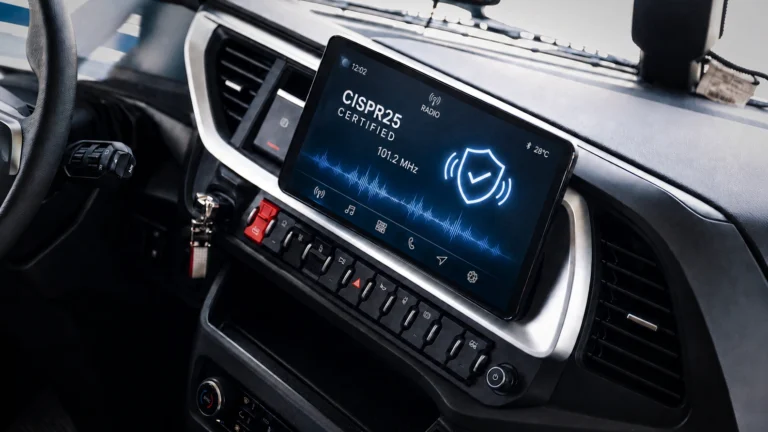
Electronics on board a truck or trailer must be able to operate without interference. However, LED lighting with switching drivers can cause electromagnetic interference that affects radio, DAB, GPS or communication systems. CISPR 25 is the international measurement standard used to measure and limit electromagnetic emissions in order to protect on-board receivers. Class 5 is the most stringent class, but it is not automatically mandatory. This article explains what CISPR 25 means for vehicle lighting, what classes are available and how to choose the right one.
In this blog you will read:
What CISPR 25 measures and why;
Why LED lighting can cause interference;
the five classes defined by CISPR 25;
Which class is right for your vehicle?;
The difference between ECE R10 and how to verify an EMC claim.
What is CISPR 25 in relation to vehicle lighting?
CISPR 25 is a technical measurement standard for electromagnetic emissions from vehicles and vehicle components. In the case of vehicle lighting, the light is tested as a component or electronic sub-assembly. The current edition is CISPR 25:2021, with a total measurement range of 150 kHz to 5,925 MHz.
The aim is clear: to protect on-board receivers from interference caused by components within the same vehicle. Examples include radios, DAB, GPS/GNSS and communication equipment. The standard therefore does not assess the light output of a lamp, but rather the electromagnetic emissions that may interfere with on-board receivers.
TRALERT® supplies LED vehicle lighting that has been tested in accordance with international EMC standards. You can see straight away in the TRALERT® lighting shop which products comply with these standards.
Why can LED lighting cause EMC interference?
Modern LED lighting uses electronic drivers that rapidly switch the voltage. Pulse-width modulation for dimming also causes rapid current fluctuations. These switching frequencies can generate electromagnetic emissions. These then propagate via the cabling or radiate as an electromagnetic field. Without proper EMC interference suppression, this can interfere with the operation of sensitive equipment.
What is tested?
CISPR 25 distinguishes between two types of emissions. It is useful to understand this distinction, as it determines the source of any interference.
Conducted emissions are interference that propagates via the light’s power and signal cables. Radiated emissions leave the component as an electromagnetic field and thus affect other systems. For a vehicle builder, this distinction is more important than the exact truck setup: the difference between interference via the cabling and interference via radiation determines the approach.
What CISPR 25 classes are there?
CISPR 25 has five limit classes, ranging from Class 1 to Class 5. Class 1 has the most lenient emission limits. Each subsequent class applies stricter limits, with Class 5 being the strictest. The standard does not generally specify which class a vehicle lamp must meet.
Practical explanation: Mid-range between the most generous and the strictest limits
Class4
Relative stringency: High
Practical explanation: Stricter control of emissions
Class5
Relative stringency: Highest
Practical explanation: The strictest limits within CISPR 25
The terms ‘lowest’ and ‘highest’ here refer only to the stringency of the emission limits, not to the product quality or suitability of a light.
Which CISPR 25 class do you need?
The correct class does not depend on a single fixed rule, but on the vehicle’s configuration. Consider the following factors:
the requirements of the vehicle manufacturer or OEM;
the position of the lighting in relation to aerials;
the radio, DAB, GPS/GNSS and communication systems on board;
the type of vehicle and the application;
the consequences of potential communication faults;
the results and scope of the truck report.
There is therefore no general rule stating that every truck requires Class 3 or every emergency service vehicle requires Class 5. The required class is determined by the OEM specifications and the EMC risk analysis of the vehicle configuration.
Vehicle manufacturers consider not only the specified class, but also the mounting position, cable routing and distance from antennas. Particularly in vehicles with multiple communication and navigation systems, the lighting is taken into account as part of the overall vehicle configuration.
For which vehicles is CISPR 25 particularly important?
CISPR 25 is particularly important for vehicles that rely on reliable radio, navigation and data communications. Examples include emergency service vehicles, trucks with extensive on-board communications, agricultural machinery with GNSS or RTK guidance, and construction machinery with telematics or machine control systems. Strict EMC requirements may also apply to service, communications and defence vehicles.
It is not just the vehicle type that determines the required level. The number of receivers, the position of the antennas, the mounting location of the lighting and the consequences of potential interference also play a part. For example, a work light situated close to a GNSS or communications antenna requires more attention than a light located at a considerable distance from sensitive receiving equipment.
trailers generally have fewer receivers, but lighting on the trailer can still affect systems in the tractor via the cabling or by radiating light. You should therefore always assess lighting as part of the complete vehicle configuration.
Electric and hybrid vehicles
EMC requires extra attention in the case of electric and hybrid vehicles. These vehicles contain, amongst other things, inverters, electric motors, DC/DC converters, charging technology and high-voltage cabling, which together shape a complex electromagnetic environment.
Additional LED lighting must not unnecessarily interfere with on-board radio, navigation and communication systems. This does not mean that electric vehicles automatically require CISPR 25 Class 5 lighting. The appropriate class and truck requirements are determined by the vehicle manufacturer’s specifications, the vehicle configuration and the position of the lighting in relation to cabling, antennas and receivers.
What is the difference between CISPR 25 Class 3 and Class 5?
Class 3 and Class 5 are two classes that feature in product specifications. The difference lies in the stringency of the emission limits. Class 5 sets stricter emission limits than Class 3. This class may therefore be relevant for sensitive recipients or where there are strict OEM requirements, provided the truck results cover the relevant measurement methods and frequency ranges. However, a higher class is not necessarily better for every application. The decisive factor is whether the class meets the requirements of your vehicle configuration.
Practical benefit: A CISPR 25 result is only valid under the tested conditions, such as voltage, operating mode and cable length. The same light may behave differently in a different installation scenario. You should therefore check for which measurement method and frequency ranges the specified class has been achieved, and ask for the truck report rather than just the class rating.
CISPR 25 versus ECE R10
CISPR 25 and ECE R10 appear similar, but regulate slightly different aspects. This distinction is important when assessing a lighting product.
Aspect
ECE R10
CISPR 25
AspectCharacter
ECE R10Type-approval Regulation for EMC
CISPR 25 Technicalmeasurement standard
Scope
ECE R10 Vehicleand electronic sub-assembly
CISPR 25 Vehiclesand components/modules
AspectObjective
ECE R10 EMCtype approval of vehicles and electronic sub-assemblies
CISPR 25 Protectionof on-board receivers
In short, ECE R10 governs the EMC type approval of vehicles and electronic sub-assemblies. CISPR 25 sets out measurement methods and limits specifically aimed at protecting on-board receivers. The documents may be relevant in parallel, but are not interchangeable.
How do you verify an EMC claim?
A strong EMC claim must be verifiable. You should therefore prefer wording such as ‘tested in accordance with CISPR 25’ or ‘complies with Class 5 limits’, supported by a truck report. The term ‘CISPR 25-certified’ on its own means little without a report. If in doubt, ask which edition of CISPR 25 was applied and exactly which emission tests – conducted or radiated – the claim covers.
What if interference does occur?
Even approved lighting can cause interference in a specific installation. An ECE R10 approval reduces the risk, but does not guarantee interference-free operation in every vehicle configuration. If you experience radio interference when switching on the lighting, the diagnosis should start with the installation itself. For more general issues, our guide to troubleshooting faults caused by LED lighting will help you further.
CISPR 25 lighting from TRALERT®
TRALERT® develops LED vehicle lighting with a focus on reliable operation, even on EMC-sensitive vehicles. If you would like to know whether a specific product complies with a particular CISPR 25 class, and which edition and truck methods the truck result covers, please consult the product specification or put your question to our team.
No. Class 5 is the strictest emission class within CISPR 25, but the standard does not stipulate that every vehicle lamp must meet this class. The required class is determined by the vehicle manufacturer’s or OEM’s specifications and by the EMC risk analysis of the vehicle configuration, not by a general rule.
Is ECE R10 the same as CISPR 25?
No. ECE R10 is a type-approval regulation for the electromagnetic compatibility of vehicles and electronic sub-assemblies. CISPR 25 is a technical measurement standard that focuses on emissions which may interfere with on-board receivers. They complement each other, but are not interchangeable and serve different purposes.
Can ECE R10-approved lighting still cause radio interference?
Yes, that is possible. An ECE R10 approval reduces the risk of interference, but does not provide a warranty for compatibility with every vehicle installation. Factors such as cabling, mounting position and proximity to antennas influence the final result. In the event of interference, further diagnosis of the installation is required to identify the cause.
How can you recognise CISPR 25-tested lighting?
Regarding the truck report. A reliable claim specifies the edition of CISPR 25 applied, the class achieved and which emission tests were carried out. The wording ‘tested in accordance with CISPR 25’ or ‘complies with the limits of Class 5’ is more precise than the vague term ‘certified’. You should therefore always ask for the underlying report.
Sources
IEC, CISPR 25:2021, Vehicles, boats and internal combustion engines, Radio disturbance characteristics: webstore.iec.ch
UNECE, UN Regulation No. 10 (electromagnetic compatibility), consolidated text Revision 6: unece.org
Specifications and truck reports
Are you unsure which CISPR 25 class is suitable for your vehicle configuration? Browse our range of LED lighting for trucks and filter by the desired CISPR class. Or discuss your situation with our specialists so that we can assist you.
Share this article:
ABOUT TRALERT®
TRALERT® is the leading manufacturer and partner in high-quality LED lighting solutions for commercial vehicles. By taking care of everything from drawing board to realisation, you and your customers can hit the road safely, carefree and professionally lit.
The TRALERT® Experience Centre is an interactive showroom with training and truck rooms. Experience TRALERT® LED vehicle lighting in practice and experience the lighting performance in different situations. Plan your Experience Centre visit.
Over 3,000 productsLighting and cabling for trucks, trailers, trailers and work vehicles
Fast delivery from our own stockOften delivered the next day; within 2 to 3 days across Europe
Advice from specialistsWe work with you to find the right lighting for your vehicle
Knowledge baseRegulations, connections and interference clearly explained
Two questions, in 30 seconds.
Question 1 of 2
Who is this lighting intended for?
Question 2 of 2
What suits your business best?
Dealer enquiry
Request access to our dealer portal
TRALERT® works with a dealer network. Dealers can view current stock levels, place orders online on account and receive a product feed for their online shop or system. We assess each enquiry internally and will let you know within 1 to 2 working days whether a partnership is possible.
Good to know
We’ll put you in touch with a partner
You can purchase TRALERT® lighting through our partners, either locally or online. Simply provide your details, and we’ll find the partner best suited to help you.