

Blog
ECE-approved lighting is technically approved according to a relevant ECE/UN regulation. However, this does not automatically mean that any mounting or use on public roads is permitted. Whether you can use lighting on a vehicle also depends on the installation, vehicle category, function, switching and national legislation.
In this article, you will read:
- What an ECE or UNECE approval does and does not say;
- What is the difference between ECE approval and E-approval;
- Why installation regulations such as ECE R48 count;
- How national legislation affects permitted use;
- Why ECE-approved lighting is sometimes not enough;
- What you, as a vehicle builder, fitter or purchaser, should look out for.
What does an ECE or UNECE approval mean for vehicle lighting?
The technical requirements for vehicle lighting stem from UN regulations drawn up within the UNECE. An ECE approval confirms that a product has been tested and meets the requirements for a specific light function. These include requirements for light output, colour, visibility, marking and the function for which the light is intended.
VEHICLE BODY
Lighting for bodywork and vehicle construction
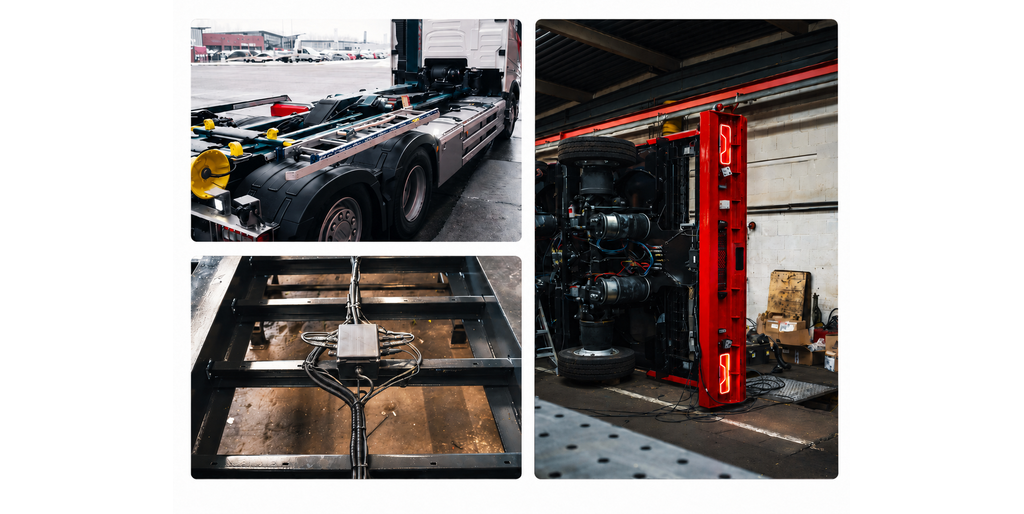
TRALERT® supports body builders and vehicle builders with certified LED vehicle lighting, cable sets and plug-&-play solutions for professional 24V vehicle bodywork.
You can find a complete overview of the individual regulations in our article on ECE standards and legislation. If you want to know about market approval within Europe, read the explanation on EU type approvals for vehicle lighting. Keep this distinction in mind: an approval is about the product itself, not automatically about how you later apply it to a vehicle.
What is the difference between ECE approval and E-approval?
ECE approval is the technical approval according to an ECE/UN regulation. The E mark is the visible marking on the product indicating that approval. In practice, you usually see this as the letter E in a circle, followed by a country code, an approval number and sometimes additional function indications.
In short: the ECE approval is the approval itself, the E-mark is the marking by which you recognise this approval on the light.
Why is ECE-approved lighting not always enough?
An ECE approval confirms that the product meets the requirements of the relevant approval, but not that every application is permitted. The same approved light may be correct in one position and not in another. Whether a light is permitted depends on several factors at once:
- the function for which the light is approved;
- the vehicle category to which you mount it;
- mounting position and height above the road surface;
- the prescribed visibility angles;
- the light colour appropriate to that function;
- switching and simultaneous lighting with other lighting;
- The national regulations for use on public roads.
If one of these points deviates, an otherwise correct light can still fall outside the rules. The approval on the product remains valid, but the application on the vehicle is then not correct.
Product approval, installation requirements and use: four levels
It helps to keep four levels apart. At each level, a different demand applies. Only when product, installation, vehicle application and national use fit together is the application in order. The installation requirements for lighting are largely in ECE R48. Among other things, that regulation describes for many vehicle categories how lighting must be placed, visible and switched on the vehicle.
| Level | Request | Example |
|---|---|---|
| Product approval | Is the light technically approved? | ECE approval of the light |
| Installation instructions | Is the light correctly mounted and switched? | ECE R48 |
| Vehicle approval | Does the vehicle comply as a whole? | Type approvals or inspections |
| National use | Can this feature be used in this country? | Warning lights, marking, exceptions |
Practical advantage: you can check on the light itself what it is approved for. Next to the E in the circle are often the regulation number, the approval number and a function indication. If you check these designations before mounting, you can see more quickly whether the approved function fits the intended position and application.
Practical examples
Driving lights or lightbar switched incorrectly
A driving light can be technically approved and still fall outside the rules due to the way it is connected. Additional driving lights that can operate as high beam functions simultaneously with the existing high beam count towards the joint reference number. Mounting position, symmetry and visibility also play a role. The product may then be technically sound, while the application on the vehicle is incorrect.
Marker light with incorrect function or position
A marker or side marker light has a fixed function, colour and location. If you use an approved light in a position or colour that does not belong to that function, the application is not correct. So the light may be technically approved, while its placement or function on the vehicle does not fit the rules.
R65-approved flashing light or beacon
A flashing or strobe light may be approved according to ECE R65. This approval says something about the product, not about who may carry the light. Use on public roads is reserved for certain vehicles and situations, and this is regulated by country.
Lighting with D-homologation
Sometimes a light carries an additional designation that specifies its application more precisely. D-homologation is one such example. This designation indicates that a light may be used multiple times on each side of the vehicle for the same light function, for example, for rear lights, brake lights or indicators. You should therefore check for this marking in addition to the general ECE approval.
How strongly national regulations can differ from each other, despite a European approval, can be seen in our article on flashing marker lights in Germany.
How ECE approval and national legislation relate to each other
UN regulations provide internationally harmonised technical requirements. The forum that drafts these regulations, WP.29, falls under UNECE and ensures that an approval in one member country is also recognised in another. This harmonises the technology, while admission, inspection and enforcement adapt through European and national frameworks.
An EU type approval then regulates market access within the Union. Technical approval is internationally harmonised, but practical application on the road is partly determined by European vehicle regulations, national approval, testing, traffic rules and enforcement. This can lead to differences from one country to another in how a feature may be used or when additional conditions apply.
Within these frameworks, countries can apply additional conditions, rules of use or exceptions. You will see this especially with functions such as warning lights, signalling, visibility requirements and applications for specific vehicle groups. An ECE approval thus shapes a necessary basis, but not an automatic permission for every use.
The interplay between ECE approval and national legislation ultimately determines whether lighting is not only technically approved, but also applied correctly.
What you, as a vehicle builder, fitter or purchaser, should bear in mind
With a short pre-check you reduce the risk of problems during inspection or monitoring:
- check which function the lighting is approved for;
- check the marking and any function indications on the product;
- check whether the light fits the vehicle category;
- check mounting position, height and visibility;
- watch out for switching and simultaneous lighting;
- check national regulations as soon as deviating functions are involved;
- In projects, establish which standard or application is leading.
The role of TRALERT® in certified vehicle lighting
TRALERT® supplies and advises on certified LED vehicle lighting, cable sets and appropriate application choices. We help you choose the right, approved lighting for your vehicle or surface mounting. Checking installation regulations and national rules remains part of your own preparation.
For final vehicle approval, inspection or an exception situation, the competent authority or your inspection partner remains in charge. This page provides general explanations on vehicle lighting. If in doubt, always check the current national regulations or consult an approval authority.
Frequently asked questions
Is ECE-approved lighting enough for use on public roads?
Not always. An ECE approval confirms that the product meets the technical requirements. Whether you can use the lighting also depends on mounting, vehicle category, function, switching and national regulations. Only when all these points are correct is use permitted.
What is the difference between ECE approval and E-approval?
ECE approval is the technical approval according to an ECE/UN regulation. E-approval is the common name for the visible marking on the product. This marking shows according to which approval the light is permitted and for which function the lighting is intended.
What is the difference between ECE approval and ECE R48?
An ECE approval applies to the product and confirms that a light meets the requirements for its function. ECE R48 is about installation: including where lighting should be placed on the vehicle, how it should be visible and how certain functions may be switched. The first approval deals with the component, the second with its application on the vehicle.
Does an ECE approval automatically apply throughout Europe?
Technical requirements are harmonised, which means that an approval is recognised within member countries. However, use on public roads is also determined by vehicle approval, testing, traffic regulations and national enforcement. As a result, additional conditions or exceptions may apply per country, for example on who may carry a feature or when it may be visible.
Who determines whether vehicle lighting is legally fitted?
That is ultimately what the competent authority or inspection partner does. A supplier supplies certified products and advises on application, but the final assessment in the case of testing or inspection lies with the inspection authority. In projects, therefore, it is important to establish which standard or application is leading, so that the choice can be followed afterwards.
Choosing the right certified lighting
Do you want to work with certified lighting that fits your vehicle body? Take a look at the range of LED vehicle lighting for body and wagon construction, or contact our specialists for advice on product selection, functions and connection options.
Disclaimer:
At TRALERT®, we do our best to keep the information in this article as accurate and up-to-date as possible, including the regulations surrounding vehicle lighting. However, legislation can change regularly, and although we make every effort to implement these changes in a timely manner, it is possible that certain updates or adjustments have not yet been incorporated into this article. We therefore always advise our readers to check the current legislation with their local government or regulatory bodies, especially when it comes to exceptions or specific national regulations. TRALERT® is not liable for any damages or fines resulting from outdated or incomplete information in this article.
If in doubt, always contact the competent authority to ensure that your vehicle meets all legal requirements.