Specialised partner in LED vehicle lighting

The short answer
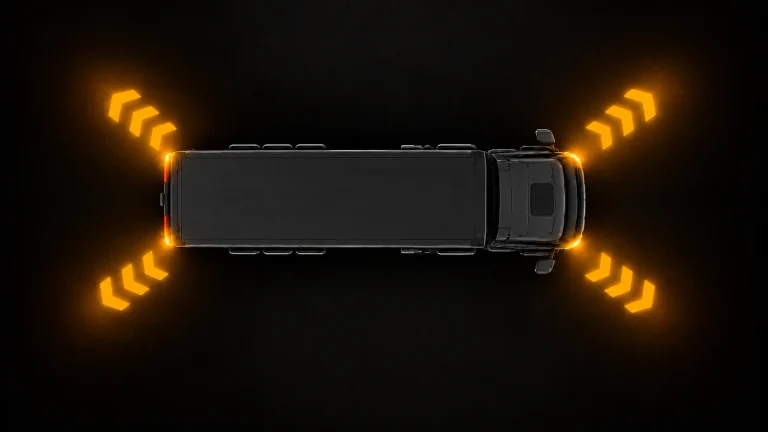
We are all familiar with an indicator as a flashing light on a vehicle. But what if that same indicator were also visible on the road surface alongside the vehicle? That is exactly what happens with Signal Road Projection.
The technology already exists; the first production vehicles are already on the road, and in 2026 a regulatory framework for Direction Indicator Projection was adopted within the UNECE. Of interest to our market: this framework covers not only passenger cars, but also commercial vehicles, trucks and heavy trailers. For vehicle builders, this does not mean that new lights will be mandatory on every vehicle tomorrow. On the contrary. Signal Road Projection is optional. However, the possibility of implementing it is now coming a good deal closer.
In this article, you will read:
Update September 2026
New regulations allow for Direction Indicator Projection under UN R48 and UN R148. For vehicles in the N category, projection may be fitted at the front and/or rear. For heavy O3 and O4 semi-trailers, this applies to rear projection. This feature is not mandatory.
Signal Road Projection, or SRP for short, is vehicle lighting that projects a light signal onto the road surface.
With Direction Indicator Projection, the existing indicator is supplemented by amber coloured chevrons on the road. As soon as the driver indicates, the projection flashes in sync.
So you can see not only from the vehicle itself which way it is heading, but also from the side of the vehicle.
That may sound like a futuristic detail, but the idea behind it is particularly interesting when it comes to large vehicles.
A lorry and trailer combination can be long. A cyclist, pedestrian or other road user is not always in a position where the indicator is immediately within their field of vision. A projection onto the road makes the vehicle’s intention visible in a different way.
Direction Indicator Projection is governed by UN Regulation No. 48 regarding the installation, position and operation of the projection on the vehicle. The Direction Indicator Projector itself must be type-approved in accordance with UN Regulation No. 148, which sets out the technical requirements for the light signalling unit.
No.
And that is probably the most important thing for vehicle builders to know straight away.
The new regulations do not require an additional mandatory indicator. Therefore, a truck, trailer or vehicle body being built today does not need to be modified as a result of this development.
Direction Indicator Projection is an optional feature.
Regulations primarily create a framework within which vehicle and lighting manufacturers can apply the technology in future vehicle concepts.
| Request | Answer |
|---|---|
| RequestWhat’s changing? | Answer: A regulatory framework for projected indicators is to be introduced |
| RequestIs it compulsory? | Answer: No |
| RequestDoes an existing truck or trailer need updating? | Answer: No |
| RequestIs this of interest for new vehicle development? | AnswerZeker |
It is worth noting that the regulations explicitly extend beyond passenger cars.
| Vehicle category | Possible projection |
|---|---|
| Vehicle category: N1 commercial vehicle | Possible projection: Front and/or rear |
| Vehiclecategory: N2 truck | Possible projection: Front and/or rear |
| Vehiclecategory: N3 truck | Possible projection: Front and/or rear |
| Vehicle categoryO3 trailer /semi-trailer | Possible projection: Rear |
| Vehicle categoryO4 trailer /semi-trailer | Possible projection: Rear |
For trucks, Direction Indicator Projection can therefore be fitted at the front, rear or both positions.
For O3 and O4 semi-trailers, rear projection is the only permitted option. Which makes sense.
This is certainly an important development for trailer manufacturers. New light functions will ultimately not only be incorporated into a light, but must also be integrated into the vehicle lighting cabling, electronic control systems and the overall vehicle architecture.
The Direction Indicator Projection is specifically designed for low speeds. The projection may normally be switched on at speeds of up to 15 km/h.
So think instead of a truck that:
This immediately makes it clear what the technology is intended for.
Not to produce more light, but to make the vehicle’s intention recognisable sooner and more clearly.
The Direction Indicator Projection consists of amber coloured chevrons that flash in the same phase and at the same frequency as the standard indicator.
A manufacturer cannot, therefore, project a symbol of its own design onto the tarmac.
The area in which the projection may appear is also specified:
Previous proposals round Signal Road Projection had also considered projection along the side of the vehicle.
For a truck, the concept is obvious. Consider a cyclist alongside a truck and trailer combination turning off the road: wouldn’t you want the turning manoeuvre to be clearly visible along the entire side of the vehicle?
However, that shape of side projection did not make it into the final Direction Indicator Projection framework.
For M and N vehicles (cars, buses, trucks), this involves front and/or rear projection. For O3 and O4 semi-trailers, it involves rear projection only.
This is good to know, as older concept images of Signal Road Projection sometimes show applications that are no longer part of these regulations.
Yes.
And that makes this development far more interesting than regulations for a technology that currently exists only on paper.
Toyota introduced Signal Road Projection in 2025 on the Corolla Cross for the Japanese market.
When the indicator is activated, three chevrons appear on the road surface. This means that the intended direction is visible not only via the light on the car, but also on the road itself.
Toyota developed the system in collaboration with the Japanese lighting manufacturer KOITO.
What is particularly noteworthy is that Toyota brought this to market even before the new UNECE framework for Direction Indicator Projection had been adopted.
At that time, Japan did not yet have specific regulations for this type of road projection. Toyota and KOITO therefore worked with the Japanese authorities to find a way to have the technology approved within the existing regulatory framework.
It worked.
Japan was therefore not ahead of the curve because the new UNECE regulations were already in place there. A national route to authorise the technology had simply been found earlier.
Toyota is not alone in this.
Manufacturers such as Audi are also working on lighting systems that project information onto the road surface. In addition, major automotive lighting suppliers are developing systems in which indicators and other signalling functions are increasingly visible outside the traditional lamp unit.
This is creating a clear trend in the market.
Whereas headlights were once primarily intended to illuminate the road, modern lighting systems are increasingly becoming part of the communication between the vehicle and its surroundings.
We are already seeing the first applications appearing in passenger cars.
For trucks and trailers , this development appears to be in its early stages.
And that is precisely why it is significant that N2, N3, O3 and O4 are now explicitly included in the regulations.
Probably not that much today.
You do not need to modify existing vehicle designs, and Signal Road Projection will not become a new mandatory light function.
However, for future vehicle projects, this is certainly a development worth keeping an eye on.
Because once such a feature is implemented, it is about more than just a projector.
The technology must work in conjunction with, amongst other things:
Furthermore, the projector itself must comply with the relevant requirements, and its mounting on the vehicle must comply with UN R48.
Simply fitting any old projector under the chassis is therefore not the same as an approved Direction Indicator Projection system.
For trailer manufacturers, one detail is of particular interest:
O3 and O4 semi-trailers are explicitly included in the new regulations.
For an O3/O4 trailer or semi-trailer, only rear Direction Indicator Projection may be used under this provision.
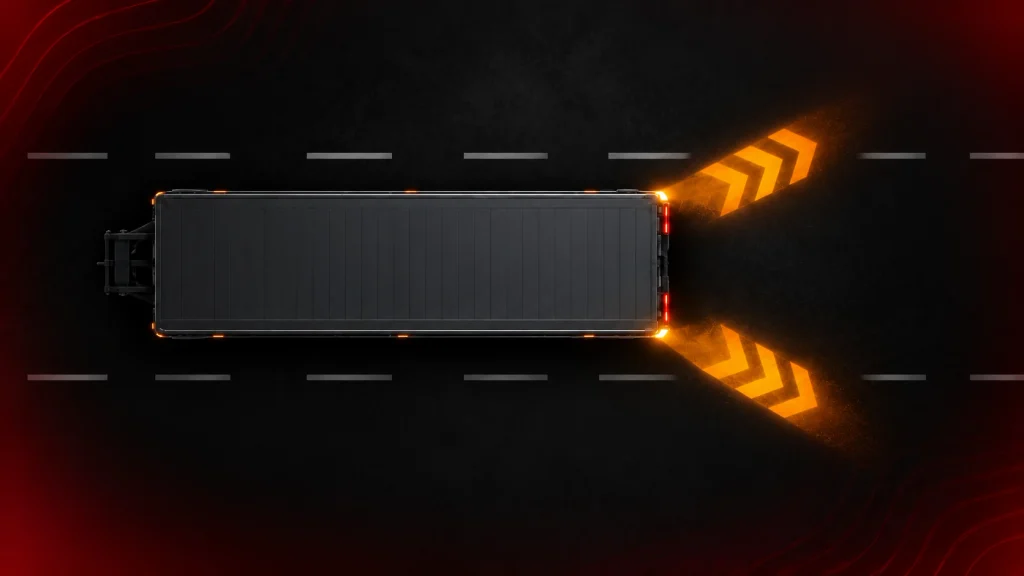
This opens up the possibility in the future of integrating Direction Indicator Projection into complete rear lighting systems for heavy- trailers s and semi-trailers. And that’s when it becomes interesting for our market. Because in a ‘ trailer ’, lighting rarely stands entirely on its own. Rear lights, marker lights, wiring harnesses, connectors, connection boxes and electronic functions all form a single system.
New light functions such as road projection will therefore ultimately also influence the way in which complete lighting solutions are developed.
It would be premature to say that every car and truck will be projecting chevrons onto the tarmac in a few years’ time. But the first production cars are already fitted with the technology. Major car manufacturers and lighting producers are investing in it. And trucks and heavy trailers are already covered by the regulatory framework. These are strong indications that we will be hearing and seeing much more about this in practice.
At TRALERT®, we continue to monitor developments in this field closely.

A selection of LED lighting for trucks and trailers.
A comprehensive overview of our LED vehicle lighting and accessories.
Plug-&-play lighting kits, cabling and lighting for bodybuilders.
What TRALERT® can do for you as a partner in LED vehicle lighting.
Plug-&-play kits, cabling and lighting for 24V semi-trailers.
A selection of high-quality LED driving lights and LED bars.
Lighting, wiring harnesses and accessories for trailers.
The TRALERT® DARK LED range.
Work lights, rear lights, driving lights, beacor bars and more for DAF Trucks.
Work lights, rear lights, driving lights, beacor bars and more for Ford Trucks.
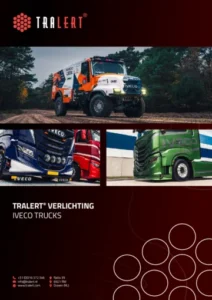
Work lights, rear lights, driving lights, beacon bars and more for Iveco.
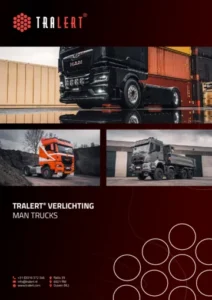
Work lights, rear lights, driving lights, beacon bars and more for MAN.
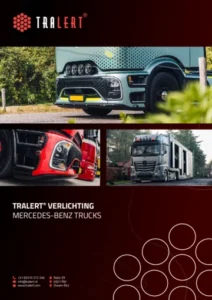
Work lights, rear lights, driving lights, beacon bars and more for Mercedes-Benz Trucks.
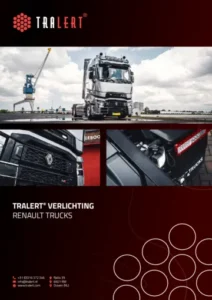
Work lights, rear lights, driving lights, beacor bars and more for Renault Trucks.
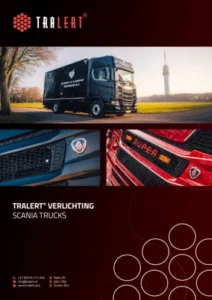
Work lights, rear lights, driving lights, beacor bars and more for Scania.
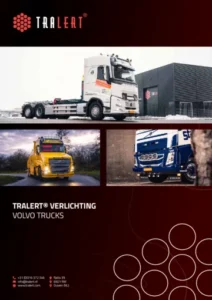
Work lights, rear lights, driving lights, beacon bars and more for Volvo Trucks.
The catalogue opens in a new tab. Can’t see it?
Open the catalogue (PDF)Two questions, in 30 seconds.
TRALERT® works with a dealer network. Dealers can view current stock levels, place orders online on account and receive a product feed for their online shop or system. We assess each enquiry internally and will let you know within 1 to 2 working days whether a partnership is possible.
You can purchase TRALERT® lighting through our partners, either locally or online. Simply provide your details, and we’ll find the partner best suited to help you.
Would you prefer to find a stockist yourself?We will assess your enquiry internally. You will hear from us within 1 to 2 working days to let you know whether a partnership is possible.
We’ll let you know within 1 to 2 working days which partner will be able to assist you further.
New
The Trailerkit Configurator is now live
Put together your ‘ trailer ’ and receive the complete lighting kit packaged as a single set: lighting, marker lights and wiring harnesses, all coordinated and ready for mounting. Includes a mounting diagram and mounting instructions.
Launch the configurator