Specialised partner in LED vehicle lighting

The short answer
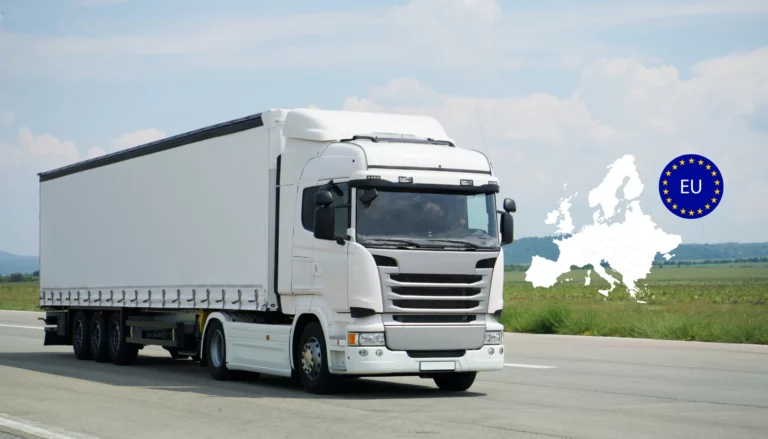
In the Netherlands, a truck may be a maximum of 2.55 metres wide, 4.00 metres high and 12 metres long. A tractor unit with a semi-trailer may be 16.50 metres long and a truck with a trailer 18.75 metres. The maximum weight is 50 tonnes in the Netherlands and 40 tonnes for international transport.
The table shows the maximum sizes per vehicle type. Other EU countries largely use the same sizes, but differ in terms of weight and for long and heavy trucks (LHGVs).
| Vehicle | Maximum width | Maximum height | Maximum length | Maximum weight in the Netherlands |
|---|---|---|---|---|
| VehicleTruck without a trailer | Maximum width: 2.55 m | Maximum height: 4.00 m | Maximum length: 12.00 m | Maximum weight in the Netherlands, depending on the number of axles |
| VehicleTractor unit with semi-trailer | Maximum width: 2.55 m | Maximum height: 4.00 m | Maximum length: 16.50 m | Maximum weight in the Netherlands: 50 tonnes |
| VehicleTruck with trailer | Maximum width: 2.55 m | Maximum height: 4.00 m | Maximum length: 18.75 m | Maximum weight in the Netherlands: 50 tonnes |
| VehicleLZV (with exemption) | Maximum width: 2.55 m | Maximum height: 4.00 m | Maximum length: 25.25 m | Maximum weight in the Netherlands: 60 tonnes |
Refrigerated trucks may be 2.60 metres wide. The 50-tonne limit is the legal maximum; the actual weight a vehicle is permitted to carry is stated on the registration certificate.
The maximum width of a truck in the Netherlands and the rest of the EU is 2.55 metres. Refrigerated trucks may be 2.60 metres wide.
Those extra 5 centimetres are due to the insulation required to maintain the load’s temperature. This compensates for the loss of cargo space caused by the thicker walls. The exemption applies only if the side walls, including insulation, are at least 45 millimetres thick.
The load counts towards the width, but not every part of the truck does. Mirrors and cameras that replace the mirrors do not count towards the maximum width of 2.55 metres. This also applies to the following components:
No. Mirrors are among the items excluded when determining a vehicle's overall width under the UK Construction and Use Regulations.
TRALERT® specialises in vehicle lighting for the truck and semi-trailer industry.
Our mission is to contribute to road safety by complying with regulations and supplying products that are fully aligned with these requirements.
A truck may be a maximum of 12 metres long, a tractor-semi-trailer 16.50 metres and a truck with a trailer 18.75 metres.
In the Netherlands, a truck may be no more than 4.00 metres high, including its load. Most European countries apply the same limit, which stems from European Directive 96/53/EC on maximum vehicle dimensions.
However, it is important to know that height limits are not completely uniform within Europe. Some countries have different national limits or operate with infrastructure restrictions. For example, Finland allows vehicle heights up to around 4.40 metres, while in countries such as Sweden and Norway, practical limits are often determined by the available headroom of bridges and tunnels.
Drivers and transport companies must therefore always take into account local regulations and signage on the road network.

Tip: For extra visibility with tall vehicles, the use of top lights or roof lights can help others better gauge the vehicle’s height, particularly when driving in the dark or transporting exceptional loads. TRALERT® offers robust LED lights for this purpose that comply with ECE regulations.
In the Netherlands, a truck or truck combination may weigh a maximum of 50 tonnes. That is the legal limit. The exact weight a vehicle is permitted to carry depends on the number of axles and is stated on the registration certificate.
For international transport within the EU, the standard limit is 40 tonnes. For intermodal transport, where the load is transferred between road, rail or ship, the limit is 44 tonnes. In the Netherlands, a maximum of 60 tonnes applies to light goods vehicles (LZVs).
A truck’s weight depends on its type and load. An empty standard semi-trailer weighs approximately 7 to 9 tonnes. When fully loaded, a tractor unit with a semi-trailer weighs up to 40 tonnes in international transport and up to 50 tonnes in the Netherlands.
In addition to the total weight, there are also rules for maximum axle loads in Europe. According to the EU framework, the maximum load is typically:
- 10 tonnes for a single non-driven axle
- 11.5 tonnes for a driven axle
National enforcement may have additional rules or exceptions to this, depending on vehicle configuration and number of axles.
Long and heavy truck (LHVs), also known as European Modular System (EMS) vehicles, are playing an increasingly important role in making European road transport more sustainable. However, regulations and authorisation vary greatly from country to country.
Below we list the most notable exceptions for different countries in Europe.
| Country | Maximum length (metres) | Maximum weight (tonnes) | Max. width / height | Special conditions |
|---|---|---|---|---|
| CountryGermany | Maximum length (metres)Up to 25.25 metres (Long Lkw / LZV) | Maximum weight (tonnes): 40 tonnes standard, 44 tonnes in combined transport | Max. width / height: 2.55 m / 4.00 m | Special conditions: Permittedon the designated Positivnetz. The same weight limits apply to long lorries as to standard combinations. |
| CountryNetherlands | Maximum length (metres)Up to 25.25 metres (LZV) | Maximum weight (tonnes): 60 tonnes | Max. width / height: 2.55 m / 4.00 m | Special conditions: LZVs are permitted on a designated road network. Special routes, RDW exemption and LZV certification are required. |
| CountryItaly | Maximum length (metres)18.75 metres | Maximum weight (tonnes): 44 tonnes | Max. width / height: 2.55 m / 4.00 m | Special conditions: In practice, Italy follows the standard EU limits. A general LZV regime has not been introduced. |
| CountryFrance | Maximum length (metres)18.75 metres | Maximum weight (tonnes): 44 tonnes | Max. width / height: 2.55 m / 4.00 m | Special conditions: France generally follows EU limits and does not generally permit long EMS or LZV combinations. |
| CountryUnited Kingdom | Maximum length (metres)16.5 m (tractor-semi-trailer) / 18.75 m (truck + trailer) | Maximum weight (tonnes): 44 tonnes (e.g. 6-axle combinations) | Max. width / height: 2.55 m / height depending on national regulations and infrastructure | Special conditions: Nogeneral LZV regime of 25.25 metres. Strict vehicle and axle load regulations remain in force. |
| CountrySpain | Maximum length (metres)Up to 32 metres (Euro-modular combinations) | Maximum weight (metric tonnes)Up to 72 metric tonnes | Max. width / height: 2.55 m / 4.00 m | Special conditions: Euromodular combinations are permitted to travel on approved routes within the Spanish road network. |
| CountryFinland | Maximum length (metres)Up to 34.5 metres | Maximum weight (tonnes)76 tonnes | Max. width / height: 2.55 m / 4.40 m | Special conditions: Finland permits larger vehicle dimensions at national level than many other European countries. |
| CountrySweden | Maximum length (metres)Up to 34.5 metres | Maximum weight (tonnes)Up to 74 tonnes (BK4 roads) | Max. width / height: 2.55 m / height depending on infrastructure | Special conditions: OnBK4 roads, heavier and longer vehicle combinations are permitted within the Swedish road network. |
In the Netherlands, LZV combinations of up to 25.25 metres and 60 tonnes are permitted to travel on a specially designated road network. This requires an exemption from the RDW, and the vehicle must be approved as an LZV.
Super Eco Combi's (SEC) are still in the research and testing phase in the Netherlands. According to government communication, the first truck on public roads was expected in 2026.
Germany allows LHVs up to 25.25 metres, with a weight limit of 40 tonnes. In combined or intermodal transport, this may go up to 44 tonnes. These vehicles are only allowed on the so-called Positivnetz - a specifically designated road network, further expanded by 2025.
Operators must comply with stringent technical requirements, such as the installation of blind-spot assistance systems and additional lighting requirements. Since 2022, marker lights with indicator function have been mandatory. From 2025, this requirement will be further tightened in line with EU standards.
LHVs can reduce the number of trips per load transported and thus contribute to more efficient transport. The exact CO₂ savings depend on load factor, route and vehicle configuration.
The width of a truck’s cargo space can vary. The cargo space of a standard semi-trailer is approximately 13.6 metres long and 2.45 to 2.48 metres wide.
There are many options for illuminating the cargo space. Consider cargo space lighting with motion sensors. This lighting is specially designed for use in interior spaces. TRALERT® offers a wide range of LED interior lighting.
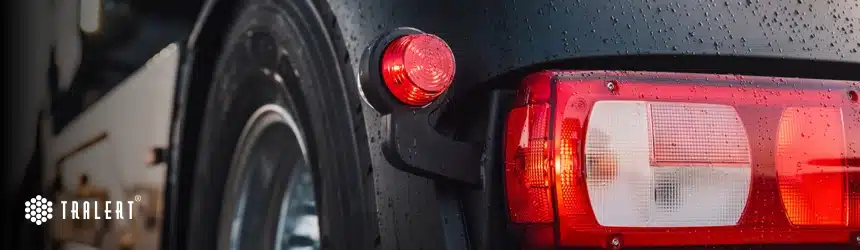
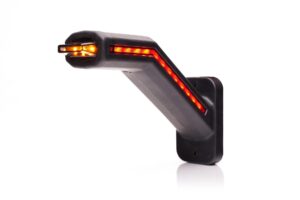
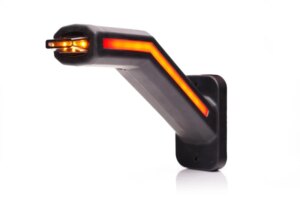
For road safety, it is vital that other road users can accurately gauge the width of your vehicle. Various lighting options are available to make this easier, such as side marker lights. Side marker lights, as the name suggests, are designed to clearly indicate the width of the vehicle. This is important when another road user approaches your vehicle in the dark. Side marker lights are also crucial when meeting oncoming traffic or overtaking. Serious accidents can occur if a road user is unable to accurately judge the width of a large vehicle. Find out more about the rules and legislation governing lorry lighting.
Below is a selection of our approved side marker lights:
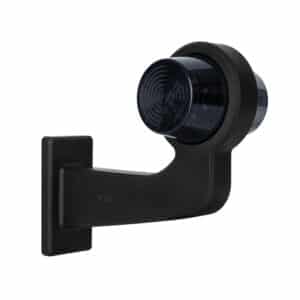
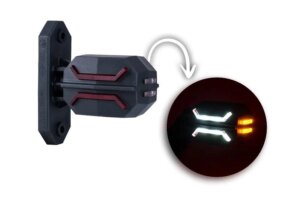
A truck's load is allowed to protrude, provided it is within the limits of the truck's maximum length, width and height. It is important to distinguish between two types of cargo: divisible and indivisible cargo. Divisible cargo can be split into several parts, such as packages or dismountable objects. Indivisible cargo, on the other hand, cannot be divided into pieces and must be transported in one piece.
Divisible loads must not protrude from the front of the truck. At the rear, divisible loads may protrude, up to a maximum of 1 metre. Divisible loads must not protrude beyond the width of the vehicle.

Indivisible cargo may protrude at the front in some cases, depending on national regulations, but the overall vehicle length must often stay within the legal limits. At the rear, indivisible load is allowed to protrude, with a general European limit of a maximum of 3 metres behind the vehicle. National exceptions can extend this to, say, 5 metres, as in the Netherlands. It is mandatory to use marking signs when indivisible cargo protrudes more than 1 metre, to ensure safety.
In the Netherlands, a truck carrying an indivisible load may be a maximum of 3.00 metres wide and 4.00 metres high without a special permit. A tractor-semi-trailer combination may then be 22 metres long. If the load is wider, higher, longer or heavier than permitted by law, an exemption for exceptional transport from the RDW is required.
How long is a truck with a semi-trailer?
A tractor unit with a semi-trailer may be a maximum of 16.50 metres long. In the Netherlands, this increases to 22 metres for indivisible loads.
How long can an LZV be?
In the Netherlands, a heavy goods vehicle (LZV) may be a maximum of 25.25 metres long and weigh up to 60 tonnes. This requires an exemption from the RDW.
How heavy can a truck be?
In the Netherlands, the maximum is 50 tonnes. For international transport within the EU, the limit is 40 tonnes, or 44 tonnes for combined transport.
Can a truck be wider than 2.55 metres?
Yes, in two cases. A refrigerated truck may be 2.60 metres wide, and a width of 3.00 metres is permitted for indivisible loads. Above that, an exemption from the RDW is required.
Netherlands
European Union
Germany
United Kingdom
Disclaimer:
At TRALERT®, we do our best to keep the information in this article as accurate and up-to-date as possible, including the regulations surrounding vehicle lighting. However, legislation can change regularly, and although we make every effort to implement these changes in a timely manner, it is possible that certain updates or adjustments have not yet been incorporated into this article. We therefore always advise our readers to check the current legislation with their local government or regulatory bodies, especially when it comes to exceptions or specific national regulations. TRALERT® is not liable for any damages or fines resulting from outdated or incomplete information in this article.
If in doubt, always contact the competent authority to ensure that your vehicle meets all legal requirements.

A selection of LED lighting for trucks and trailers.
A comprehensive overview of our LED vehicle lighting and accessories.
Plug-&-play lighting kits, cabling and lighting for bodybuilders.
What TRALERT® can do for you as a partner in LED vehicle lighting.
Plug-&-play kits, cabling and lighting for 24V semi-trailers.
A selection of high-quality LED driving lights and LED bars.
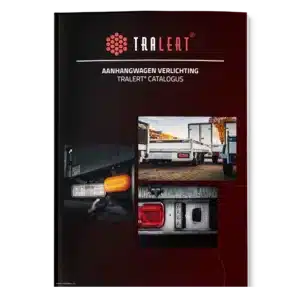
Lighting, wiring harnesses and accessories for trailers.
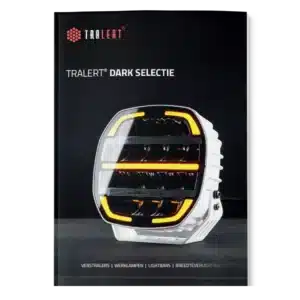
The TRALERT® DARK LED range.
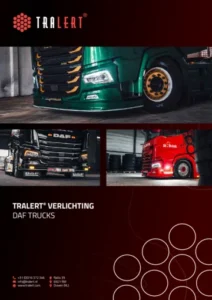
Work lights, rear lights, driving lights, beacor bars and more for DAF Trucks.
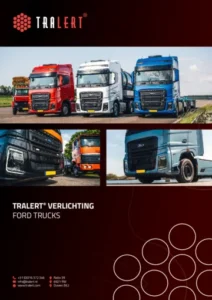
Work lights, rear lights, driving lights, beacor bars and more for Ford Trucks.
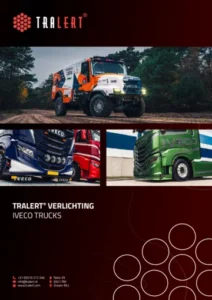
Work lights, rear lights, driving lights, beacon bars and more for Iveco.
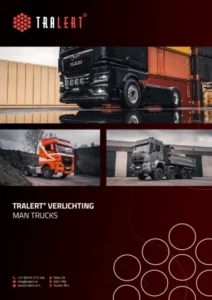
Work lights, rear lights, driving lights, beacon bars and more for MAN.
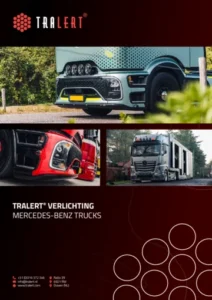
Work lights, rear lights, driving lights, beacon bars and more for Mercedes-Benz Trucks.
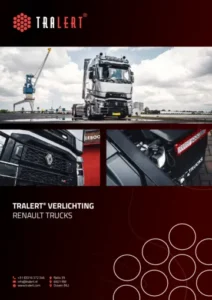
Work lights, rear lights, driving lights, beacor bars and more for Renault Trucks.
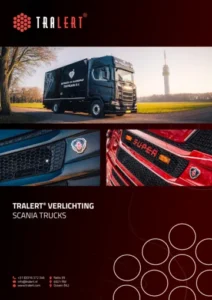
Work lights, rear lights, driving lights, beacor bars and more for Scania.
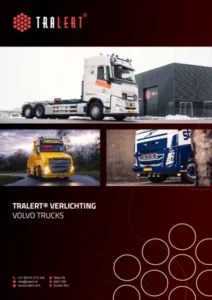
Work lights, rear lights, driving lights, beacon bars and more for Volvo Trucks.
The catalogue opens in a new tab. Can’t see it?
Open the catalogue (PDF)Two questions, in 30 seconds.
TRALERT® works with a dealer network. Dealers can view current stock levels, place orders online on account and receive a product feed for their online shop or system. We assess each enquiry internally and will let you know within 1 to 2 working days whether a partnership is possible.
You can purchase TRALERT® lighting through our partners, either locally or online. Simply provide your details, and we’ll find the partner best suited to help you.
Would you prefer to find a stockist yourself?We will assess your enquiry internally. You will hear from us within 1 to 2 working days to let you know whether a partnership is possible.
We’ll let you know within 1 to 2 working days which partner will be able to assist you further.
TRALERT® operates through a dealer network. Prices, stock levels and online ordering are therefore only available to business customers with an account.
We assess every enquiry internally and will let you know within 1 to 2 working days whether a partnership is possible.
For your own use?Find a stockist
Would you prefer a quote first?Add this product to your quotation request and send it off when you’re ready.