Specialised partner in LED vehicle lighting

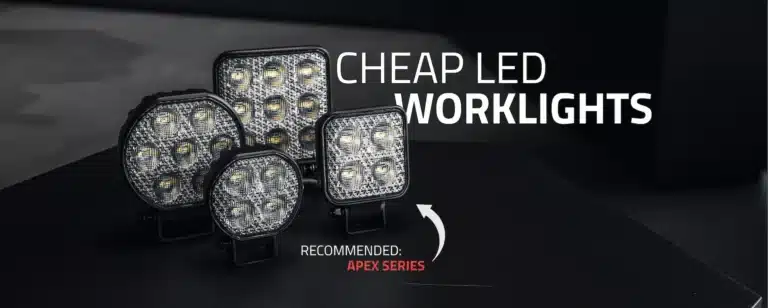
The short answer
At first glance, an LED work light seems easy to compare. Thanks to the digital age and globalisation, there is a vast range of LED work lights, driving lights and safety signalling equipment available. But how can you determine whether a product will provide the desired light and continue to perform under vibrations, moisture, high-pressure cleaning and voltage spikes? It goes far beyond the number lumen. You can read exactly what lumen measure and why this figure alone is not decisive in our explanation of lumen in work lights (including video).
In this article you will read:
- how to objectively evaluate the quality of an LED work light
- which components justify a certain price
- what risks cheap alternatives can pose to your customers and your reputation
Cheap LED work lights may seem attractive because of their price and high lumen output. However, in many cases they do not meet the applicable standards for use on public roads. Many lights lack CE or ECE certification, such as R10 (EMC), or have low IP protection classes.
Therefore, do not be immediately seduced by a flashing advertisement and a low price. Much more important is the "total cost of ownership". By this we mean the total cost of a product throughout its lifetime, including purchase and maintenance. Especially with lighting on vehicles, you don't want a light to fail, cause interference or not provide a pleasant light for the driver.
Differences between high-quality LED work lights vs. low-cost variants
| Characteristic | Cheap import lamps | Professional quality | Practical impact |
|---|---|---|---|
| Specifications: ECE R10, EMC | Cheap importedlights: Often lacking | Professional quality – Complieswith UNECE Reg. 10 | Practical impact: PreventsCAN-bus errors |
| Feature: IP rating | Cheap importedlamps: low IP value or not tested at all | Professional quality: IP67 / IP68 or IP69K (high-pressure resistant) | Practicalimpact: Withstands daily cleaning |
| Features: Light pattern & lens | Cheap importedlamps: Basic, hotspots | Professional qualityAdvanced RFT/Fish-eye | Practical impact: Reducedfatigue, improved safety |
| Feature: Cabling | Cheap imported lamps: Thin, low copper density | Professional quality, robust and waterproof | Practical benefits: Stablecurrent, reduced overheating |
| Feature: Bracket& housing | Cheap importedlights Thin metal | Professional quality– Robust, vibration-resistant | Practical impact: Longerservice life |

Quality with LED work lights is not a coincidence, but a sum of certification and technology. You can recognise a high-quality light by its ECE R10 EMC interference suppression, an IP69K rating, and a robust aluminium housing. Where cheap lights often cause radio interference or moisture problems, premium lights guarantee continuity and safety under the toughest conditions.
According to the UNECE Regulation No. 10, LED work lights (as Electronic Sub-Assemblies) must be fully ignited. Cheap lights without this certification often act as jammers on your CAN-bus, radio or ECU. Especially in modern Euro 6, Stage V or electric vehicles, this is essential: without proper interference, you risk error messages in the on-board computer or an unusable radio.
Lumens are just a number; it's all about usable light output. Quality lamps use RFT (Reflective Facet Technology) or Fish-eye lenses.
The difference: Whilst cheap lights have a bright ‘hotspot’ in the centre and dark edges, premium lenses ensure a uniform beam pattern without glare. This enhances safety and prevents driver fatigue.
An IP67 rating is the standard (dust-tight and submersion-proof), but for the agricultural and construction sectors this is often insufficient. IP69K (ISO 20653) offers protection against powerful water jets of 80–100 bar at temperatures up to 80 °C. We usually see this in heavy-duty LED work lights. A light with an IP69K rating can easily withstand the daily cleaning of your machinery, whereas with a cheaper model there is a high risk of the interior becoming fogged up.
An underestimated price difference is on the inside.
Heavy machinery vibrates continuously. A budget lamp often has a thin bracket that loosens or breaks over time. A professional light has a die-cast aluminium housing and a weighted stainless steel bracket (≥2.5 mm) with multiple attachment points. This takes the beating of rough terrain without making the light beam dance.
Not every LED is the same. Premium brands use high-binning chips (such as OSRAM or CREE) with a guaranteed lifetime of >50,000 hours (L70). This means that after 50,000 hours, the light still delivers at least 70% of its original light output. With B brands, you often see the light output decrease drastically after just a few months.
Modern machines can cause voltage spikes when starting. Quality lamps are multivoltage (9-36V) and equipped with overvoltage protection up to 60V. Cheap electronics burn out immediately at the first peak in the 24V system, while a quality lamp absorbs these fluctuations effortlessly.
TRALERT® Tip: When purchasing, do not look purely at the purchase price, but at the Total Cost of Ownership.

Cheap LED work lights often lack essential EMC certification and robust construction, leading to CAN-bus interference, uneven beam pattern, rapid light output decline and water ingress. This results in downtime, driver fatigue and potential failure to pass inspections or liability in the event of incidents.
Concrete drawbacks that we see in practice:
In short, a poor quality work light can be very detrimental to your customer and your reputation.
As a wholesaler of LED lighting for trucks and other commercial vehicles, we strive for the highest standards and maximum customer satisfaction. We assist our partners with comprehensive lighting solutions. This enables you to offer a complete package, ensuring a worry-free journey with excellent lighting whilst complying with the relevant regulations.

A selection of LED lighting for trucks and trailers.
A comprehensive overview of our LED vehicle lighting and accessories.
Plug-&-play lighting kits, cabling and lighting for bodybuilders.
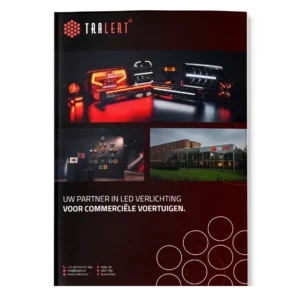
What TRALERT® can do for you as a partner in LED vehicle lighting.
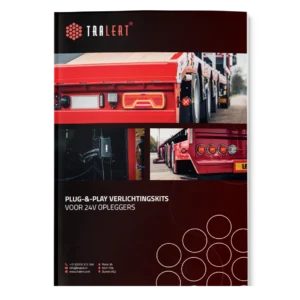
Plug-&-play kits, cabling and lighting for 24V semi-trailers.
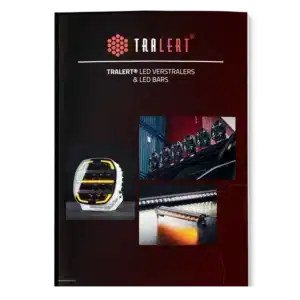
A selection of high-quality LED driving lights and LED bars.
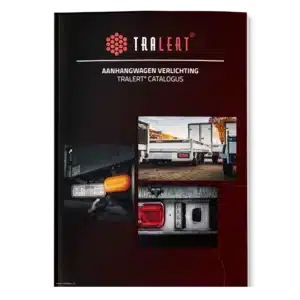
Lighting, wiring harnesses and accessories for trailers.
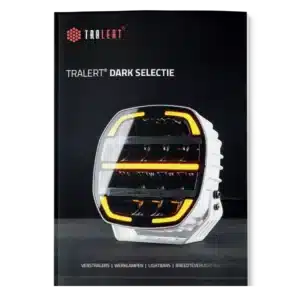
The TRALERT® DARK LED range.
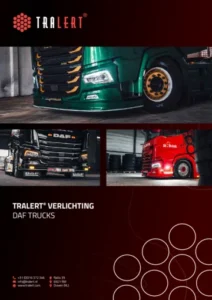
Work lights, rear lights, driving lights, beacor bars and more for DAF Trucks.
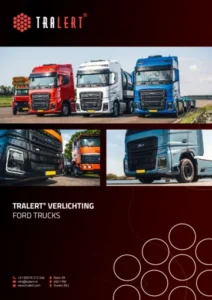
Work lights, rear lights, driving lights, beacor bars and more for Ford Trucks.
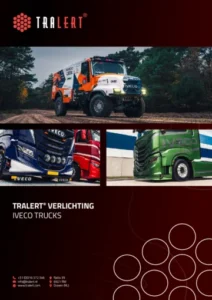
Work lights, rear lights, driving lights, beacon bars and more for Iveco.
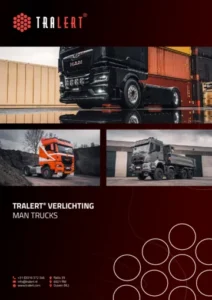
Work lights, rear lights, driving lights, beacon bars and more for MAN.
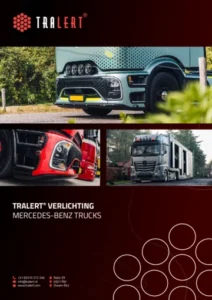
Work lights, rear lights, driving lights, beacon bars and more for Mercedes-Benz Trucks.
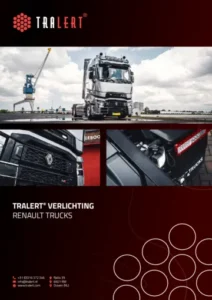
Work lights, rear lights, driving lights, beacor bars and more for Renault Trucks.
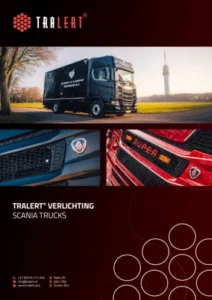
Work lights, rear lights, driving lights, beacor bars and more for Scania.
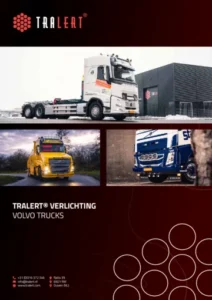
Work lights, rear lights, driving lights, beacon bars and more for Volvo Trucks.
The catalogue opens in a new tab. Can’t see it?
Open the catalogue (PDF)Two questions, in 30 seconds.
TRALERT® works with a dealer network. Dealers can view current stock levels, place orders online on account and receive a product feed for their online shop or system. We assess each enquiry internally and will let you know within 1 to 2 working days whether a partnership is possible.
You can purchase TRALERT® lighting through our partners, either locally or online. Simply provide your details, and we’ll find the partner best suited to help you.
Would you prefer to find a stockist yourself?We will assess your enquiry internally. You will hear from us within 1 to 2 working days to let you know whether a partnership is possible.
We’ll let you know within 1 to 2 working days which partner will be able to assist you further.