Specialised partner in LED vehicle lighting

The short answer
Choosing an LED work light seems straightforward. However, we do receive a lot of questions on this topic and felt it was time to provide a bit more clarification. People often look first at the number of lumen , whilst it is actually the beam pattern, the IP value, the certification and the voltage range that determine whether a light will perform well on your vehicle.
You’ll notice the difference straight away on the job site. A work light on a truck, 24V trailer or trailer requires something different from lighting for agricultural machinery or construction vehicles, where the focus quickly shifts towards the heavy-duty lighting segment. That’s why it’s useful to look not only at specifications, but above all at the intended application.
In this article, you will read:
The most suitable LED work light is the one that suits your vehicle, working distance, mounting position and working environment. For trucks, 24V trailers and semi-trailers, a wide flood beam with multi-voltage capability is often suitable. For agricultural and construction applications, higher light output, a robust housing and a high IP rating are usually more important.
If you have this in mind, we recommend comparing models only. This will prevent you from buying too much light in the wrong place, or choosing a light that does not provide enough overview in practice.
Lumen and lux are often mixed up. Yet they tell a different story.
Lumen indicates how much light a light produces in total.
Lux shows how much light actually reaches a surface.
That is why a work light with a high lumen output can still prove disappointing. For example, if the beam is too narrow, too intense or poorly distributed. In practice, therefore, the beam pattern also determines how useful the light is.
For a quick overview, please refer to the article on lumen and lux in work lights here.
| Application | Recommended beam pattern | Light output indication | What counts extra |
|---|---|---|---|
| Application: Lorry or 24V rear- trailer | Recommended light pattern: Flood | Approximate light output: 1,500–3,000 lm | Additional benefits: Widebeam angle, minimal glare |
| Application: Trailer or service vehicle | Recommended light pattern: Flood / compact | Approximate light output: 1,000–2,500 lm | Additional benefits: Compactdesign, easy mounting |
| Application: Agricultural vehicles | Recommended light pattern: Combo / wide flood | Approximate light output: 2,500–4,500 lm | Additional factors to consider: mud, vibrations, prolonged use |
| Application: Construction and construction machinery | Recommended light pattern: Combo / spot + flood | Indicative light output: 3,000 lm or more | Additional factors to consider: Durability, range and beam pattern |

In many situations, the beam pattern is more important than the number of lumen. An incorrect beam pattern causes shadows, hotspots and glare in the working area. That is precisely why it is wise to look not only at the light output, but also at the way the light is distributed.
A flood beam provides a wide light distribution. This is often the best choice for loading and unloading, work areas around the vehicle, trailers, trucks, semi-trailers and service vehicles. When working at short range, a flood beam usually provides a better overview and reduces harsh contrasts.
A spot beam bundles the light more strongly forward. This is suitable when you need more visibility at a distance, work with large machines or want to highlight a specific point or trajectory. In situations where range is more important than width, a spot beam is the obvious choice.
A combo beam combines width and reach. That makes this type interesting for agricultural machines, construction equipment and vehicles working in changing situations. You then benefit from visibility directly around the vehicle as well as further to the front.
Find out more here about choosing the right beam pattern.
When it comes to lorry lighting, the focus is often on working safely round loading bays, couplings, the sides and the rear. A wide flood beam usually works best here. It is best to choose a light with a wide voltage range, so that peak voltage in 24V systems is better absorbed.
When it comes to lighting for a trailer, compact mounting is often important. You want sufficient work lights, but without unnecessarily large luminaires. That is why compact floodlight models or smaller multi-voltage work lights are often a logical choice.
In agriculture, lighting often works for hours in dust, moisture and changing temperatures. This is when light output, vibration resistance and sealing count more heavily. A combo beam is often of interest here, because you want to maintain visibility both close up and further away.
In the construction industry, work lights and reliability are directly linked to safety. You don’t just want plenty of light; above all, you want control. That is why heavier-duty work lights are often chosen here, featuring a robust housing, high IP protection and a beam pattern that minimises shadows.

Two work lights with similar lumen can perform completely differently in practice. Not because of the LEDs, but because of the way the light is distributed. That difference often makes the difference between a lot of light and good visibility.
With a LED work light, the voltage must be right. A 12V or 24V system simply requires the right electrical connection. Yet that is only the basis. A work light that fits technically is not automatically the best choice for your application.
12V is mainly found on lighter vehicles. 24V is common on heavier vehicles such as trucks, trailers and many machines used in the agricultural and construction sectors. In many professional applications, a multi-voltage work light is a useful option, as it offers greater versatility and copes better with voltage fluctuations.
But ultimately, the choice isn’t just about voltage. The beam pattern, the seal, the robustness and the overall build quality determine whether, in practice, you’ll have truly good visibility and long-term reliability.
The IP value indicates how well a light is protected against dust and water. For vehicle lighting, this is not a detail. It partly determines service life and reliability.
For standard road use, IP67 is often sufficient. For more intensive use on trailers, in agriculture or in construction, IP68 is usually a safer minimum. When a vehicle is regularly cleaned with a high-pressure washer, IP69K is often the better choice.
Find out more in the guide to IP values for vehicle lighting.
Yes, especially in professional applications. ECE R10 refers to electromagnetic compatibility. In plain language, this means that the light must not cause any unwanted electronic interference and must itself continue to function properly in a vehicle environment.
When it comes to a work light on a truck, trailer, agricultural machine or construction vehicle, this is therefore much more than just a technical requirement. It contributes to operational reliability, particularly on modern vehicles with sensitive electronics.
Price differences do not usually arise due to:
Cheaper work lights seem attractive at first glance. In practice, however, they often deliver less consistent performance or a shorter service life. A professional work light is therefore often actually more advantageous over the total service life, as downtime, replacement and re-mounting outweigh the purchase price alone.
Read here why operational reliability is more important than the purchase price.
With trucks, the focus is often on working safely and efficiently round the cargo space, couplings, sides and rear of the vehicle. In these situations, a flood beam is usually the best choice, as you primarily need a wide field of view at short to medium distances. If you need to be able to work effectively both around the vehicle and slightly further ahead, a combo beam is often a better option. It is best to choose a work light with multi-voltage capability, so that it continues to function reliably within 24V systems and is better able to withstand voltage fluctuations. Also, pay particular attention to ECE R10 / EMC compliance, a robust housing and a reliable mounting system that can withstand vibrations and intensive daily use.
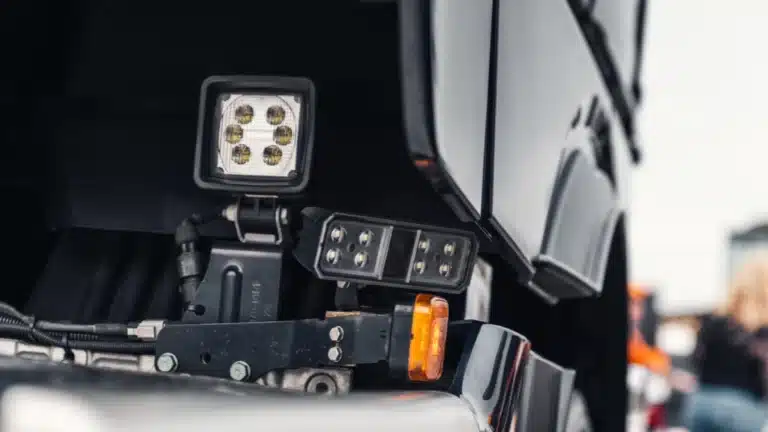
With 24V trailers , the emphasis is often on good work lights when coupling, loading, unloading and manoeuvring in the dark. A wide light distribution is usually more important here than pure range, because in practice, a clear view all round the vehicle is more important than a narrow beam with a long reach. You should therefore generally opt for a work light with a wide flood beam pattern, a stable voltage range and good protection against moisture and dust. Particularly for trailers that are used intensively or are regularly left outdoors, an IP68 rating or higher is often no luxury at all. The quality of cables, connectors and seals also plays a major role in the product’s service life.
On trailers, a work light is primarily practical and functional. You usually do not need extremely high light output, but you do need lighting that is fitted in the right place and provides immediately usable light where you need it. Compact models are often the smartest choice here, as the available mounting space is more limited and a light that is too large is more likely to be vulnerable. A wide light beam is often more practical than a narrow spotlight, as you primarily want good visibility whilst coupling, loading or working directly round the trailer. Here too, ensure the light is properly sealed and securely mounted, so that it can withstand moisture, dirt and vibrations during transport.
In the agricultural sector, a work light must perform under harsh conditions. Think of long working days, dust, mud, moisture, temperature fluctuations and constant vibrations. Consequently, it is not only light output and beam pattern that are important, but above all robustness and reliability. A combo beam or a wide flood beam is often a good choice here, as you want to maintain good visibility both close to the machine and further out in the working area. It is best to choose a work light with a sturdy housing, a high IP value and a reliable seal, so that dirt and moisture are less likely to get in. In agriculture in particular, quality pays for itself quickly, as downtime during working hours directly compromises efficiency.
In construction, good work lights are directly linked to safety, overview and productivity. Work lights often have to endure a lot here due to dust, mud, rain, shock and intensive use in changing locations. Therefore, strong housing, reliable sealing and good heat dissipation are at least as important as lumen output. In smaller work areas, wide and even light is usually most pleasant, while in larger work areas you will benefit from a combination of dispersion and range. A heavier work light with a robust construction and high IP protection is usually the wisest choice here, especially when machines or vehicles are used daily under harsh conditions.
Within the range, you see a clear shift towards more efficient, robust work lights with better light distribution and higher usability. The Apex series fits into that development as the latest generation within the worklight range, without this page having to become a product page.
A good formulation for this is:
"Within modern vehicle lighting, we see a clear trend towards more efficient light distribution, higher reliability and wider applicability. Newer series, such as the Apex series, reflect this with a strong balance between performance, build quality and professional deployment."
You do not choose the right LED work light on one specification. You look at the overall picture:
It is precisely this combination that determines whether a work light on a truck, 24V trailer, agricultural machine or construction vehicle really works well.
Are you hesitating between several options? Then it is smart to first determine your working area and mounting position. Then the right choice often becomes much easier.
For many applications on trucks, trailers, trailers, agricultural and construction vehicles, a practical choice lies between approximately 1,500 and 3,000 lumens. For larger work areas or heavier machinery, this figure increases. However, lumen s do not tell the whole story. The beam pattern and the mounting position ultimately determine how much visible light you actually end up with.
Would you like to be sure which LED work light best suits your vehicle or application? Then get in touch with the specialists at TRALERT®. We’d be happy to advise you on beam pattern, voltage, IP value and the right choice for trucks, trailers, trailers, agricultural vehicles and construction machinery.

A selection of LED lighting for trucks and trailers.
A comprehensive overview of our LED vehicle lighting and accessories.
Plug-&-play lighting kits, cabling and lighting for bodybuilders.
What TRALERT® can do for you as a partner in LED vehicle lighting.
Plug-&-play kits, cabling and lighting for 24V semi-trailers.
A selection of high-quality LED driving lights and LED bars.
Lighting, wiring harnesses and accessories for trailers.
The TRALERT® DARK LED range.
Work lights, rear lights, driving lights, beacor bars and more for DAF Trucks.
Work lights, rear lights, driving lights, beacor bars and more for Ford Trucks.
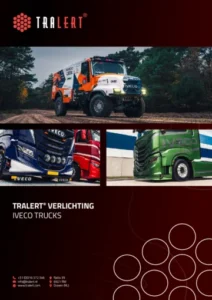
Work lights, rear lights, driving lights, beacon bars and more for Iveco.
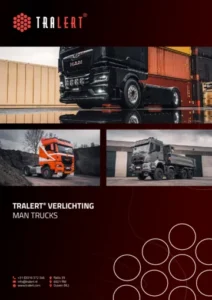
Work lights, rear lights, driving lights, beacon bars and more for MAN.
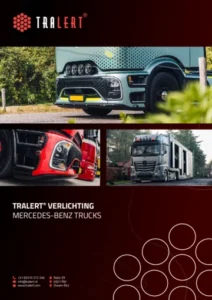
Work lights, rear lights, driving lights, beacon bars and more for Mercedes-Benz Trucks.
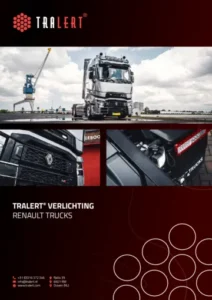
Work lights, rear lights, driving lights, beacor bars and more for Renault Trucks.
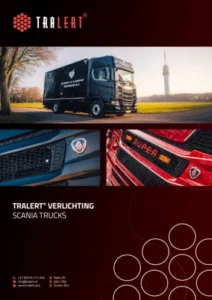
Work lights, rear lights, driving lights, beacor bars and more for Scania.
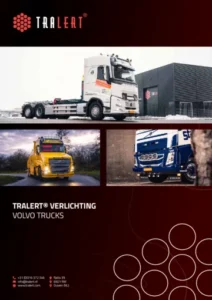
Work lights, rear lights, driving lights, beacon bars and more for Volvo Trucks.
The catalogue opens in a new tab. Can’t see it?
Open the catalogue (PDF)Two questions, in 30 seconds.
TRALERT® works with a dealer network. Dealers can view current stock levels, place orders online on account and receive a product feed for their online shop or system. We assess each enquiry internally and will let you know within 1 to 2 working days whether a partnership is possible.
You can purchase TRALERT® lighting through our partners, either locally or online. Simply provide your details, and we’ll find the partner best suited to help you.
Would you prefer to find a stockist yourself?We will assess your enquiry internally. You will hear from us within 1 to 2 working days to let you know whether a partnership is possible.
We’ll let you know within 1 to 2 working days which partner will be able to assist you further.
Trailerkit Configurator
Choose work lights and flashing lights for your trailer
Use our Trailer Kit Configurator to add work lights and flashing lights to your lighting kit. With all the lights switched on, you can immediately see what your trailer will look like at night. Everything comes as a single set with matching cables.