Specialised partner in LED vehicle lighting


When you want to drive a tractor or other agricultural vehicle on the road, different rules naturally apply. The rules for tractors differ from those for cars and trucks. But what exactly should one take into account?
In this article you will find information about:
How fast can you drive a tractor? What driver's license do you need? And where can a tractor actually drive? This article provides answers to all these questions and also discusses the required lighting for agricultural vehicles. Please note: this article is about the legislation for a tractor in the Netherlands!
TRALERT® has been a specialist in ECE-approved LED lighting for tractors, agricultural machinery and agricultural transport since 2005. Resistant to dust, vibrations and intensive use in the field and on the road.
See our lighting for agriculture →

In order to know what you all have to take into account, first of all it is important to know which category tractors fall into. Tractors fall under the so-called (agricultural) construction vehicles. This category includes various vehicles including tractors or tractors. It also includes agricultural trailers, interchangeable towed equipment and limited-speed motor vehicles. Limited-speed motor vehicles are abbreviated by the letters MMBS. This category has been replaced by the term mobile machinery since 1 January 2021. Vehicles already on the market can still be classified as MMBS.
An agricultural vehicle is not allowed to drive on every road in traffic. This is because the vehicle is simply not as fast as other traffic. On some roads, this can result in dangerous situations. There are only a few roads where agricultural vehicles are not allowed. In fact, on the vast majority of roads, you can simply drive your tractor. You are only not allowed to drive on motorways and motorways. There are also exceptions for roads with a restricted speed limit for agricultural vehicles. When this is the case, it is indicated by a traffic sign. This is a white round sign with a red border around it. In the centre is a picture of the vehicle not allowed to use the road. It may depict only a tractor but it may also be in combination with other vehicles such as mopeds.
It was mentioned earlier that a tractor is not allowed on every road as it is not as fast as other vehicles. But on other roads, there is also a limit on how fast a tractor is allowed. These speeds are also adjusted from time to time. Earlier, there was always a speed limit of 25 kilometres per hour. Since 1 January 2021, new rules apply regarding how fast a tractor is allowed. Namely, since 2021, you are allowed 40 kilometres per hour. What is important though is that this only applies if your tractor has a registration number.
Besides the maximum speed, there are also requirements regarding braking capacity. This is because it is important that a large vehicle like a tractor does manage to come to a stop in time. To make this clear, it is first useful to know what the term construction speed means. The construction speed is the maximum speed for which a vehicle is made. This is important to see how fast a tractor is allowed to go. This is because all parts of the vehicle, including the brakes, are adjusted accordingly.
Braking power requirements are as follows: At construction speeds of 30-40 km/h, this is a minimum of 3.1 m/s2, above those construction speeds 4.5 m/s2. This means that the permitted stopping distance (the sum of the "reaction distance" and the stopping distance) of the agricultural vehicle is about 15 m at speeds of 25 km/h and about 30 m at 40 km/h. The crazy thing about this is that this is not entirely in accordance with the law. This is because the stopping distance is then 30-50 % longer compared to a passenger car. The law states that in principle this should be the same.
Nowadays, to drive a tractor, you need a special driving licence, namely the 'T-driving licence'. Before 1 July 2015, this was not the case and was automatically credited. So back then, a "normal" B licence already allowed you to get behind the wheel of a tractor. If you got your driving licence before 1 July 2015, you do not still need to get a special T-driving licence. When you renew your driving licence, it will be added automatically. T and B driving licences also apply in other countries within the European Union. When travelling on private property, you are allowed to drive the vehicle without a driving licence.
Before the introduction of the T-driving licence, people aged 16 or 17 were also allowed to drive a tractor. Back then, it did not matter what driving licence you had but you had to be in possession of the so-called 'certificate of competence' to drive a tractor. People who held this certificate had one year to convert it to a T-driving licence. If you had not done so in time, you will still have to get the T driving licence separately.

For a long time, it was not necessary to register a tractor . As a result, it was always impossible to fine an agricultural vehicle if it failed to comply with the rules. Partly for this reason, it has been compulsory since 1 January 2021 to have a registration number on your agricultural vehicle if you wish to drive on public roads. If you only use the vehicle on your own land, a registration is not required. In order to register your tractor, the vehicle will first need to be inspected. This would not have been necessary if the registration had been applied for before 31 December 2021. For more information on the registration requirement for agricultural vehicles, please see our blog post entitled: ‘Registration requirement tractor and other agricultural vehicles’. In summary, having a registration number largely determines where you are permitted to drive tractor .
Any vehicle on the public road requires different lighting. After all, visibility in traffic is very important. Indeed, in the dark, a vehicle should be clearly visible to avoid accidents. As with other vehicles, a tractor should have basic lighting. This consists of:
Dimming lights at the front: these serve two purposes. Firstly, they are meant so that you yourself, the driver, can see something. In addition, it is also important because your vehicle is more visible to other vehicles. An important point here is that they must be properly adjusted. If you set your low beam lights incorrectly, this will cause blinding for other road users. This can be very dangerous.
Another lighting that is also mandatory are sidelights on the mudguards. Many people think that city lights are the same as position lights but this is not the case. City lights are meant to ensure that a vehicle is clearly visible when parked. This is why the lighting is sometimes called parking lights. The lighting does not contribute to the visibility of the driver of the vehicle. However, it does contribute to being better seen when parked next to the road.
Indicators are, of course, also compulsory for agricultural vehicles. By using indicators, you make it clear to other road users which direction you are heading in. When you use them, other road users will be able to anticipate your movements when it comes to right of way and similar matters.
Naturally, a tractor is also required to have rear lights when driving in the dark. Rear lights ensure that vehicles approaching you from behind can see you clearly. This is essential, particularly in the case of agricultural vehicles, which are generally slower. The TRALERT® range also includes various types of rear lights for tractors.
The rear light naturally includes the brake lights. When there are people driving behind you, especially in the case of the slower agricultural vehicle, it is important to be able to see whether you are braking or not. This allows the driver behind the vehicle to react. You can imagine what would happen if there were no brake lights.
Now that the number plate requirement for agricultural vehicles has been in force for some time, licence plate lights have also become compulsory for tractors when they are on public roads. This is because a number plate must be clearly visible at all times, whether in the dark or in bad weather. Licence plate light ensures that the number plate is always clearly visible. LED licence plate light, in particular. Compared to other light sources, LEDs provide a much clearer light. You also save energy with LEDs because they simply require less power.

You may also be required to fit warning lights when driving on public roads. This depends on the width of the vehicle. If your tractor unit is wider than 2 metres 60, you are required to fit a beacon. A beacon must also be used when the wide vehicle is working at the roadside. This must be orange in colour, also known as amber . This is because warning lights of other colours could be mistaken for other types of vehicles, such as the blue warning lights used by the police, fire brigade or ambulances. The TRALERT® range includes a variety of flashing beacons for your tractor , ranging from standard flashing beacons to strobe lights.
Reflectors are also very important on an agricultural vehicle. A reflector does not give light itself but it reflects it so that you are still visible. A reflector will never improve visibility as much as lighting but it certainly helps. A tractor must have two or four red reflectors at the rear of the vehicle. Note that these should not be triangular reflectors. This is because it is a motorised vehicle. However, it must have a so-called truncated triangle reflector. This is a triangle with no sharp points. It looks like the ends have been cut off. This is because this is meant for slower vehicles.

As well as the mandatory lighting, it is of course also possible to fit your tractor with additional lighting. Dimming lights, for example, are compulsory, but in the dark, high beams can also be very useful. Each type of lighting offers advantages in a specific situation. In addition to basic lighting, TRALERT® also has additional lighting in its range to fit to your tractor . This includes work lights or an LED bar. This is lighting that a tractor is not always permitted to use whilst driving. The lighting can be so bright that it may dazzle other road users. It is also possible to add extra marker lights to your tractor.
As of 1 January 2021, in addition to the requirement for a number plate, the rules regarding the dimensions and weight of tractor have also changed. Among other things, the maximum length of an agricultural vehicle has been adjusted. These may now be up to twenty metres long. From 1 January 2022, trailers with a load bed may be no more than 2.55 metres wide. Trailers that were put into service before that date will be approved. The maximum width across the tyres remains three metres. A combination with a trailer may be a maximum of 18.75 metres long.
When it comes to weight, the rules have not changed. The maximum mass of a limited-speed motor vehicle is 60,000 kilograms. The maximum axle load is still 12,000 kilograms. However, there is a rule that can reduce the maximum mass. If an agricultural vehicle is fitted with an overrun brake, it may weigh a maximum of 8,000 kilograms. This is to comply with European directives.
A tractor 's load may still consist of sharp parts. When this is the case, the load will have to be properly protected so that no damage or bodily injury can occur. The law states that mobile work equipment on which people move around, including tractor, must be equipped to minimise danger to anyone.
If one or more rules regarding the weight, size or load cannot be met, you are not allowed on the road. If this is the case, you will have to apply for an official exemption. You can apply for this from the road authority.
It has already emerged that not all rules apply when driving on private property. First of all, there is no registration requirement. If you only use your tractor on your own property, there is no need to provide it with a registration number. Note, however, that if you only need to cross the road from one meadow to another you are on the public road for a while. In those cases, it is officially mandatory to have it though. Also, the rules for which driving licence you need for the tractor do not apply on private land. So where you are allowed to drive the tractor without any driving licence depends on the location. Of course, it is important that not everyone gets behind the wheel like this. This is your own responsibility.
If you are looking for lighting for the Tractor, TRALERT® has a wide range. The set includes rear lights, marker lights, licence plate lights and side marker lights, allowing you to not only be safe on the road, but also stylish with our careful choice.
Better Light Work Safer!

In our stock


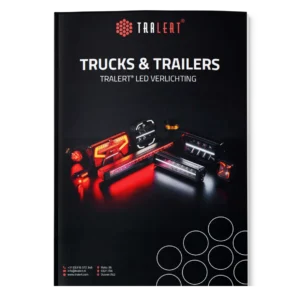
A selection of LED lighting for trucks and trailers.
A comprehensive overview of our LED vehicle lighting and accessories.
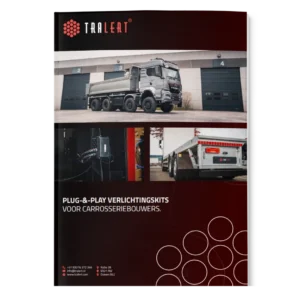
Plug-&-play lighting kits, cabling and lighting for bodybuilders.
What TRALERT® can do for you as a partner in LED vehicle lighting.
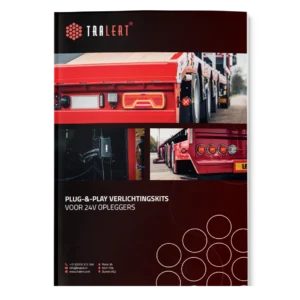
Plug-&-play kits, cabling and lighting for 24V semi-trailers.
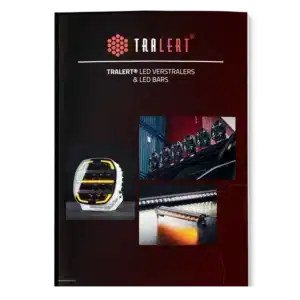
A selection of high-quality LED driving lights and LED bars.
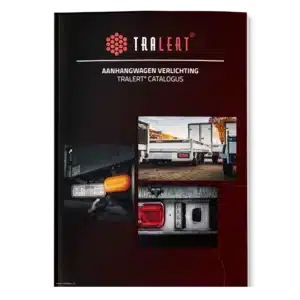
Lighting, wiring harnesses and accessories for trailers.
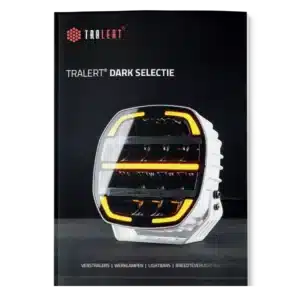
The TRALERT® DARK LED range.
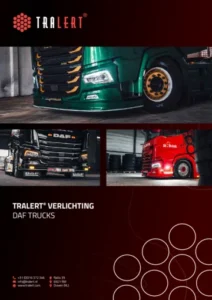
Work lights, rear lights, driving lights, beacor bars and more for DAF Trucks.
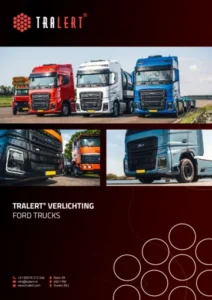
Work lights, rear lights, driving lights, beacor bars and more for Ford Trucks.
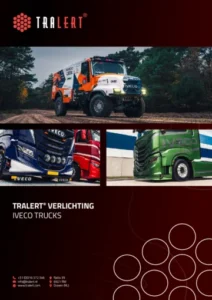
Work lights, rear lights, driving lights, beacon bars and more for Iveco.
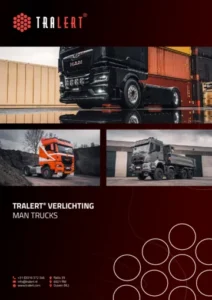
Work lights, rear lights, driving lights, beacon bars and more for MAN.
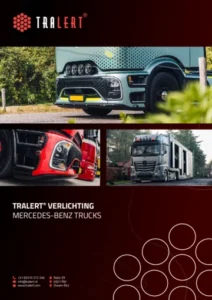
Work lights, rear lights, driving lights, beacon bars and more for Mercedes-Benz Trucks.
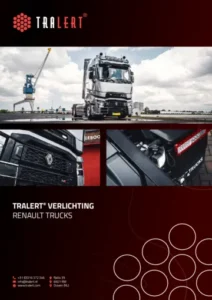
Work lights, rear lights, driving lights, beacor bars and more for Renault Trucks.
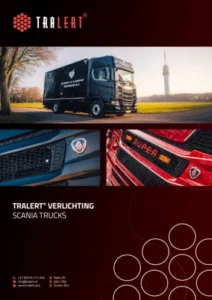
Work lights, rear lights, driving lights, beacor bars and more for Scania.
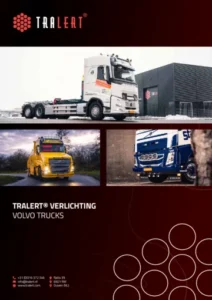
Work lights, rear lights, driving lights, beacon bars and more for Volvo Trucks.
The catalogue opens in a new tab. Can’t see it?
Open the catalogue (PDF)Two questions, in 30 seconds.
TRALERT® works with a dealer network. Dealers can view current stock levels, place orders online on account and receive a product feed for their online shop or system. We assess each enquiry internally and will let you know within 1 to 2 working days whether a partnership is possible.
You can purchase TRALERT® lighting through our partners, either locally or online. Simply provide your details, and we’ll find the partner best suited to help you.
Would you prefer to find a stockist yourself?We will assess your enquiry internally. You will hear from us within 1 to 2 working days to let you know whether a partnership is possible.
We’ll let you know within 1 to 2 working days which partner will be able to assist you further.
TRALERT® operates through a dealer network. Prices, stock levels and online ordering are therefore only available to business customers with an account.
We assess every enquiry internally and will let you know within 1 to 2 working days whether a partnership is possible.
For your own use?Find a stockist
Would you prefer a quote first?Add this product to your quotation request and send it off when you’re ready.