

Blog
When choosing an LED work light, the right light image (beam pattern) is actually more important than the lumen output. An incorrectly chosen light image leads to shadows and insufficient lighting of the work area. This can even cause fatigue. It is therefore important to determine in advance which type of work light best suits the situation.
Therefore, when it comes to professional vehicle lighting, you never choose solely on lumen or lux-on-distance. The right light pattern determines whether your work area is illuminated evenly, whether you maintain an overview and whether colleagues or bystanders are not blinded.
In this article, you will read:
- What is the difference between a: flood beam, spot beam and combi beam?
- How to choose the right light image
- What the role of lumen and lux is in work lights
Why light image is often more important than lumen output?
The light image determines the shape, spread and intensity of the light in your working area and is therefore at least as important as the total light output. A high lumen rating without a suitable pattern leads, in practice, to hotspots, shadows or glare. The result: plenty of light, but insufficient usable visibility. For further explanation, see our article on the meaning of lumens in work lights.
The Beam Pattern
The right beam pattern ensures an even distribution of light across the working area. This means fewer differences in contrast, less visual strain and a better overview during prolonged use on trucks, trailers and machinery.
Professional light measurements also confirm this. In realistic tests, measurements are not made straight into the light, but perpendicular to the work surface, with fixed tilt angles such as -17° or 10-12°. This ensures that the range is not artificially overestimated and provides an honest picture of effective lighting.
That is why, when selecting a work light, we recommend first determining the beam pattern and only then comparing the output . In practice, this leads to better visibility, less glare and a stable lighting setup that meets professional requirements such as EMC ECE R10 and high IP ratings.
What light patterns exist for LED work lights and when do you use them?
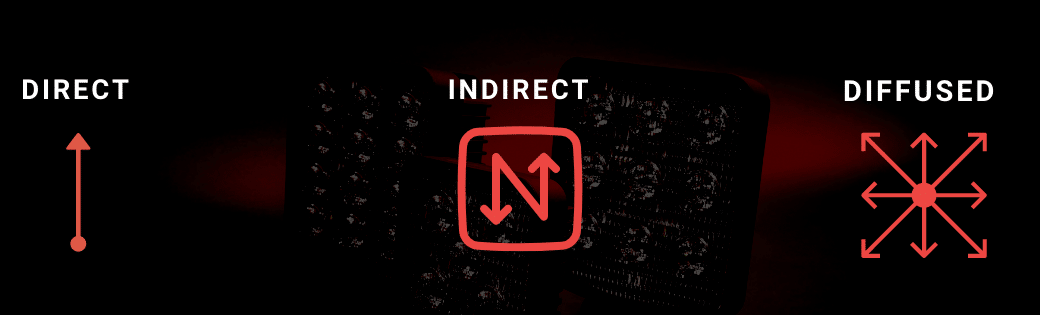
The most commonly used light patterns in professional vehicle lighting are flood beam ,spot beam beam and combi beam . In addition, Driving lights are used for driving lighting at higher speeds. Each pattern is optimised for a specific distance and mounting position. Therefore, never choose solely on lumen, but always on application and working distance.
Professional-quality work lights
When you’re using lighting whilst working, it’s certainly nice to have the best possible light. It makes the job a lot easier. The right light image is a key factor. But there are other factors that distinguish professional lighting from cheaper, lower-performance alternatives. Find out more in the article on cheap vs professional work lights.
What is a flood beam?
A flood beam distributes light at a wide angle. The goal is not maximum distance, but an evenly lit work zone around the vehicle.
This type of work light is often fitted:
- At the rear of trailers
- On the side of surface mounting
- On service vehicles
- At loading and unloading areas
A flood beam provides an overview close to the vehicle. Think of a light range of, for example, 40 lux at 40 metres and 1 lux round 80 metres, depending on the model.
Flood beams are ideal when coverage is more important than distance. In this article, you can read more about flood beams
What is a driving light (spotbeam)?
A driving light(spot beam) focuses the light strongly forward. The beam is concentrated and focused at longer distances.
This type of work light is suitable for:
- Crane vehicles
- Remote work
- Off-road work in open areas
- Situations where range is crucial
The concentrated beam reaches further, but the spread is more limited. This is why a driving light is often combined with a flood beam for optimal coverage.
What is a combi beam?
A combi beam combines spot and flood in one luminaire. You get both range and spread.
This is interesting when:
- You have limited mounting space
- You want one compact solution
- You want both distance and direct work zone lightening
For many truck and semi-trailer applications, this is a practical middle way.
How to choose the right light pattern for your vehicle in 5 steps?
First determine the working distance, then the mounting position (taking into account ECE R48 regulations), followed by the tilt angle; assess the risk of glare and, where necessary, combine multiple beam patterns. This allows you to create realistic, shadow-free lighting that is technically sound and meets professional vehicle requirements.
Step 1 - Determine the working distance
The distance you want to see effectively is leading.
- Near work area (0-30 metres) → Choose a flood beam
- Medium range (30-80 metres) → Choose a Combo beam
- Longer distance (80 metres and beyond) → Choose a Spot beam
For higher speeds or driving applications, choose driving lights instead of work lights.
Step 2 - Determine the mounting height and position
Mounting strongly influences the light image.
- Low rear mounting → Flood beam for wide coverage
- High mounting on cabin or roof → Spot or Combo for extra range
- Vehicle side → Flood for safe working zone
The higher the mounting, the more important controlled range becomes.
Step 3 - Choose the right tilt angle
A work light should not shine horizontally "in the air".
Professional adjustment is done at a fixed angle, often round:
- -17°
- 10-12° tilt
This prevents the range from appearing artificially high and ensures realistic light distribution on the work surface.
Step 4 - Assess the glare risk
Consider:
- Are there personnel working around the vehicle?
- Is the vehicle located near public roads?
- Are cameras or sensors active?
In these cases, controlled spread is more important than maximum output. A Flood or properly adjusted Combo limits direct viewing of the light source and reduces visual stress.
Step 5 - Combine for full coverage
A single pattern is rarely used in professional surface mounting.
An effective configuration often consists of:
- Flood beam rear
- Spot or Combo front
- Possible additional Flood on sides
This creates 360° coverage without dark zones or excessive lumen overkill.
With these principles, you will never choose wrong again. Safer work, higher productivity and full compliance.
Which work light suits your application?
| Patterns | Features & distribution | Ideal application |
|---|---|---|
| Flood beam | Wide spread (approx. 60-120°), even coverage close up, less depth | Work area round truck or trailer, loading and unloading area, sides, rear |
| Spot beam | Narrow focused beam (approx. 10-30°), long range, high lux at distance | Remote inspection, manoeuvring in open terrain, forward vision at low speed |
| Combo beam | Combination of wide and targeted beam, balance between range and coverage | Daily use where both near and remote coverage is required |
| Driving lights | Directional driving light with longer projection, designed for higher speed | Open terrain, agricultural applications, additional driving lights where permitted |
What does lux mean in light range?
Lux says something about the light intensity at a certain distance.
For example:
- 40 lux at 40 metres means clear illumination of the work area at a distance of 40 metres.
- 1 lux at 80 metres means minimal orientation lighting at 80 metres.
Lux is therefore usually more relevant than just lumen. It says something about usable lighting at working distance.
In addition, the following play a role:
- Mounting height
- Beam angle
- Reflection of substrate
- Ambient light
When is lumen important?
Lumen becomes important once you have already determined the right light pattern.
First you determine:
- Flood, Spot or Combo
- Working distance
- Mounting position
Only then does lumen come into the picture. Are you comparing two Flood-beams with similar spread angles?
Then lumen gives an insight into how much total light output is available.
More lumen then usually means:
- Higher light intensity in the same beam
- More coverage in adverse weather conditions
- Better performance on larger working surfaces
Within a single type of pattern, lumen are therefore a relevant factor for comparison. Read more about lumen
Related articles