
ECE R149 determines whether a headlight, driving light or LED bar is technically approved for use on public roads. You can recognise this by the E-mark and the corresponding approval number on the light. Yet this approval does not say it all.
What does ECE R149 mean for vehicle lighting?
Watch the video for a short explanation of ECE R149 and the role of this regulation in the technical approval of front vehicle lighting.
In order to actually use a light in practice, it must be fitted in accordance with ECE R48. An LED bar may therefore be approved under R149, but must also be correctly fitted in accordance with R48. This is particularly important in the case of additional high beams, as the total reference value of all high beam units lit simultaneously must not exceed 100, including the existing headlights.
What is ECE R149?
ECE R149, in full Road Illumination Devices (RID), is the UNECE type approval for lights and lighting systems on the front of a vehicle. It replaces many older regulations including R19, R98, R112, R113, R119 and R123. It bundles those separate approval frameworks into one modern standard.
The original version came into force on 15 November 2019. It was followed by the 01 series of amendments on 4 January 2023, and in February 2025, UNECE published the consolidated Revision 1 (E/ECE/TRANS/505/Rev.3/Add.148/Rev.1).
R149 consists of a general section with administrative provisions and general technical requirements, followed by specific performance requirements per lamp function. Manufacturers go through a type-approval procedure at a designated body. Only after approval may a light carry the corresponding E-mark and approval number.
To which lighting does ECE R149 apply?
ECE R149 covers the type approvals of almost all vehicle front lighting.
- Headlights with low beam (passing beam) and high beam(driving beam)
- Adaptive Front Lighting Systems (AFS) that dynamically adjust the beam according to speed, weather or steering angle
- Front fog lights (front fog lights)
- Cornering lights that illuminate the side of the road when turning
Please note that position lights (DRL) are not covered by ECE R149, but by ECE R148 (light-signalling devices).
The regulations apply to a wide range of vehicle categories, including two- and three-wheelers (category L), passenger vehicles (M), commercial and goods vehicles (N) and agricultural vehicles (T). This makes R149 directly relevant to the lorry, semi-trailer and agricultural sectors as well.
For some lamp functions, R149 still refers to specific other regulations, for example for light sources under R37, R99 or R128. For vehicle-level installation requirements, R149 explicitly refers to ECE R48, R53, R74 and R86, depending on the vehicle category. So R149 regulates what the light must be able to do, not how and when you may carry it on your vehicle.
ECE R149 and driving lights: when is it relevant?
For LED driving lights and LED bars , ECE R149 is applicable if the product has type approval as a high-beam function(driving beam). A driving light certified as a high beam counts at vehicle level as an additional high beam unit and thus falls under R149.
In practice, you will encounter three situations:
1. Driving lights with R149 high beam approval. The product is approved as a high beam function. You will recognise this by the E-mark with the approval number beginning with 149, sometimes combined with the indication for the driving beam function. These driving lights may be operated on public roads, provided the installation complies with ECE R48.
2. Driving lights without R149 approval. Usually marked as off-road or work lights. On public roads, these should not be on - full stop. In the field, on a construction site or in your own yard, it's a different story.
3. Driving lights with R112 marking from older stock. R112 was the predecessor of R149 for high-beam functions and remains valid for type approvals already issued, but R149 is used for new type approvals. Further on, you can read what this difference means for your purchasing.
Do you want to be sure that a driving light or LED bar is suitable for your truck, trailer or work vehicle? On the LED driving lights page, you’ll find an overview of TRALERT® models with their corresponding certifications.
Driving lights with ECE R149
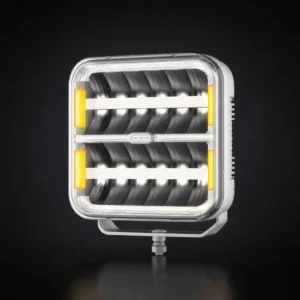
This selection of top quality driving lights have ECE R149 certification and include modern features such as dynamic start-up. They can withstand harsh conditions, a perfect choice for trucks.
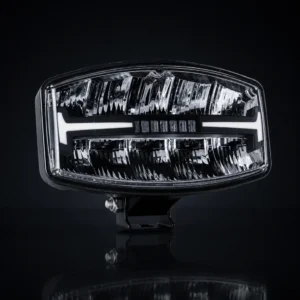
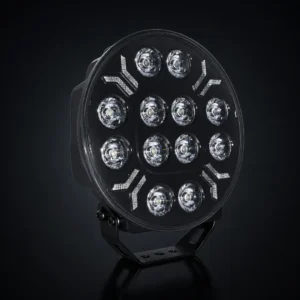
LED Ypsilon 12LED amber-white with warning light 8000lm - 3m cable | WD-12080.1
In our stock
SKU:
WD-12080.1
How do you recognise an ECE R149 approved light?
An ECE R149-approved light always carries a visible marking. Always. You will find it in a rectangle or circle on the lens, on the housing or on an adjacent plate. It contains three key details.
1. The E mark. A capital letter E in a circle, followed by a number. That number refers to the country where the type approval was issued. For example, E1 stands for Germany, E4 for the Netherlands, E9 for Spain. So the number indicates the issuing authority, not the country where you are allowed to use the light. An E1 marking is recognised throughout Europe.
2. The approval number. Directly below or next to the E-circle is a sequence starting with 149. This is the regulation number and confirms that approval has been granted under ECE R149. Following that is a series and unique approval number.
3. Function and class symbols. Letters or codes indicating which specific function the light performs, e.g. for high beam, low beam, fog light or an AFS class. For high beam units (such as driving lights), this also includes the reference value: a number indicating the luminous intensity contribution. That number is not a performance rating, but an installation rating: all simultaneously burning main-beam units together may have a reference value of no more than 100 at vehicle level (see the block on mounting and use).
An additional development is that R149 also allows use of a 'Unique Identifier'. When that system is used, the light no longer needs to carry a conventional E-mark; all approval documentation can then be accessed via a secure UNECE database. Currently, in practice, you almost always still see conventional E-marking.
Would you like to go deeper into what exactly an E-mark means? Then read the explanation on the E-mark page.
ECE R149, E-mark, ECE R48 and ECE R10: what is the difference?
This is where things almost always go wrong in conversations. People use R149, E-label and R48 interchangeably, even though they are three different things that each cover a different part of the story. At a glance:
ECE R149: the light's type approval
R149 sets requirements for the light itself: how strong it radiates, how sharp the cut-off is, how it performs under moisture and vibration, and which functions it performs correctly. So an R149 approval says something about the product, not about your vehicle.
E-mark / E-approval mark
The E mark is not a separate regulation, but the marking by which a product makes visible that it has been approved according to a UNECE regulation. So a light with an E-mark and approval number 149 is E-approved based on R149. An E marking can also belong to other regulations, for example R10 for EMC or R7 for marker lights. More explanations can be found at E-mark.
ECE R48 the installation on the vehicle
R48 regulates how lighting should be mounted, connected and used on a vehicle: number of lights, mounting height, spacing, switching conditions and the maximum number of simultaneous high beams. So R149 approves the light, R48 approves the installation. You need both to drive legally on public roads. Read more on ECE R48.
ECE R10 electromagnetic compatibility
R10 is independent of light performance and deals with electromagnetic interference: a light must not interfere with other vehicle systems and must itself be resistant to interference from outside. A good LED driving light is therefore usually both R149- and R10-approved. More information on ECE R10.
Summarised
| Regulations | What it regulates | When relevant |
|---|---|---|
| ECE R149 | Light type approval (performance and function) | When selecting and purchasing the light |
| E-mark / E-approval mark | Visible marking of approval | When visually checking the product |
| ECE R48 | Installation and use on vehicle | In mounting and driving on the road |
| ECE R10 | Electromagnetic compatibility | With electronic integration in vehicle |
Whoever wants to use an LED driving light or LED bar on public roads will in practice always have to deal with R149 and R48 - and preferably also with R10. They are not mutually exclusive, but complementary. For the overarching framework, read more at ECE regulation.
ECE R149 versus ECE R112: what has changed?
Until the introduction of R149, ECE R112 was one of the main regulations for headlights with asymmetrical low and high beam, including driving lights with high beam function. Since 2019, R112 will be replaced by R149 for new type approvals. This does not mean that R112 is suddenly invalid, but rather that the direction is unambiguous: new products will be certified under R149.
The four main differences
1. Wider scope. R112 mainly covered headlights with a specific light source technology. R149 bundles several older regulations into one framework and is technology-neutral in design. Whether a light operates on halogen, gas discharge or LED no longer matters in principle for the approval procedure; performance requirements are central.
2. One regulation for multiple functions. Under R112, a manufacturer often needed several separate approvals when a light fulfilled multiple functions. R149 allows the inclusion of dimming, high beam, fog and cornering functions within one approval framework.
3. Updated, technology-neutral performance requirements. R149 updates requirements round, among others, cut-off (the sharp cut-off line of the dimming lights), photometric performance and the behaviour of adaptive systems. The focus is on measurable performance testing, independent of the light source technology used.
4. Compatibility with installation rules. R149 is deliberately aligned with the installation regulations in ECE R48, R53, R74 and R86. As a result, lamp approval is more closely aligned with vehicle practices.
What does this mean for your procurement?
Products with a valid R112 approval remain legally marketable as long as the type approval has not been withdrawn. In practice, you can see that more and more manufacturers are opting for R149 certification, as this is the future-proof route. When in doubt about a specific driving light or LED bar from older stock: look at the approval number on the marking. If it starts with 149, then it is the current standard. Does it start with 112, then it is an approval under the older standard.
For a more detailed explanation of the older standard, please refer to ECE R112.
What should you pay attention to when mounting and using?
An R149 approval on the product is an important starting point, but it is not the whole story. What you are allowed to fit to your vehicle and simultaneously illuminate on public roads is determined by ECE R48. These are the practical points of interest.
The maximum of high beams
R48 requires that all simultaneously burning main-beam units together at vehicle level must have a reference value of no more than 100, corresponding to no more than 430,000 candela combined light output. Each R149-approved main-beam unit has its own reference value, which is marked on the marking. If you add up those values of your headlights plus additional driving lights, the sum should be under 100.
This is where things go wrong in practice. Two headlights with reference value 30 and two driving lights with reference value 25: together 110. Too much. Even if each light individually has a neat R149 approval, the combination is not allowed on public roads. We see this come up every month.
Switching conditions
Additional high beams (e.g. driving lights and light bars) may only be switched on at the same time as the vehicle's regular high beam. At low beam, they should switch off automatically. A correct connection via the high beam switch is therefore a requirement.
Number and placement
R48 also defines the maximum number of forward high beam units, their mounting height and symmetry in relation to the centre line of the vehicle. Different maximum numbers apply to trucks and heavy commercial vehicles than to passenger cars or agricultural vehicles. If in doubt, consult the specific vehicle category in ECE R48 or coordinate with your flush mounting specialist.
Work lights and off-road lighting
Driving lights and light bars that are marked as work lights or off-road do not fall under R149 as a high beam function. In principle, these should not be switched on on public roads. However, for off-road, construction site or yard application, they are of course perfectly usable.
An R149 marking on a driving light is not a license to run it anytime, anywhere. The light is approved as a product, but whether your vehicle set-up as a whole is correct determines ECE R48.
Frequently asked questions about ECE R149
Is ECE R149 mandatory for driving lights and headlights?
For new type approvals of headlights and high-beam functions, R149 is the current framework. Existing R112 approvals remain valid as long as they have not been withdrawn. Do you want to operate a driving light or headlight on public roads in Europe? Then you need a valid UNECE approval (in practice, this will increasingly be R149).
Is ECE R149 the same as an E mark?
Not quite. The E mark is the visible marking by which a light shows that it is approved according to a UNECE regulation. ECE R149 is the regulation itself. So a light with E-mark and approval number 149 is E-approved based on R149. Other E-markings may refer to R10 or R7, for example.
Is an LED bar with ECE R149 marking always allowed on public roads?
No, not automatically. R149 approves the light, but whether you can carry it depends on ECE R48. The main rule there: all simultaneously burning high beams together must not exceed a reference value of 100 (equivalent to 430,000 candela) at vehicle level.
What is the difference between ECE R149 and ECE R112?
R112 was the older standard for headlights with asymmetrical low and high beams. R149 replaces R112 for new type approvals and is technology-neutral in design. Thus, R149 bundles several old regulations into one modern framework, with tightened requirements for cut-off, photometry and adaptive systems.
What does the reference number on a driving light mean?
Reference number - also called reference value - indicates the relative luminous intensity contribution of a main-beam unit. At vehicle level, the sum of all simultaneously illuminated main-beam headlamps may not exceed 100. The number is thus not a performance rating, but an installation rating that you need to truck the R48 requirement.
TRALERT® advice: which ECE R149 lighting fits your vehicle?
The right choice depends on your vehicle, your application and the type of road you drive on. A tractor-trailer combination requires a different setup to a van or a work vehicle on site. And as installation requirements vary by vehicle category, not every combination of headlights and supplementary driving lights is permitted by law.
The TRALERT® product range includes LED driving lights and LED bars that are certified according to ECE R149 and in most cases also ECE R10 (EMC). Suitable for the road, therefore, as long as you respect R48 when flush mounting. The same principle applies to LED headlights: choose the right marking and pay attention to mounting height, switching and symmetry when flush mounting.
Are you unsure which R149-approved driving lights are suitable for your truck, trailer or work vehicle? Then take a look at the LED driving lights category first for an overview of suitable models.
ECE R149 download
Official UNECE download: UN Regulation No. 149 Revision 1 – Amendment 3 (PDF)