Your specialised partner in LED vehicle lighting

The short answer
You cannot recognise a high-quality LED work light by its high lumen alone. You recognise quality by pleasant light, robust electronics, durable materials and the correct certification. It is precisely this that helps you prevent interference, downtime and unnecessary replacements on truck, trailer, tractor or machinery.
This checklist tells you which specifications really count. In this way you can make a reliable choice faster and avoid a light that seems a good choice but which falls short in practice.
A work light must continue to perform every day. In the yard, in construction, in the agricultural sector and in transport, lighting has to cope with vibrations, moisture, dirt, temperature changes and voltage peaks. This is when you quickly see the difference between a basic model and a professional LED work light.
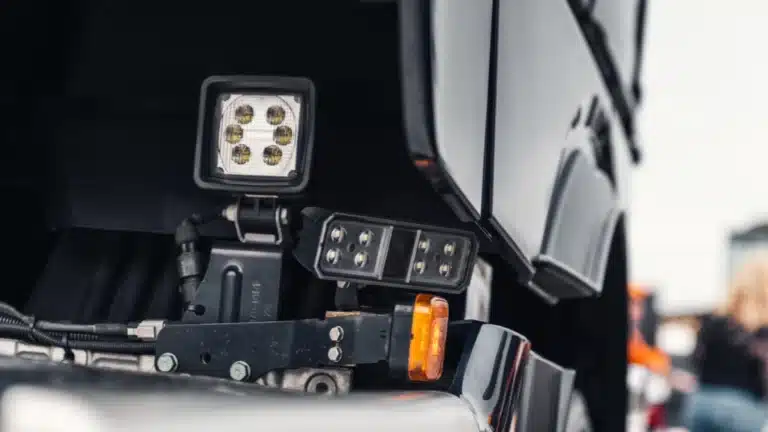
A high-quality LED work light does more than just provide light. It also supports the reliability of the entire vehicle. Effective EMC interference suppression, stable electronics and a robust housing help to minimise breakdowns and interference. This is particularly important on modern vehicles with sensitive electronics and CAN-bus systems. For example, in the case of lighting for bodybuilding.
At TRALERT® we therefore look beyond wattage or shape. We always assess a work light in terms of light image, voltage resistance, sealing, connectors, choice of material and certification.
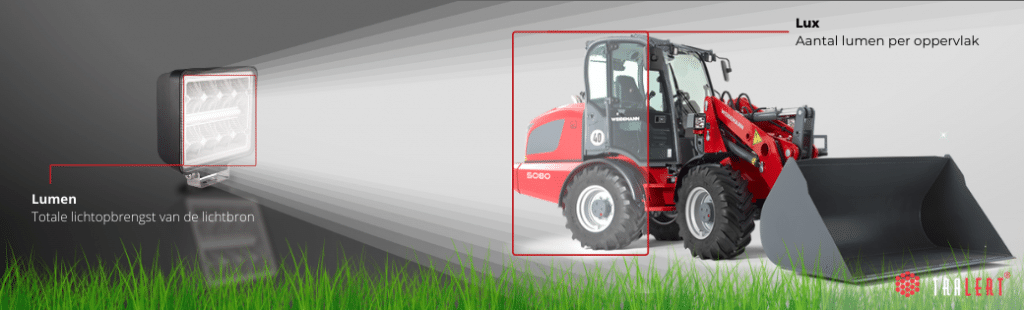
Lumens indicate the total amount of light a lamp produces. Lux shows how much light actually reaches a surface. In practice, lux is often more important. After all, you want to know what you can see at the workplace, not just what a lamp theoretically emits.
This is why you always compare work lights within the same light image. A flood lamp lightens broadly. A spot lamp reaches further. A combo combines both features. Mixing these light images gives a distorted picture.
In addition, pay attention to lumen per watt. That figure gives a first impression of efficiency. Yet it does not tell the whole story. Lens design, reflector, light distribution and thermal management also determine how much usable light you are really left with.
| Light image | Typical light output | Practical features | Application |
|---|---|---|---|
| LightPattern: Flood | Typical light output: 3,000–5,000 lumen | Practical feature: Wide beam spread | Applications: Load area, all round the vehicle, nearby work area |
| LightPattern Spot | Typical light output: 2,500–4,000 lumen | Practical feature: Adjustable beam distance | Applications: Agriculture, machinery, improved forward visibility |
| LightPattern Combo | Typical light output: 4,000–6,000 lumen | Practical feature: Wide and focused | Application: Versatile use on farmyards, roads and construction sites |
Reliable product specifications therefore reveal more than just lumen. A good example is the TRALERT® Apex WR-1829V. This light combines raw lumen with effective lumen, lux at 10 metres and a clear beam pattern. This provides a much more realistic picture of its performance in the field.
For more insight into light patterns, read the article ‘Which light image should you choose for your work light?’.
The housing determines much more than just its appearance. A strong housing protects the electronics, dissipates heat and helps the light to absorb vibrations and shocks. Therefore, it pays to look carefully at material selection.
Professional work lights often use aluminium or advanced composite materials. In the Apex Series , for example, we see aluminium ADC12 housing with a polycarbonate lens cover. This gives a strong combination of impact resistance, stability and protection of internal components.
Also in the wider TRALERT® range, you can see how material selection differs for each application. The Graphene Series uses lightweight housing for impact resistance and low weight. Other series , on the other hand, focus on maximum rigidity, corrosion resistance or compact flush mounting. So you choose a light that matches the load of your vehicle and working environment.
In addition, pay attention to the details. A solid stainless steel bracket, neat coating, solid seal and a reliable connector often make the difference in practice.
LEDs do not like heat. As soon as heat builds up, light output drops faster and the electronics wear out harder. As a result, a light with impressive specifications on paper can still fail early.
A high-quality LED work light therefore combines good LEDs with smart heat dissipation. This is reflected in cooling fins, choice of materials and the surface mounting of the housing. This is where professional lights stand out from cheap alternatives.
Sometimes a light with a lower specified lumen value performs better in practice than a heavier model. This happens when the beam is more efficient, the optics are more correct and the heat management is better balanced.
An LED work light must be resistant to water, dust and cleaning. That is why you should always check the IP rating. For professional outdoor use, IP67 is often the minimum requirement. If you work in agriculture, construction or livestock transport, IP69K is usually the wiser choice.
IP67 protects well against dust and temporary immersion. IP69K goes further and is intended for intensive cleaning with high-pressure water. That makes a big difference on vehicles that are regularly hosed down.
In the Apex datasheet, for example, we see IP68 and IP69K. This shows that the light both strongly seals against water ingress and is suitable for tougher cleaning conditions.
You can read more about this in the comprehensive guide to IP values.
Good lighting must do more than just provide light. It must also work safely alongside the vehicle’s electronics. That is why EMC certification remains essential. For work lights on vehicles, ECE R10 certification is an important indicator that the light is electromagnetically compatible.
You should also check the IP rating, CE marking and, where relevant, additional approvals such as R23 or ADR. Some applications simply require extra certainties.
| Specifications or seal of approval | Why it matters | What you pay attention to |
|---|---|---|
| Specifications orECE R10 type approval | Why this matters: Reducedrisk of EMC interference | What to look out for: Clearlabelling and documentation |
| Specifications or certification: CE marking | Why this matters: Basic requirementsfor the European market | What to look out for: Not just an empty claim, but a well-founded product |
| Specifications or rating: IP67 / IP68 / IP69K | Why this matters: Protectionagainst water and dust | What to look for: Suitablefor your cleaning requirements |
| Specifications or R23 certification | Why this matters: Suitable as a reverse light | What to look out for: Correct application and mounting |
| Specifications or ADR certification | Why this matters: Important in specific transport applications | What to look out for: Choose only when the application requires it |
| Specifications or certification: CISPR 25 Class 3 or 5 | Why this matters: Additionalindication of EMC performance | What to look out for: Important considerations for sensitive vehicle systems |
The Apex Series shows well what such a total picture looks like. There we see, among others, ECE R10, IP69K, R23, CISPR25 Class 3 and in one model also ADR. Within the TRALERT® range, you will also see series with tougher EMC specifications for professional applications.
Electronics often determine reliability in practice. Therefore, always pay attention to voltage range, peak voltage protection and connection quality. On vehicles and machines, voltage fluctuations are normal. A light must therefore be able to withstand them.
The Apex Series is a good example of such professional surface mounting. This series operates at 9-30V multivoltage, is peak voltage resistant to 36V and uses a Deutsch-connector on certain models. These are specifications that suit everyday professional use.
Other series in the range also show that that electronic basis remains important. Some series combine multivoltage with advanced lens technology, while others excel in EMC interference suppression or compact integration. This makes the light better suited to the vehicle application.
Not every light distributes light in the same way. It is precisely the optics that determine whether the light is usable, uniform and comfortable. This is why lens technology is an important quality feature.
Within the TRALERT® range, you will see different solutions for different applications. One series focuses on a tight, controlled beam. Another series opts for a wide and even light distribution. This allows you to adjust the lighting to work comfort, visibility and safety.
In addition, TRALERT® shows that optics is also about comfort. No-glare work lights are designed to reduce glare without unnecessarily reducing the overall lighting coverage. This makes them interesting for machines and work vehicles where people work close round the vehicle.
Would you like to make a vehicle-specific choice? Find out which LED work light is best suited to your vehicle.
Yes and no. A high lumen value only says how much light a light theoretically produces. For practical purposes, lux, light image, IP classification, voltage resistance, choice of material and ECE R10 are also at least as important. It is precisely this combination that determines whether a work light continues to perform reliably.
A high-quality LED work light can be recognised by its entirety. Therefore look beyond price or performance. Look for usable light, strong electronics, reliable certification, an appropriate IP value and housing made for intensive use.
This prevents interference, reduces maintenance and keeps your vehicle usable in tough conditions. This is not only safer, but also smarter investment in the long term.
Would you like immediate advice for your vehicle or application? Then take a look at our range of LED work lights or get in touch with TRALERT®. We’d be happy to help you choose a work light that performs just as well in practice as it does on paper.

A selection of LED lighting for trucks and trailers.
A comprehensive overview of our LED vehicle lighting and accessories.
Plug-&-play lighting kits, cabling and lighting for bodybuilders.
What TRALERT® can do for you as a partner in LED vehicle lighting.
Plug-&-play kits, cabling and lighting for 24V semi-trailers.
A selection of high-quality LED driving lights and LED bars.
Lighting, wiring harnesses and accessories for trailers.
The TRALERT® DARK LED range.
Work lights, rear lights, driving lights, beacor bars and more for DAF Trucks.
Work lights, rear lights, driving lights, beacor bars and more for Ford Trucks.
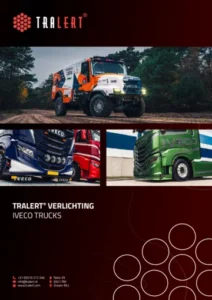
Work lights, rear lights, driving lights, beacon bars and more for Iveco.
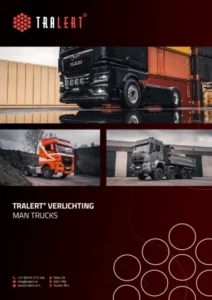
Work lights, rear lights, driving lights, beacon bars and more for MAN.
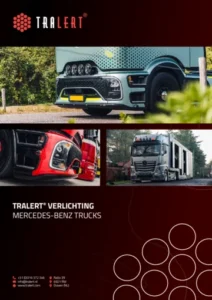
Work lights, rear lights, driving lights, beacon bars and more for Mercedes-Benz Trucks.
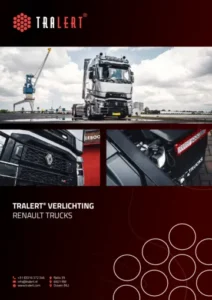
Work lights, rear lights, driving lights, beacor bars and more for Renault Trucks.
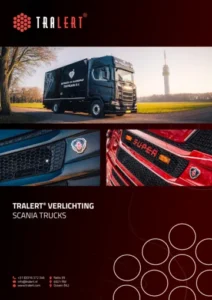
Work lights, rear lights, driving lights, beacor bars and more for Scania.
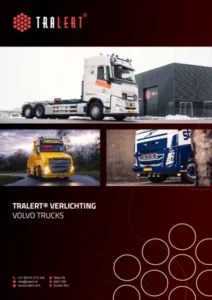
Work lights, rear lights, driving lights, beacon bars and more for Volvo Trucks.
The catalogue opens in a new tab. Can’t see it?
Open the catalogue (PDF)Two questions, in 30 seconds.
TRALERT® works with a dealer network. Dealers can view current stock levels, place orders online on account and receive a product feed for their online shop or system. We assess each enquiry internally and will let you know within 1 to 2 working days whether a partnership is possible.
You can purchase TRALERT® lighting through our partners, either locally or online. Simply provide your details, and we’ll find the partner best suited to help you.
Would you prefer to find a stockist yourself?We will assess your enquiry internally. You will hear from us within 1 to 2 working days to let you know whether a partnership is possible.
We’ll let you know within 1 to 2 working days which partner will be able to assist you further.