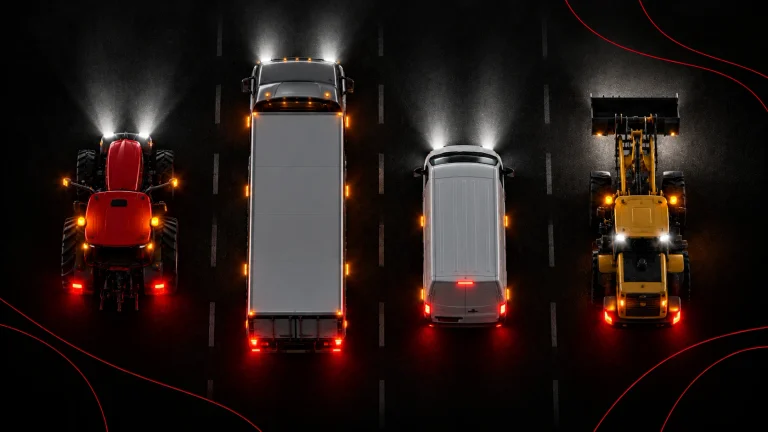
The lighting requirements that apply to your vehicle or machine depend on the vehicle category and the approval process. This is because trucks, agricultural tractors and self-propelled machinery are subject to different regulations.
It is therefore important to first establish the legal classification of the vehicle. Only then can you determine which installation regulations, product approvals and national usage requirements apply.
In this blog you will read:
How to determine which vehicle category applies.
Whether ECE R48, ECE R86 or another regulation applies.
Why product approval, mounting and national regulations on use must be assessed separately.
Which regulations apply to trucks, agricultural vehicles and mobile machinery, amongst others?
The main rule in short
The sector in which a vehicle operates does not automatically determine which lighting regulations apply. The official vehicle category and approval route are the guiding factors. You then determine which light functions, ECE approvals and mounting requirements apply to that specific application.
Which lighting requirements apply to which vehicle?
The table below provides a practical starting point. However, do not use this classification as a substitute for the Certificate of Conformity (CoC), registration certificate or type-approval file.
Vehicle or machine
Common categories
Key installation guidelines
Vehicle or machine: Passenger car or bus
Common categoryM
Key installation framework: ECE R48
Vehicle or machine: Van, commercial vehicle or truck
Common categories
Key installation framework: ECE R48
Vehicle or machine: Standard trailer, semi-trailer or trailer
Common categoryO
Key installation framework: ECE R48
Vehicle or machinery: Agricultural or forestry tractor on wheels
Common categoryT
Key installation framework: EU agricultural vehicle framework and ECE R86
Vehicle or machinery: Agricultural or forestry tractor on caterpillar tracks
Common category Cwithin the EU
Key installation framework: EU agricultural vehicle framework
Vehicle or machineryAgriculturalor forestry trailer
Common categories
Key installation framework: EU agricultural vehicle framework and ECE R86
Vehicle or machine: Interchangeable towed equipment
Common categories
Key installation framework: EU agricultural vehicle framework and ECE R86
Vehicle or machineSelf-propelledmobile machine
Common category: Possibly U
Key installation framework: Regulations for non-road mobile machinery
In practice, a lighting enquiry often starts with the product. Which rear light unit is suitable? Which headlight has the correct E-mark? Yet that step actually comes later.
First, it must be clear which vehicle is being built or modified. This classification determines which installation requirements and approval procedures apply.
Next, you should consider the mandatory light functions, mounting position and visibility. Only then should you select a light with the correct technical approval.
This sequence is particularly important in the case of specialised vehicle bodies. For example, a machine may resemble construction equipment, whilst the underlying vehicle remains, legally speaking, a truck.
Kismet: a concrete pump, aerial work platform or crane body may therefore be subject to a different lighting framework to a self-propelled machine. The function may appear similar, but legally the vehicle may be classified differently.
M, N and O vehicles: ECE R48 governs the installation
For standard road vehicles in categories M, N and O, ECE R48 is the key UNECE installation regulation for lighting and light-signalling systems.
This includes, for example, passenger cars, buses, commercial vehicles, trucks, trailers and semi-trailers. R48 specifies, amongst other things, where light functions must be fitted and how they must be visible.
The electrical circuitry and the interplay between different functions also play a role. A technically approved luminaire is therefore not sufficient on its own.
Do you mainly build trucks or trailers? If so, please also read our practical guide to EU type approvals for vehicle lighting. There, we cover the approval process in greater detail.
Agriculture and forestry vehicles: check the T, C, R and S categories
For agricultural and forestry vehicles, European type approvals use categories T, C, R and S. As a result, these vehicles fall under a different technical framework.
ECE R86 shapes an important UNECE installation framework for vehicles in the fields of agriculture and forestry. Within the EU, you must also comply with the European type-approval framework for these vehicle categories.
Classification remains essential in this regard. For example, an agricultural trailer does not fall into the same category as a standard O-type trailer coupled to a truck.
Even a mounted implement is not automatically classified as Category S. You should therefore always check the official vehicle documentation before specifying mounting requirements or light functions.
Excavators, wheel loaders and other mobile machinery require a separate assessment
A self-propelled excavator, wheel loader or other work machine is not automatically covered by ECE R48 or ECE R86. It is precisely with these machines that you must first determine the technical approval route.
The European Union has now introduced Category U for this purpose. This category is intended for certain non-road mobile machinery that also takes part in traffic on public roads.
Terms and conditions apply, and there are exceptions. Not every self-propelled machine therefore automatically falls within category U. Factors such as the vehicle’s construction, function and approval process remain decisive.
There is also an important deadline to bear in mind. Regulation (EU) 2025/14 is already in force, but will become generally applicable to machinery within its scope from 29 January 2028.
Until 29 January 2036, there is also a transitional period during which Member States may, subject to certain conditions, continue to apply their national approval rules. It is therefore important for manufacturers to check both the European framework and the national requirements.
Would you particularly like to know how to ensure your excavator is properly lit in practice? Then take a look at our guide to excavator lighting. It focuses on work lights, visibility and technical product selection.
A machine mounted on a lorry chassis does not automatically remain a mobile machine
With specialist surface mounting, confusion often arises regarding the intended use. For example, a vehicle may be used as a crane, an aerial work platform, a cleaning machine or a concrete pump.
However, that function does not automatically determine the vehicle category. If the base vehicle and the final approval remain in category N, ECE R48 may still be relevant.
Conversely, a self-propelled machine without a standard lorry chassis may follow a different classification. You should therefore always use the classification stated in the vehicle documentation as your starting point.
This distinction is also important for buyers. The same LED light may appear technically suitable, whilst its function, mounting position or approval may vary depending on the vehicle type.
Lighting regulations operate on three levels
Have you identified the vehicle category? If so, it helps to divide the regulations into three levels. This prevents confusion between product approval, vehicle installation and use.
1. Installation on the vehicle
The installation framework determines which functions must be present and where they should be fitted. Furthermore, requirements may apply regarding height, width, symmetry, visibility and electrical circuitry.
For M, N and O vehicles, ECE R48 is particularly relevant. For vehicles in the agriculture and forestry sectors, the European Agricultural Vehicle Framework and ECE R86 play an important role.
2. Technical approval of the light
The selected light must then be approved for its intended function. Modern product regulations therefore categorise vehicle lighting according to different technical functions.
ECE R148 applies to many light signal functions, for example, indicators, brake lights and position lights.
ECE R149 applies to various shapes of driving lights.
Retro-reflective devices and markings fall under ECE R150.
For electrical and electronic vehicle components, ECE R10 also applies with regard to electromagnetic compatibility.
In addition, there are other product regulations for specific functions, such as optical warning lights. You should therefore always check what the product in question is actually approved for.
3. National regulations for use on public roads
Finally, national traffic regulations may impose additional requirements regarding actual use. This applies, for example, to work lights, warning lights, oversized dimensions and special vehicle configurations.
An E-mark indicates that a product has been approved in accordance with a specific UNECE regulation. However, this does not necessarily mean that the light will be fitted correctly to your vehicle.
For example, an indicator may have the correct type-approval mark but be fitted outside the permitted mounting position. Furthermore, a body panel may restrict the required visibility.
The same applies to a headlight or other light function. Product approval, mounting and wiring must all be correct for the entire installation to be technically sound.
This is how you determine which lighting requirements apply to your vehicle
For a new vehicle project, we recommend following a set sequence. This helps you avoid incorrect assumptions only coming to light during homologation or the final inspection.
Determine the vehicle category. Check the Certificate of Conformity (CoC), registration certificate, type-approval file or the vehicle’s technical specifications.
Determine the approval route. Check whether EU type approval, individual approval or a national route applies.
Identify the mandatory light functions. Determine which lighting and reflective devices the vehicle requires.
Check the product approval. Select each light for the function for which it is officially approved.
Check the mounting and visibility. Pay attention to position, distances, mounting height and geometric visibility.
Assess the electrical circuit. Check how light functions interact with one another and with towed vehicles.
Check the final vehicle configuration. Implements, surface mounting and protruding parts may obstruct the lighting.
Check the country of use. National traffic regulations may impose additional requirements.
For B2B procurement, there is an additional practical step. Keep approval documentation and datasheets to hand right from the product selection stage. This ensures that the vehicle manufacturer does not have to request evidence again at a later stage.
Practical examples: which route will you choose?
You are building a semi-trailer for a truck
A standard semi-trailer generally falls within category O. Consequently, ECE R48 forms the main regulatory framework for vehicle lighting. You should then check the relevant product approval for each light function.
You are building an agricultural trailer to be towed by a tractor
Under the European framework, an agricultural or forestry semi-trailer falls under category R. You should therefore refer to the agriculture vehicle framework and the relevant R86 installation regulations. The rules for an O-semi-trailer are therefore not automatically applicable.
You are selecting lighting for a self-propelled excavator
Do not automatically assume it is R48 or R86. First check the vehicle classification and the approval route. For certain mobile machinery, category U will become a key consideration from 2028 onwards.
You are performing surface mounting of a crane on a lorry chassis
The crane function does not automatically classify the base vehicle as category U. If the final vehicle approval remains within category N, R48 may still be relevant for the installation of road lighting.
EU regulations are not always the end of the story
European type approvals harmonise many technical vehicle requirements. However, countries retain their own rules for certain shapes of road use and vehicle operation.
That is why, when operating across borders, it is advisable to carry out a national check. Pay particular attention to additional requirements regarding vehicle width, marking devices, work lights and warning lights.
The United Kingdom is a special case in this regard, as it is not an EU Member State. You should therefore check UK regulations as a separate legal framework.
Frequently asked questions about lighting requirements for vehicles and machinery
Which ECE regulation applies to my vehicle?
This depends mainly on the vehicle category and the light function. For standard M, N and O vehicles, ECE R48 plays a central role in the installation. Vehicles in the agriculture and forestry sectors follow a different regulatory framework. Mobile machinery may also fall under category U and a separate approval process.
Does every work machine fall under ECE R48?
No. Use as a work machine does not automatically determine the installation framework. A machine mounted on a lorry chassis may remain in category N, whilst a self-propelled excavator has a different vehicle classification. You should therefore always check the official vehicle documentation before applying R48 or any other regulation.
What is the difference between ECE R48 and ECE R86?
ECE R48 covers the installation of lighting on standard road vehicles, including M, N and O vehicles. ECE R86 focuses on vehicles in the agriculture and forestry sectors. Within the EU, the European type-approval framework for T, C, R and S also applies to this latter group.
Is an E-mark sufficient for vehicle lighting?
No. An E-mark certifies that a product has been technically approved for a specific function. However, the mounting, visibility and electrical circuitry must still be suitable for the vehicle. In addition, national regulations may impose further conditions.
What regulations apply to an excavator on public roads?
That depends on the technical classification and approval route of the machine. From 29 January 2028, certain mobile machines will fall under the new European framework for Category U. However, during the transition period, national approval regulations may still play an important role.
Do I need to fit different lighting for each EU country?
Not necessarily. Many technical vehicle requirements are harmonised across Europe. However, national traffic regulations may impose additional conditions regarding, for example, marking, exceptional width, work lights or warning lights. You should therefore always check the current official regulations before operating in another country.
Are you unsure which lighting regulations apply to your vehicle?
A good lighting solution starts with the correct vehicle classification. After that, product approval, mounting and electrical connection must all come together to form a reliable system.
TRALERT® supports vehicle builders, OEMs and B2B buyers in making this transition. This enables you to select lighting that is technically approved and also fits the vehicle project in practical terms.
TRALERT® is the leading manufacturer and partner in high-quality LED lighting solutions for commercial vehicles. By taking care of everything from drawing board to realisation, you and your customers can hit the road safely, carefree and professionally lit.
The TRALERT® Experience Centre is an interactive showroom with training and truck rooms. Experience TRALERT® LED vehicle lighting in practice and experience the lighting performance in different situations. Plan your Experience Centre visit.
Over 3,000 productsLighting and cabling for trucks, trailers, trailers and work vehicles
Fast delivery from our own stockOften delivered the next day; within 2 to 3 days across Europe
Advice from specialistsWe work with you to find the right lighting for your vehicle
Knowledge baseRegulations, connections and interference clearly explained
Two questions, in 30 seconds.
Question 1 of 2
Who is this lighting intended for?
Question 2 of 2
What suits your business best?
Dealer enquiry
Request access to our dealer portal
TRALERT® works with a dealer network. Dealers can view current stock levels, place orders online on account and receive a product feed for their online shop or system. We assess each enquiry internally and will let you know within 1 to 2 working days whether a partnership is possible.
Good to know
We’ll put you in touch with a partner
You can purchase TRALERT® lighting through our partners, either locally or online. Simply provide your details, and we’ll find the partner best suited to help you.