Vehicle categories O & N explained: from vans to heavy semi-trailers
Updated:
By:
Kevin van Mierlo
Contents
Anyone who builds a trailer , converts a chassis or purchases vehicles will come across the letter code for the vehicle in question. On the registration certificate, in a type approval document or in a specification. What exactly is O3, and how does it differ from O4? And why can both a delivery van and a tractor fall under category N? In this article, you can find out exactly how it works.
In this blog you will read:
What a vehicle category is and why it means the same thing across Europe
What the N categories N1, N2 and N3 mean
The difference between the O categories O1, O2, O3 and O4
What distinguishes a semi-trailer from an ordinary trailer
Under which category agriculture and forestry vehicles fall
Which lighting belongs to which vehicle category
What is a vehicle category?
A vehicle category is the official classification with which a vehicle is admitted to public roads. The classification says something about the construction and use of the vehicle: does it transport passengers, goods, or is it towed? Based on this, specific technical requirements apply, including those for lighting.
Important for those operating internationally: these categories are defined at European level, not nationally. The basis is Regulation (EU) 2018/858, which has been directly applicable in all Member States since 1 September 2020. The regulation therefore applies in the same way everywhere, whilst the national authorities are responsible for authorisation and enforcement. An O4 semi-trailer in the Netherlands thus falls under exactly the same classification as in Germany, France or Italy, with the same weight limits.
However, which authority handles this approval differs from country to country. Each Member State has its own national approval authority, such as the RDW in the Netherlands, the KBA in Germany or the Motorizzazione Civile in Italy. The category remains the same everywhere, only the counter differs. Therefore, you can rely on the letter code regardless of the country in which the vehicle operates.
The main classification has three letters. M stands for vehicles that transport people, think cars and buses. We leave those out of consideration here. N and O are relevant to the transport sector, and we deal with them below from light to heavy.
The N categories: commercial vehicles and trucks
Category N includes all motorised vehicles designed for goods transport. The subdivision runs entirely by weight, or technically permissible maximum mass. The category is the starting point for lighting, but does not determine it on its own: the actual requirements follow from the applicable UNECE regulations and also depend on vehicle length, width and surface mounting.
N1: up to 3.5 tonnes
The N1 category covers light commercial vehicles up to 3.5 tonnes, such as vans and light pick-ups. The basic lighting requirements applicable to passenger cars also apply to this class. These include headlights, indicators, brake lights and rear lights. Marker lights are not yet relevant here, as the sizes and weight remain below the relevant thresholds.
N2: 3.5 to 12 tonnes
N2 covers medium-duty trucks, with a maximum mass above 3.5 tonnes up to 12 tonnes. Side marking often plays a role in these vehicles, although this obligation is not hanging on the category itself but on the length and the applicable UNECE regulation. With longer lengths, side visibility becomes more important, especially in the dark and when crossing traffic.
N3: more than 12 tonnes
N3 concerns heavy tractors and trucks over 12 tonnes, the workhorse of road transport. This is where the most extensive lighting requirements apply in practice. Exactly which marking is mandatory, and from which dimensions, follows from the applicable UNECE regulations and not from the category alone. You can find the luminaires, positions and mounting heights to suit them in our overview of lighting for trucks.
The O categories: trailers and semi-trailers
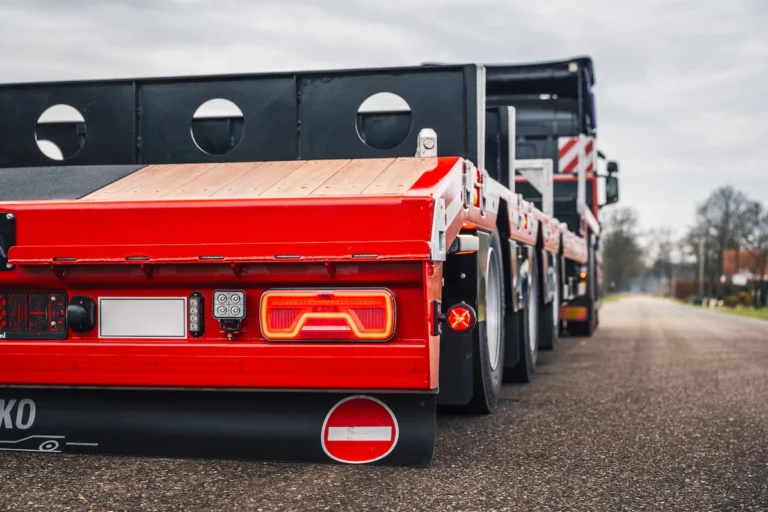
Category O covers everything that is towed: trailers and semi-trailers. As with the N categories, the maximum mass determines the sub-categories. It is precisely in this category that many vehicle builders have questions about the difference between O2, O3 and O4. Bear in mind that the category defines the class, whilst the actual lighting requirements also depend on length, width, surface mounting and the applicable UNECE regulation.
O1: up to 0.75 tonnes
O1 covers the lightest trailers up to 750 kilograms, such as a small luggage trailer. The lighting requirements here are limited to the basics: rear lights, brake lights, indicators and a licence plate light. Due to their low weight and small dimensions, there are no additional marking requirements.
O2: 0.75 to 3.5 tonnes
The O2 category covers trailers weighing between 750 kilograms and 3.5 tonnes. This class encompasses a large proportion of commercial trailers, ranging from braked box lorries to lighter transporters. The basic lighting requirements correspond to those of O1. Depending on the width and length, side marker lights and side reflectors may be required, again as determined by the applicable regulations rather than by the category itself.
O3: 3.5 to 10 tonnes
O3 refers to heavier trailers and semi-trailers weighing between 3.5 and 10 tonnes. From this class onwards, the requirements become stricter in practice, although the exact obligations depend on length, surface mounting and the applicable UNECE regulations. For semi-trailers, side marker lights are required for lengths exceeding six metres, including the coupling. Furthermore, for new O3 and O4 semi-trailers, it has been a requirement since 1 January 2025 that the side markings must flash in synchronisation with the indicators. This improves visibility when turning, a recurring point of concern with long vehicle combinations.
O4: more than 10 tonnes
O4 is the heaviest class, for semi-trailers and trailers weighing over 10 tonnes. The most comprehensive regulations generally apply here, including side markings and, where the vehicle is long enough, markings that make the vehicle’s outline visible. Exactly which combination is required depends on the dimensions and the applicable regulations. If you work on vehicles in this class, you will find practical details on positioning and selection in our article on lighting for heavy goods vehicles.
What is the difference between a trailer and a semi-trailer?
Both fall under category O, but they are coupled to the towing vehicle in different ways. A trailer rests entirely on its own axles and is coupled to the vehicle via a drawbar or ball coupling. The weight therefore rests entirely on the trailer’s own wheels.
A semi-trailer operates differently. Part of the weight rests on the tractor unit itself, via a fifth-wheel coupling above the driven axle. As a result, the tractor unit bears a considerable vertical load. This design is typical of heavy goods transport, where the tractor-semi-trailer combination is the standard shape.
In terms of lighting, this distinction makes little difference in itself, as both categories follow the O classification based on weight. However, the greater length of a semi-trailer often means that side markings and contour markings are required sooner. You should therefore select the correct lighting for trailers based on both the category and the sizes.
Agriculture and forestry vehicles: categories T, C, R and S
Agricultural vehicles fall outside the M, N and O classifications. They have their own European framework, laid down in Regulation (EU) 167/2013. This is also harmonised EU-wide, so the codes apply equally across borders. The classification is logically surface mounting by function.
T stands for wheeled tractors, C for tracked tractors. R indicates agricultural semi-trailers, while S includes interchangeable towed implements, such as a mounted sprayer. These vehicles have their own lighting requirements, tailored to their lower driving speed and use on both road and land. Visibility remains the guiding principle here, especially when wide implement vehicles are participating in traffic.
Which lighting belongs to which vehicle category?
The category is the starting point for your lighting choice, but dimensions and the applicable regulations are the final deciding factor. Indeed, the category defines the approval class, while the installation of light-signalling, lighting and retro-reflective devices for all M, N and O categories goes back to the UNECE regulations, with R48 as the framework for installation. The table below therefore gives an indication of what is usually involved for each class, not a conclusive list of obligations.
Lighting overview (indicative): Basic, side marking applies to longer vehicles
Vehiclecategory N3
Vehicle type: Heavytruck >12 t
Lighting overview (indicative)Comprehensive set; markings depending on size
Vehiclecategory O1
Vehicle type: Trailerup to 0.75 t
Lighting overview (indicative)Basic rear lighting
Vehiclecategory O2
Vehicle type: Trailer0.75–3.5 t
Lighting overview (indicative)Basic, side marker lights to size
Vehiclecategory O3
Vehicle type: Trailer/semi-trailer 3.5–10 t
Lighting requirements at a glance (indicative):Side marker lights for vehicles over 6 m in length; new semi-trailers must have flashing side marker lights
Vehiclecategory O4
Vehicle type: Semi-trailer >10 t
Lighting overview (indicative)Extensive marking, depending on length and surface mounting
The table shows that the vehicle’s weight determines the direction, whilst length, width and surface mounting specify the actual requirements. If you want to be sure what is required in a specific situation, please refer to our article on the rules for lighting on a trailer, in which we set out the requirements by width and length.
Frequently asked questions
What is an O4 category vehicle?
An O4 is a trailer or semi-trailer with a maximum mass of more than 10 tonnes. It is the heaviest of the four O categories. Vehicles in this class typically feature the most comprehensive lighting, including side marker lights and, where the vehicle is long enough, lights that indicate the vehicle’s outline.
What is the difference between vehicle category O2 and O3?
The difference is entirely in the weight. An O2 weighs between 0.75 and 3.5 tonnes, an O3 between 3.5 and 10 tonnes. For O3 vehicles, heavier lighting requirements often apply in practice, but the exact requirement also depends on length, surface mounting and the applicable UNECE regulations.
What are the vehicle categories M, N and O?
M covers vehicles for passenger transport, such as cars and buses. N stands for vehicles that transport goods, from vans to heavy trucks. O covers all towed vehicles, i.e. trailers and semi-trailers. The N and O categories are particularly important for the transport sector.
What is the difference between a trailer and a semi-trailer?
A trailer rests entirely on its own axles and is coupled via a drawbar eye or ball coupling. With a semi-trailer, part of the weight rests on the tractor via a fifth-wheel coupling. Both fall under category O, but the semi-trailer is typically used for heavy goods transport with tractor-semi-trailer combinations.
Are you unsure about the right lighting for your class of vehicle?
The category provides the direction, but the right lamp choice makes the difference between a smooth inspection and costly follow-up work. We are happy to think with you, from initial surface mounting to final mounting. Check our offer for your vehicle type or contact our specialists, and together we will choose the lighting that fits your class and dimensions.
Disclaimer:
At TRALERT®, we do our best to keep the information in this article as accurate and up-to-date as possible, including the regulations surrounding vehicle lighting. However, legislation can change regularly, and although we make every effort to implement these changes in a timely manner, it is possible that certain updates or adjustments have not yet been incorporated into this article. We therefore always advise our readers to check the current legislation with their local government or regulatory bodies, especially when it comes to exceptions or specific national regulations. TRALERT® is not liable for any damages or fines resulting from outdated or incomplete information in this article.
If in doubt, always contact the competent authority to ensure that your vehicle meets all legal requirements.
Share this article:
ABOUT TRALERT®
TRALERT® is the leading manufacturer and partner in high-quality LED lighting solutions for commercial vehicles. By taking care of everything from drawing board to realisation, you and your customers can hit the road safely, carefree and professionally lit.
The TRALERT® Experience Centre is an interactive showroom with training and truck rooms. Experience TRALERT® LED vehicle lighting in practice and experience the lighting performance in different situations. Plan your Experience Centre visit.
Over 3,000 productsLighting and cabling for trucks, trailers, trailers and work vehicles
Fast delivery from our own stockOften delivered the next day; within 2 to 3 days across Europe
Advice from specialistsWe work with you to find the right lighting for your vehicle
Knowledge baseRegulations, connections and interference clearly explained
Two questions, in 30 seconds.
Question 1 of 2
Who is this lighting intended for?
Question 2 of 2
What suits your business best?
Dealer enquiry
Request access to our dealer portal
TRALERT® works with a dealer network. Dealers can view current stock levels, place orders online on account and receive a product feed for their online shop or system. We assess each enquiry internally and will let you know within 1 to 2 working days whether a partnership is possible.
Good to know
We’ll put you in touch with a partner
You can purchase TRALERT® lighting through our partners, either locally or online. Simply provide your details, and we’ll find the partner best suited to help you.