What lighting requirements apply to mobile work vehicles (category U)?
Updated:
By:
Kevin van Mierlo
Contents
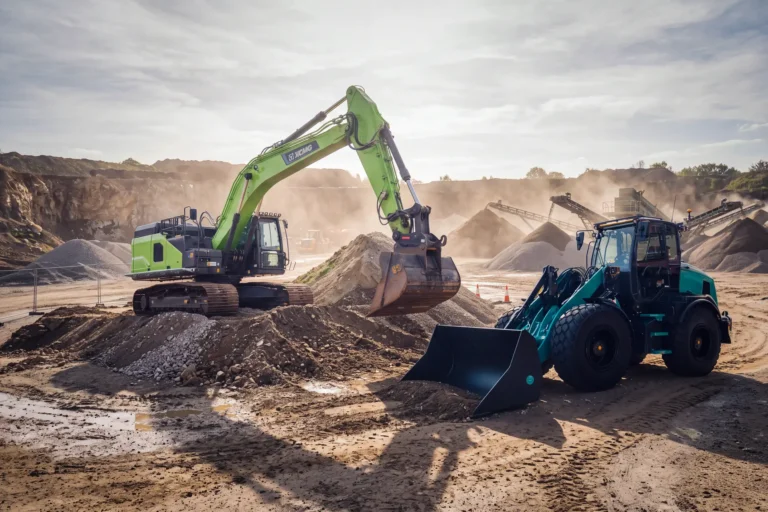
In this article, we will discuss lighting requirements for mobile work vehicles such as excavators, wheel loaders or combine harvesters. These vehicles fall under category U.
This development is important for machine manufacturers, OEMs and B2B buyers. Europe is harmonising technical road safety requirements, which currently still vary considerably from one Member State to another. Lighting, mounting, visual warnings and markings will also form an integral part of these requirements.
In this article, you will read:
Which mobile work vehicles may fall within category U.
Which national regulations still apply today in various European countries.
What will change for manufacturers and machinery builders from 29 January 2028.
Which technical and lighting requirements Europe has harmonised for Category U.
Category U in a short overview
Category U is the new European framework for certain self-propelled mobile machinery that carries out work and also uses public roads. At present, various national approval systems still apply to this category. From 2028, a harmonised European framework will be introduced for new machinery falling within its scope.
What is vehicle category U?
Category U is the European vehicle category for certain self-propelled mobile machinery specifically designed to carry out work and which occasionally or regularly participate in traffic on public roads. The machinery is not primarily intended for the transport of people, animals or standard goods. The machine has a design speed of more than 6 km/h and up to 40 km/h. The official European term is ‘non-road mobile machinery’. Internationally, the abbreviation NRMM is often used for this: Non-Road Mobile Machinery.
That may sound contradictory. After all, the machine is specifically designed to be driven on public roads from time to time. The distinction therefore lies in its primary function. These machines are designed to carry out work, not for regular passenger or goods transport.
However, such vehicles often have to travel from a depot to a construction site. Furthermore, they may reach various work sites via public roads. It is precisely for this use on public roads that Regulation (EU) 2025/14 introduces the European Category U.
Which mobile work vehicles is Category U intended for?
Category U does not automatically apply to every machine on a construction site. The European regulation sets out clear requirements for the vehicle.
The machine must be self-propelled, carry out work and be intended for occasional or regular use on public roads.
Furthermore, the design-determined maximum speed is above 6 km/h and up to a maximum of 40 km/h.
In practice, we can divide the main applications into four groups.
Construction and construction machinery
In the construction and construction machinery sectors, Category U is likely to be a frequent consideration. After all, many machines need to be able to drive independently between work sites.
mobile excavators;
wheel loaders, front-end loaders and shovels;
telehandlers;
certain bulldozers and dumpers;
asphalt pavers and rollers;
certain self-propelled mobile cranes.
Of course, the machine must comply with the full scope of application. Not every tracked machine or mobile crane therefore automatically falls into category U.
Agriculture, landscaping and forestry
Self-propelled machinery that is not classified as a standard tractor is also used in agriculture and forestry.
combine harvesters and forage harvesters;
beet and potato harvesters;
self-propelled field sprayers;
certain self-propelled mowers;
self-propelled forestry machinery.
However, a standard agricultural or forestry tractor remains within the vehicle framework intended for it. In this context, ECE R86 may be relevant for agricultural and forestry vehicles.
Industry and internal transport
Industrial machinery may also fall under category U if it actually uses public roads.
certain heavy-duty or off-road forklift trucks;
self-propelled aerial work platforms;
other self-propelled industrial work machines.
Here, the primary function is once again the determining factor. A vehicle that primarily transports goods does not fall within the intended category.
Infrastructure and public spaces
Finally, the market encompasses various machines for road management, maintenance and public spaces.
street sweepers;
certain professional mowers;
self-propelled shredders;
other self-propelled maintenance machines.
These examples do not constitute an automatic vehicle classification. The technical specification, speed, function and existing approval ultimately determine whether category U applies.
When does a machine not fall under Category U?
The European regulation contains various exclusions. This prevents Europe from overlapping with existing vehicle categories and other approval frameworks.
Machines with a maximum speed of 6 km/h fall outside the scope of the European U-framework.
Machines with a design speed exceeding 40 km/h are also excluded.
Vehicles with more than three seats, including the driver’s seat, fall outside the scope of application.
Vehicles intended primarily for the transport of people, animals or goods are not classified as category U.
Vehicles that fall exclusively under existing EU vehicle regulations remain within that existing framework.
Machinery placed on the market, registered or put into service in the EU before 29 January 2028 is not subject to this regulation retrospectively.
A crane body mounted on a truck does not therefore automatically fall into category U. If the vehicle remains in category N, ECE R48 may continue to apply to the installation of vehicle lighting.
Towed machinery is also excluded from Regulation (EU) 2025/14. This is because the new U framework applies only to self-propelled mobile machinery.
Incidentally, a towed machine is not automatically classified as category S. That category applies specifically to vehicles used in agriculture and forestry.
Why is Europe introducing Category U?
The reason for Category U is primarily practical. Europe did not yet have a fully harmonised system for the road safety of these vehicles.
As a result, different technical approval regulations apply in the Member States today. A manufacturer may therefore have to have the same type of machine assessed several times.
In Germany, for example, there is the ‘selbstfahrende Arbeitsmaschine’. In France, regulations apply to ‘matériels de travaux publics’, amongst other things.
Italy uses the term ‘macchine operatrici’. The Netherlands, meanwhile, already has a national vehicle category U for mobile machinery.
However, the technical meaning and approval procedures are not the same everywhere. This results in additional costs and administrative work for manufacturers.
The new European framework is specifically designed to reduce these differences. A single European type-approval can then be recognised across the EU for harmonised components.
In doing so, Europe is effectively creating a single common ‘vehicle language’ for machinery that, for many years, fell into a grey area between work machinery and road vehicles.
Where do we stand with category U at present?
The European framework regulation has now been adopted and is in force. However, in 2026 we will still be in the technical implementation phase.
Regulation (EU) 2025/14 sets out the framework. The detailed technical requirements are then specified through delegated and implementing acts.
The European Commission must adopt the key delegated technical regulations by 29 January 2027 at the latest.
Moment
What does this mean in practice?
MomentNow
What does this mean in practice?The basis for Category U is established. National approval systems remain of great practical importance.
MomentNo later than 29 January 2027
What does this mean in practice?The Commission must adopt the key delegated technical rules.
MomentFrom 29 January 2028
What does this mean in practice?Regulation (EU) 2025/14 will apply generally to new machinery within its scope.
Moment2028 to 29 January 2036
What does this mean in practice?EU approval and national type-approval routes can co-exist, subject to certain conditions.
Legally, the possibility of European type-approval is already in place. However, practical application also requires the necessary technical delegated and implementing regulations.
From 29 January 2028, the system will then become generally applicable.
What are the current regulations for mobile machinery in Europe?
Until European harmonisation becomes fully applicable, you should focus primarily on the country of approval at present.
That does not mean that every national requirement is completely different. Nevertheless, classification, homologation and technical authorisation still vary significantly from country to country.
Germany: self-propelled work machine
In Germany, there is the category of ‘selbstfahrende Arbeitsmaschine’(self-propelled work machine). The FZV defines this as a motor vehicle that carries out work and is not intended for the transport of passengers or goods.
Many of these vehicles are formally exempt from standard type-approval. However, they may not simply be used on public roads without vehicle approval.
To this end, the vehicle must conform to an approved type or have individual approval. Furthermore, additional number plate regulations apply at speeds above 20 km/h.
The German StVZO remains the key regulation for lighting at present. It contains specific provisions covering, amongst other things, work machines, headlights, rear lights and mounting heights.
Belgium: homologation is organised on a regional basis
In Belgium, the administrative structure is an additional point of consideration. Homologation, technical inspections and mass measurements have been regional responsibilities since 2014.
Consequently, Flanders, Wallonia or Brussels will handle the specific application. The region you choose therefore determines where you start the type-approval procedure.
The Netherlands already uses Category U for mobile machinery. This national system overlaps significantly with the future European vehicle group.
However, the two frameworks are not legally equivalent. The European U-category has its own definition, scope of application and approval procedure.
In the Netherlands, motor vehicles travelling at speeds of 6 km/h or more are currently subject to a registration requirement when used on public roads.
This differs slightly from the European framework. Regulation 2025/14 excludes machines capable of travelling at speeds of up to 6 km/h.
For projects in the Netherlands, you can find the current guidelines from the RDW for mobile machinery.
United Kingdom: separate legal framework
The United Kingdom is not an EU Member State. Category U therefore does not directly fall within the European type-approval framework there.
In the UK, the term ‘engineering plant’ is used, amongst others, to refer to certain construction and work machinery.
In this context, the Construction and Use Regulations and the Road Vehicles Lighting Regulations remain key national sources of guidance.
From 29 January 2028, Regulation (EU) 2025/14 will come into general effect. This will establish a harmonised European type-approval process for category U.
A manufacturer can therefore apply for EU type approval for a machine type. There is also a route for individual EU type approval.
The major benefit lies in the recognition this brings. Member States may not reject a compliant machine on the basis of the same harmonised technical aspects a second time.
This reduces the need to have the same machine re-approved technically in multiple countries.
However, a significant transition period remains. Until 29 January 2036, Member States may continue to apply national type-approval rules, subject to certain conditions.
During this transition, a manufacturer may opt for EU type approval, individual EU approval or the available national route.
What is being harmonised at European level?
The new framework goes far beyond just a number plate or registration. Europe is, in fact, harmonising the technical road safety of the vehicle.
Regulation (EU) 2025/14 specifies, amongst other things, the following components:
Technical topic
Practical meaning
Technical topicStructural safety
Practical meaning: The vehicle must be constructed safely for use on public roads.
Technical topicMaximum speed
Practical implications: Speed limitsand speed information will form part of the assessment.
Technical topicBrakes
Practical meaning: The machine must be able to decelerate and stop sufficiently and in a controlled manner.
Technical topicControl systems
Practical meaning: The driver must be able to control the vehicle safely on the road.
Technical topicVisibility and indirect visibility
Practical implications: Technical requirements are being introduced for fields of vision, windows and indirect vision systems.
Technical topicLighting and signalling
Practical implications: Lighting, mounting, visual warnings and markings are harmonised.
Technical topicWork equipment in parking position
Practical implications:Booms, buckets and swivelling structures alsoneed to be taken into account when using the vehicle on the road.
Technical topicWarning signals
Practical implications: Acousticwarning devices form part of the regulatory framework.
Technical topicDimensions and mass
Practical implications: Width, length, mass, axle loads and ground pressure are all taken into account.
Technical topicTyres or tracks
Practical implications: The connection between the machine and the road surface is alsoassessed.
Technical topicReversing
Practical meaning: The safe execution of reversing manoeuvres falls within this framework.
Technical topicDriver’s cab
Practical implications: Seating, controls and safety features are taken into account.
The exact technical specifications and truck methods are further defined by supplementary European regulations.
What remains relevant at national level following harmonisation?
European type-approval does not mean that every mobile machine is then permitted to travel on any European road without conditions.
National traffic regulations remain particularly relevant for large work machines. This applies especially to vehicles with exceptional sizes and masses.
Furthermore, the EU regulation explicitly allows Member States to impose restrictions on certain approved machines if they exceed excessive sizes or mass limits.
The same may apply in the case of high axle loads, ground pressure or certain fully automated driving functions.
In addition, national regulations may still apply regarding routes, exemptions and practical road use.
Important for international deployment
EU type approval means that the harmonised technical approval is recognised. It does not automatically mean that every machine is permitted to operate anywhere in Europe without additional conditions.
When do ECE R48, ECE R86 or Category U apply?
When it comes to mobile machinery, confusion can easily arise between ECE R48, ECE R86 and the new Category U framework.
It is not the work performed by the machine that determines the lighting requirements; rather, the legal vehicle category and approval process are the guiding factors.
Vehicle or machine
Legal proceedings
Framework for the installation of lighting
Vehicle or machineTruck or commercial vehicle
Legal classification: Category M, N or O
Framework for the installation of lighting: ECE R48
Vehicle or machineWork machine on a lorry chassis
Legal framework: For example, category N
Framework for the installation of lighting: ECE R48 where the vehicle remains in category N
Vehicle or machineAgricultural tractor or agricultural vehicle
Legal framework: T, R or S category
Framework for the installation of lighting: ECE R86
Vehicle or machineSelf-propelled machinery for agriculture or forestry
Legal framework: May fall within the NRMM/U framework
Framework for the installation of lighting: UNECE is working on extending ECE R86 to cover agricultural and forestry non-road mobile machinery (NRMM)
Vehicle or machineExcavator, wheel loader, road roller or similar work machine
Legal framework: Category U where Regulation (EU) 2025/14 applies
Framework for the installation of lighting: Not automatically ECE R48 or R86; the European U-framework and the associated technical requirements are the guiding principles
A mobile crane illustrates this difference well. A crane body mounted on a truck may legally remain in category N. In that case, ECE R48 remains relevant for the installation of the vehicle lighting.
A mobile machine designed in-house, on the other hand, may fall within category U. In that case, you must not automatically use ECE R48 as the regulatory framework for its installation.
ECE R86 is being extended to cover self-driving agricultural machinery
Furthermore, a significant UNECE development is currently underway for machinery used in agriculture and forestry. Work is progressing on a new series of amendments to ECE R86, which will explicitly include agricultural and forestry non-road mobile machinery within its scope.
This is particularly relevant, for example, to self-propelled harvesting and agricultural machinery that is not classified as a standard tractor.
However, this expansion is still under development in 2026. For this reason, TRALERT® does not yet present the R86 as the definitive installation framework for every agricultural machine that will soon fall within category U.
Please note: a mobile machine is not covered by ECE R48 simply because it is used in the construction industry. Similarly, a machine is not automatically covered by ECE R86 simply because it is used in agriculture. Always start with the official vehicle classification.
What do the lighting requirements for Category U entail?
For TRALERT®, one aspect of the new regulations is particularly relevant. The European regulations explicitly mention lighting, the installation of lighting, visual warnings and markings.
It is not just the luminaire itself that matters; its position and functionality within the entire machine are also key factors.
Furthermore, the regulations refer to the exterior of the machine when it is in road mode. This also includes work equipment and swivelling structures.
This has direct implications for, say, an excavator. After all, a boom or excavator arm can obstruct an indicator or headlight.
For future approval, the traffic function must therefore continue to operate correctly in the relevant road configuration.
For machine manufacturers, this is a key design principle: do not assess lighting solely on the bare chassis, but on the complete machine in its operational position.
Which lighting is likely to be important?
The basic regulation does not yet provide a universal R48-style mounting table for Category U. We should therefore not make assumptions about exact distances and heights.
However, we already know which functions Europe intends to regulate from a technical perspective. These include traffic lighting, signalling, warnings and markings.
For engineering, this means you can already take the following into account:
visible front and rear lights;
indicator and brake lights;
visibility of the machine’s outline;
visual warning devices;
reflective devices and markings;
the impact of work equipment on all traffic functions.
Once the detailed European technical regulations have been finalised, these requirements can be translated more precisely into fitting positions and product selection.
Work lights are different from road lighting
In mobile work vehicles, work lights often account for a large proportion of the overall lighting package. This makes sense during construction machinery operations, loading or working in the dark.
However, work lights and road lights serve different purposes. A powerful work light is therefore not automatically suitable for use as an official headlight.
Work lights support the work process. Road lighting and light signalling, on the other hand, ensure safe participation in traffic and high visibility.
Are you particularly keen to improve the working areas around an excavator? Then read our practical guide to optimal lighting for excavators.
An E-mark alone is not sufficient
Even within the new U framework, product approval remains just one part of a complete vehicle build.
An E-mark on vehicle lighting indicates the technical specifications for which a product has been approved. The application on the machine must then be correct.
For example, an indicator may be technically sound, but it can be obscured by an excavator arm. As a result, its traffic function still fails to work adequately when the vehicle is stationary.
You should therefore always check product approval, mounting position, visibility and electrical control as a single, integrated whole.
EMC also warrants attention in the context of mobile work vehicles
Modern machines contain an ever-increasing amount of electronics. Cameras, GPS, radar, CAN-bus and electronically controlled hydraulics are now very common.
For this reason, additional lighting must not cause any unwanted electromagnetic interference. Conversely, electronic components must also be sufficiently resistant to external electromagnetic influences.
When dealing with electronic vehicle components, you should therefore also check whether ECE R10 for electromagnetic compatibility is relevant to the chosen application.
How do you prepare a new machine platform for Category U?
Machine manufacturers do not need to wait until 2028 to take the new European framework into account.
Particularly with new platforms, it pays to factor in the future approval process early on in the engineering and procurement stages.
First, determine the vehicle classification. Check whether the machine actually falls within category U.
Identify the target markets. Check which national regulations currently apply in the countries where you sell the machinery.
Determine the road position. Include booms, bodies, attachments and swivelling structures in the assessment.
Distinguish between road lights and work lights. Each light function must be clearly designed for the correct application.
Check visibility at an early stage. Ensure that work equipment does not obscure essential traffic lights.
Keep technical product documentation to hand. Record approval numbers, certificates and datasheets immediately at the time of purchase.
Keep up to date with the European technical developments. This will enable you to adapt your platform in good time ahead of general implementation in 2028.
Check national usage requirements. EU approval does not override every local traffic regulation.
This preparatory work can save a great deal of money. After all, adjusting a light position during the engineering phase is simpler than modifying an entire machine series retrospectively.
For type-approval projects, we always recommend checking the latest European publications. The technical developments leading up to 2028 remain important for product selection and vehicle design.
TRALERT® is keeping abreast of these developments. We will therefore update this article whenever new European lighting requirements have implications for machine manufacturers and purchasers.
Frequently asked questions about Category U
What is Category U?
Category U is the European vehicle framework for certain self-propelled mobile machinery that carries out work and also uses public roads. This applies to new machinery falling within the scope of Regulation (EU) 2025/14. This regulation will come into force on 29 January 2028.
What is the speed limit for category U?
The European U-framework does not apply to machines capable of travelling at speeds of up to 6 km/h. Machines capable of speeds exceeding 40 km/h are also excluded. The relevant speed range is therefore between 6 km/h and a maximum of 40 km/h, provided the machine also meets the other conditions.
Does every excavator fall under category U?
No. Among other things, the machine must be self-propelled, carry out work and be intended for road use. In addition, there are requirements regarding speed, seating and primary function. An existing European vehicle classification may also mean that the U-framework does not apply.
Does Category U already apply in Germany and France?
The European base regulation is already in force, but will only be generally applied from 29 January 2028. Germany and France are therefore still using their existing national approval frameworks at present. During the transition period after 2028, national type-approval routes may continue to exist, subject to certain conditions.
Will Category U be subject to an ECE regulation such as ECE R48?
Not at present. Category U is based on Regulation (EU) 2025/14. The specific technical requirements are set out in supplementary European regulations. Existing ECE approvals may be relevant for components, but this does not automatically mean that R48 or R86 becomes the installation framework.
What lighting requirements will soon apply to Category U?
Europe has already stipulated that lighting, installation, visual warnings and markings will form part of the type-approval process. The detailed technical requirements are currently being finalised. Consequently, there is as yet no universal fitting chart for all Category U machines.
Can an EU-approved machine be driven anywhere in Europe?
It’s not that simple. EU type-approval harmonises the technical approval aspects. However, Member States may retain restrictions regarding, for example, exceptional sizes, mass, axle loads or certain traffic situations. You should therefore continue to check the relevant country’s regulations even after 2028.
Preparing lighting for mobile work vehicles for the European market
Category U ultimately brings the European type-approval of mobile machinery closer to a single, unified system. For manufacturers, this presents opportunities, but also new technical considerations.
TRALERT® assists OEMs, machinery manufacturers and B2B buyers in selecting reliable LED lighting and signalling systems for heavy-duty applications. In doing so, we consider type-approval, vehicle construction, electrical integration and day-to-day use.
Are you working on a new machine platform or preparing your product range for Category U? Our specialists would be happy to help you find the right solution.
TRALERT® is the leading manufacturer and partner in high-quality LED lighting solutions for commercial vehicles. By taking care of everything from drawing board to realisation, you and your customers can hit the road safely, carefree and professionally lit.
The TRALERT® Experience Centre is an interactive showroom with training and truck rooms. Experience TRALERT® LED vehicle lighting in practice and experience the lighting performance in different situations. Plan your Experience Centre visit.
Over 3,000 productsLighting and cabling for trucks, trailers, trailers and work vehicles
Fast delivery from our own stockOften delivered the next day; within 2 to 3 days across Europe
Advice from specialistsWe work with you to find the right lighting for your vehicle
Knowledge baseRegulations, connections and interference clearly explained
Two questions, in 30 seconds.
Question 1 of 2
Who is this lighting intended for?
Question 2 of 2
What suits your business best?
Dealer enquiry
Request access to our dealer portal
TRALERT® works with a dealer network. Dealers can view current stock levels, place orders online on account and receive a product feed for their online shop or system. We assess each enquiry internally and will let you know within 1 to 2 working days whether a partnership is possible.
Good to know
We’ll put you in touch with a partner
You can purchase TRALERT® lighting through our partners, either locally or online. Simply provide your details, and we’ll find the partner best suited to help you.