The short answer
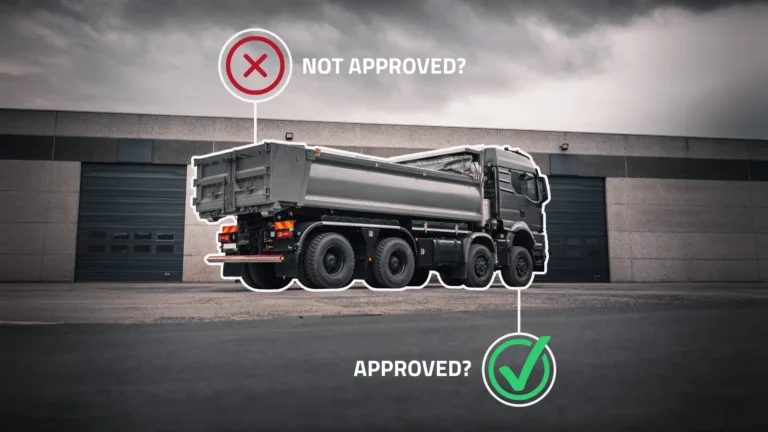
Anyone purchasing lighting for trucks, trailers or work vehicles wants certainty above all else. Not just regarding light output or build quality, but above all regarding the question: is this lighting suitable for my application, and does it make sense both technically and practically?
For buyers, vehicle builders and technical specialists, certified vehicle lighting is therefore not just about a quality mark. It is about the combination of the right function, the right application, the right documentation and a supplier who can translate regulations into a workable solution.
In this blog, we take a closer look at:
- What certified vehicle lighting means in practice.
- Which ECE regulations are often relevant for trucks, trailers and work vehicles?
- How to recognise and assess certified lighting.
- What to look out for in purchasing, surface mounting and application.
What is certified vehicle lighting?
By certified vehicle lighting, we mean lighting approved for a specific vehicle function. Think of lighting for marking, signalling, reversing, optical warning or forward driving lights.
This sounds logical, but in practice this is where confusion often arises. Especially with LED lighting, many products look alike, while the application can be completely different. A light may function fine technically, but still not be intended as official vehicle lighting on public roads.
For professional applications in trucks, trailers and work vehicles, that difference matters. You don’t just want a light that’s the right size, with the right light image or mounting, but one that’s also suited to the vehicle, its function and its intended use.
Vehicle lighting is only the right choice in practice if the product fits the light function for which you want to use it, is identified by the correct marking, can be supported by documentation and is correctly applied to the vehicle. A certification mark alone is therefore not enough.
Short explanation: E-mark, CE marking and ECE regulations
When talking about certified lighting, terms such as E-test, CE marking and ECE regulations often come up. These terms are close to each other, but do not mean the same thing.
An E mark relates to vehicle applications. A CE mark is a general product marking and does not automatically mean that a light is suitable as legal vehicle lighting. ECE or UN regulations shape the technical framework within which vehicle lighting is assessed.
Would you like to explore this topic in more depth? Then do read our separate articles on E-mark, CE marking, UNECE and ECE standards and legislation.
In this article, we focus primarily on practical considerations: what should you look out for when choosing lighting for trucks, trailers and work vehicles?
Which standards are often relevant in vehicle lighting?
As a buyer or vehicle builder, you don’t need to know every regulation off by heart. However, it is useful to know which standards are commonly encountered in practice, so that you can assess more quickly whether a product is a logical fit for your application.
R48 - installation and application on the vehicle
ECE R48 is important for how lighting is applied to a vehicle. Consider factors such as positioning, visibility and switching. For vehicle builders and bodybuilders, this is a key standard, as a light may be perfectly sound in itself but could still be fitted incorrectly. You can read more about this on our page about ECE R48.
R10 - electromagnetic compatibility
ECE R10 plays a particularly important role in modern vehicles with electronic systems. Think of trucks and work vehicles with CAN-bus or sensitive on-board electronics. In such cases, lighting must not only function properly, but also work seamlessly with the rest of the vehicle. You can read more about this on our page about ECE R10.
R65 - optical warning lights
You’ll come across ECE R65 in relation to flashing beacons, warning lights and other optical warning signals. This is particularly relevant for service vehicles, escort vehicles and specific work applications. You can read more about this on our page about ECE R65.
R148 - signal lighting
ECE R148 covers various signalling functions, such as position lights, indicators and other light functions that ensure the vehicle’s visibility and recognisability. This standard is frequently incorporated into modern lamp units. You can read more about this on our page about ECE R148.
R149 - driving lights
ECE R149 applies to forward-facing lighting, such as headlights and driving lights. This is particularly important for trucks and commercial vehicles when the lighting is intended for use on public roads. You can read more about this on our page about ECE R149.
R104 - retroreflective marking
ECE R104 is important for retroreflective markings, such as contour markings on trailers and other larger vehicles. This is a particularly relevant aspect of visibility and recognisability in the transport sector. You can read more about this on our page about ECE R104.
The core is simple: the standard must fit the function of the product as well as the way you apply the product to the vehicle.
TRALERT® does not take the place of the regulator. We help professionals in the truck, trailer and work vehicle sectors to translate regulations into practical and technically sound lighting choices.
How do you recognise certified lighting in practice?
For professional applications, the assessment always starts at the product level. Not with the marketing text, but with what is demonstrably present on or with the product.
- Marking on the light or housing - a product must be recognisable as approved lighting.
- The approval must fit the function - a light approved for one function is not automatically suitable for another application.
- Possible class or additional designation - for some types of lighting, the class or version also plays a role.
- Available documentation - a professional supplier must be able to substantiate on which basis a product is suitable for a particular application.
Especially with larger projects or vehicle construction, this documentation is important. Then you not only want to know that a product looks good, but also that the choice can be well justified later.
What should you pay attention to in practice with certified lighting?
Ultimately, this is the most important aspect. For B2B buyers and vehicle builders, the choice of lighting is primarily about risk management and the correct technical application.
Check whether the lighting matches the function
A light must fit the light function for which you are using it. This is more important than it seems at first glance. Not every light that provides sufficient light is automatically suitable as official vehicle lighting.
Look beyond just "has a seal of approval"
A seal of approval without context says too little. You want to know what the product is approved for and in which application it can logically be used.
Request documentation for serious projects
In vehicle construction, OEM projects or larger B2B projects, documentation is not a formality. It helps to have clarity in advance, instead of having to repair or explain afterwards.
Note the difference between on-road and off-road
This is especially important with work lights and additional lighting. A product may be perfectly usable in a work environment, but not intended for use as official lighting on public roads.
Look at the vehicle as a whole
Lighting never stands alone. Mounting position, visibility, switching and vehicle type all influence the final suitability of a solution.
Take EMC seriously
In modern trucks and work vehicles, failure-free operation is crucial. Therefore, electromagnetic compatibility is often more important in practice than previously thought.
Work with a partner who can think along even after delivery
In practice, questions often arise later: during mounting, during delivery or when a customer needs documentation. This is when you want to cooperate with a party that not only delivers, but can also support you in terms of content.
What does this mean in practical terms for trucks, trailers and work vehicles?
The practical focal points differ depending on the application.
Trucks
With trucks , reliability, correct light functions and compatibility with modern vehicle electronics are often key. Especially with additional functions or surface-mounted applications, lighting must do more than just provide light.
Semi-trailers
For trailers , visibility, marking and the correct application of light functions are often decisive factors. Particularly in international transport and with different vehicle configurations, it is important that the chosen solution fits logically with practical requirements.
Work vehicles
With work vehicles, the distinction between use on public roads and use in the working environment plays a major role. Not every light that is practically useful in the work field is automatically the right choice for road applications.
So the right question is not only: which light fits the vehicle? But above all: which lighting solution fits this function, this application and this work situation?
TRALERT® as a practising partner
At TRALERT®, we do not view regulations as an end in themselves. For our customers in truck, trailer and work vehicle sectors, what matters is what regulations mean in practice for choosing the right lighting.
Therefore, we do not help from the role of legislator, but as a practical partner. We translate technical requirements and relevant regulations into solutions that suit the vehicle, application and use in practice.
This includes:
- Thinking along about the right light function
- Help in selecting a suitable lighting solution
- Support with product information and documentation
- Making regulations understandable for the daily practice of vehicle construction, bodybuilding and transport
Thus we help customers not only with a product, but with a solution that is technically correct and works practically.
Frequently asked questions about certified vehicle lighting
How do I know if lighting is suitable for my truck, trailer or work vehicle?
A light is only suitable if the lighting is appropriate for the function, the vehicle type and the application. Therefore, do not just look at size or light output, but also at approval, documentation and how the lighting is fitted to the vehicle.
Is an E-approval sufficient to use lighting just like that?
No. An E-approval is important, but not the whole story. The approval must suit both the function of the light and its application on the vehicle. Mounting, visibility and switching are also important.
What documentation should I request for vehicle lighting?
For serious projects, always ask for data sheets and substantiation of the relevant approvals. Especially for vehicle construction, bodybuilding and OEM projects, documentation is important to be able to justify choices later.
Can a light be technically good and still be unsuitable for public roads?
Yes, this happens regularly. Especially with work lights or additional lighting, the difference between practical usability and legal applicability is great.
Why is R10 so important in practice?
Because modern trucks, trailers and work vehicles contain an increasing amount of electronics. Lighting must therefore not only function properly, but also work seamlessly with other systems on the vehicle.
Need help with certified lighting for trucks, trailers or work vehicles?
Do you want to be sure that a lighting solution fits your vehicle and application? Or are you looking for support in choosing lighting that is technically correct and works practically? Then it is smart to include the right requirements early on in the process.
TRALERT® is happy to help you translate regulations into a practical solution for truck, trailer and work vehicles.
Disclaimer:
At TRALERT® we make every effort to keep the information in this article as accurate and up-to-date as possible. However, regulations and product requirements may change. For specific applications or projects, please therefore always check the current requirements and coordinate with the competent authority or your technical partner where necessary.