


Blog
For semi-trailer manufacturers with existing type approvals, the double rear registration plate position has direct COC implications. Upon registration or commissioning, it must be demonstrated that the vehicle has two separate positions for a rear registration plate.
In practice, we see that this leads to questions about mounting instructions, positioning and technical implementation. In particular, engineers and constructors are currently redesigning the light box or rear beam so that it meets the applicable requirements.
In this article, you will read:
- Mounting instructions for the licence plate positions
- What is and what is not permitted for type approvals
- What options there are for the lighting of licence plate positions
- Explanation of the implementing regulations in force

Mounting requirements in relation to the CoC
As there is considerable interface with lighting in this issue, we at TRALERT® delved into the regulation. We translated these regulations into practice so that we can properly advise our partners (semi-trailer manufacturers). With specific attention to situations where number plate positions and lighting touch.
We point out that when it comes to legislation, there is a chance of differences in interpretation. Therefore, it remains important that specific solutions are assessed in connection with the complete vehicle and coordinated with the competent testing authority.
What is permitted
- Two separate licence plate spaces positioned close to each other, provided that each space individually fully meets all requirements for shape, dimensions, positioning and visibility.
- Mounting on a flat or almost flat surface, which includes a grid or lattice construction, provided it is within the specified tolerances (including mesh spacing and minimum radius of curvature).
- Use of soft materials, such as foam or felt, only as vibration damping, as long as the supporting mounting surface itself consists of a constructively hard and stable material.
What is not permitted
- A mounting surface on which several licence plate positions are possible without these positions being clearly defined. And it is therefore not clear what the positions exactly are.
- Mounting where soft materials shape the load-bearing mounting surface. Soft materials must never take over the structural function of the mounting surface.
- Placement where the licence plate is outside the defined visibility zones, or is partially shielded by vehicle parts, structural parts or body components.
Both licence plate positions must be separately present, independently usable and separately meet the technical requirements.
Focal points for engineering and workshop
For engineering and workshops, the dual number plate position means a change in design.
Below is a list of focal points for modern 24V semi-trailer lighting arising from European regulations. This table is intended as a technical frame of reference for engineering and design. It reflects the explicit requirements as laid down in the applicable EU type-approval documentation. For final release of designs, testing against the complete vehicle, including national application and type approvals, remains necessary.
| Topic | Literal regulatory requirement | Source (document) |
|---|---|---|
| Vehicle category | Applicable to category O3 and O4 vehicles | Regulation (EU) 2021/535, Annex III |
| Number of rear registration plate spaces | Category O3 and O4 vehicles must have two separate spaces for mounting and attaching rear registration plates | Regulation (EU) 2021/535, Annex III, part 2, point 2.1.2 |
| Target second position | In view of optional identification of a towing vehicle, if required by a national authority | Regulation (EU) 2021/535, Annex III, part 2, point 2.1.2 |
| Mounting surface shape | Rectangular flat or nearly flat surface | Regulation (EU) 2021/535, Annex III, Part 2, point 2.3.1 |
| Definition "almost flat" | Surface with radius of curvature of at least 3,000 mm | Regulation (EU) 2021/535, Annex III, part 2, point 1.1 |
| Grid surface | Allowed if mesh/bar spacing ≤ 15 mm (mesh size or distance between bars) | Regulation (EU) 2021/535, Annex III, Part 2, points 1.2 and 1.3 |
| Installation surface dimensions | Minimum 520 × 120 mm (wide) or 340 × 240 mm (high) | Regulation (EU) 2021/535, Annex III, part 2, point 2.2.1 |
| Holes / cut-outs | Allowed up to a maximum height of 75 mm | Regulation (EU) 2021/535, Annex III, part 2, point 2.3.2 |
| Protuberances | Maximum 5.0 mm above nominal surface (bolts, rivets, etc.) | Regulation (EU) 2021/535, Annex III, part 2, point 2.3.3 |
| Soft materials | Very soft material (foam/felt) for vibration damping is disregarded when assessing protrusions | Regulation (EU) 2021/535, Annex III, part 2, point 2.3.3 |
| Positioning width | Licence plate completely within vehicle width | Regulation (EU) 2021/535, Annex III, Part 2, point 2.3.4.1.2 |
| Vehicle orientation | Licence plate perpendicular (±5°) to the longitudinal median plane of the vehicle | Regulation (EU) 2021/535, Annex III, Part 2, point 2.3.4.1.3 |
| Vertical inclination | Permitted inclination angles depending on mounting height | Regulation (EU) 2021/535, Annex III, Part 2, point 2.3.4.2 |
| Bottom edge height (rear) | At least 200 mm above the road surface | Regulation (EU) 2021/535, Annex III, Part 2, point 2.3.4.3.2 |
| Top edge height | Up to 1,500 mm above the road surface, unless not structurally possible | Regulation (EU) 2021/535, Annex III, Part 2, point 2.3.4.3.3 |
| Transition to new types | Type approvals for new vehicle types denied if not compliant | Implementing regulation (EU) 2024/883, art. 1 |
| Transition of existing approvals | Registration / entry into service refused from set date | Implementing regulation (EU) 2024/883, art. 1 |
| Licence plate lighting - type | Lighting must be type-approved to UN/ECE R4 or UN/ECE R148 | UN/ECE Regulation No. 4 / No. 148 |
| Licence plate lighting - installation | Installation must comply with UN/ECE Regulation No. 48 | UN/ECE Regulation No. 48 |
Lighting of licence plate positions
Based on the above requirements, there are various licence plate and lighting solutions suitable for application within these regulations. Such as this series of licence plate holders with lighting already incorporated.

LED licence plate holder incl. lighting | 150cm cable
In our stock
SKU:
MK-1800
| Weight | 0.1 kg |
|---|---|
| EAN | 5907556039971 |
| Whole series | MK-1800 serie |
| Light colour | White |
| Connectors | Open wire end |
| Filter connectors | Open wire end |
| Cable length | 150cm cable |
| Cable length filter | 101 - 150cm |
| Dimensions | 550 x 145.7 x 37.2mm |
| Voltage | 12-24v |
| Voltage filter | 12-24v |
| Brand | Fristom |
| Width | 550mm |
| Width filter | 501-600mm |
| Height | 145.7mm |
| Height filter | 101-150mm |
| Depth | 37.2mm |
| Depth filter | 31-40mm |
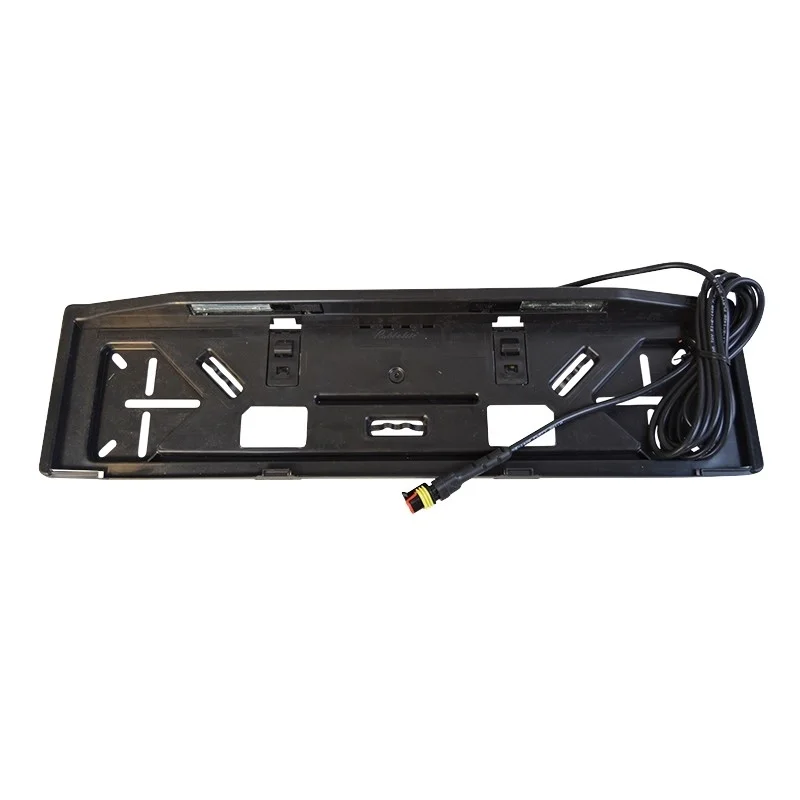
LED ADR licence plate holder incl. lighting 2.5m + SuperSeals
In our stock
SKU:
647/01/04
| Weight | 0.519 kg |
|---|---|
| Whole series | 647C-Serie |
| Connectors | 2-PIN's SuperSeal |
| Filter connectors | SuperSeal |
| Cable length | 250cm cable |
| Cable length filter | 151 - 300cm |
| Dimensions | 550 x 143 x 36mm |
| Voltage | 12-24v |
| Voltage filter | 12-24v |
| Housing material | Polycarbonate |
| Weight | 0,54 |
| Protection class | IP69K |
| Housing colour | Black |
| lens material | Polycarbonate |
| Certification | ADR, CE, ECE-R10, ECE-R4 |
| Warranties | 2 years |
| Brand | Truck-Lite |
| Width | 550mm |
| Width filter | 501-600mm |
| Height | 143mm |
| Height filter | 101-150mm |
| Depth | 36mm |
| Depth filter | 31-40mm |
| Suitable for trucks | Yes |
| Suitable for semi-trailer | Yes |
| Suitable for commercial vehicles | Yes |
| Suitable for semi-trailers | Yes |
| Suitable for tractor | Yes |
| Suitable for excavators | Yes |
| Suitable for forklifts | Yes |
| Suitable for: | Semi-Trailers, Commercial vehicles, Excavator, Forklifts, Tractor, Semi-trailers, Trucks |

LED licence plate holder incl. lighting 12-24v, 2m cable | 2100
In our stock
SKU:
2100
| Weight | 0.22 kg |
|---|---|
| Connectors | Open wire end |
| Filter connectors | Open wire end |
| Cable length | 200cm cable |
| Cable length filter | 151 - 300cm |
| Dimensions | 548 x 155 x 36.5mm |
| Voltage | 12-24v |
| Voltage filter | 12-24v |
| Housing material | Polycarbonate |
| Protection class | IP69K |
| Housing colour | Black |
| lens material | Polycarbonate |
| Certification | CE, ECE-R10, ECE-R4 |
| Lens colour | White |
| Warranties | 2 years |
| Brand | WAŚ Sp. z o.o. |
| Width | 548mm |
| Width filter | 501-600mm |
| Height | 155mm |
| Height filter | 151-200mm |
| Depth | 36.5mm |
| Depth filter | 31-40mm |
| Suitable for trucks | Yes |
| Suitable for semi-trailer | Yes |
| Suitable for commercial vehicles | Yes |
| Suitable for semi-trailers | Yes |
| Suitable for tractor | Yes |
| Suitable for excavators | Yes |
| Suitable for forklifts | Yes |
| Suitable for: | Semi-Trailers, Commercial vehicles, Excavator, Forklifts, Tractor, Semi-trailers, Trucks |
Thanks to built-in lighting, the licence plate is reliably lightened, which contributes to vehicle visibility both during the day and at night. Of course, you can also opt for the standard licence plate lights we carry in our range.
TRALERT® supplies plug-&-play lighting and cabling for semi-trailer manufacturers.
We think along with you about practical solutions that fit within your design and applicable regulations. Contact our specialists for specific technical advice.
Implementing regulation (EU) 2024/883
This implementing regulation amends the existing technical specifications for vehicles and explicitly introduces the requirement for two separate spaces for rear registration plates on O3 and O4 semi-trailers. In addition, this regulation contains the transitional provisions, including the date on which vehicles not complying with it may no longer be registered or put into service.
Regulation (EU) 2019/2144 (General Safety Regulation)
The General Safety Regulation shapes the legal framework for the European type approval of vehicles and 12V semi-trailers. This regulation stipulates that structural requirements, such as provisions for registration plates, are part of vehicle safety and traceability. The technical elaboration of this is done through implementing regulations, including Regulation (EU) 2021/535 and its amendment 2024/883.
UN/ECE Regulation No. 48 (ECE R48)
UNECE Regulation No. 48 contains the installation requirements for lighting and light signalling devices on vehicles. For this topic, R48 is relevant because it prescribes how licence plate lighting should be installed, regardless of whether it is integrated in a licence plate holder or applied as a separate light. Read more about this in our article on ECE R48.
Upon request, we can send you the applicable implementing regulations. Please request them from your TRALERT® account manager or via nl
Related articles
Engineering
- Adapting CoC in case of changes to lighting
- Breaking open CoC: what does this mean for lighting?
- ECE R10: electromagnetic compatibility explained
- Lighting for heavy-duty transport
- 24V semi-trailer lighting and cabling
Workshop
- Reduce installation time for semi-trailer lighting
- Connecting lighting: practical challenges
- Preventing damage and interference with semi-trailer lighting
- 24V plug & play lighting kits
- LED licence plate lights
Procurement
- Trends in semi-trailer lighting
- Shortage of bodybuilding professionals
- Trail lighting: structurally reducing assembly time
- truck & semi-trailer 24V wiring harnesses
- Connection boxes
Disclaimer
This article was compiled with great care on the basis of the currently valid European regulations and their implementing regulations. TRALERT® endeavours to keep the information as current and correct as possible. However, laws and regulations may change or be applied differently nationally, and interpretation may also differ from one type approval authority to another. The content of this article is intended as a translation of regulations into practice and cannot be regarded as legal or type-approval advice.