



Blog
Installation instructions for trailer lighting in accordance with ECE R48
- Updated:
- By: Kevin van Mierlo
Home / Knowledge Base / Installation instructions for trailer lighting in accordance with ECE R48
Contents
When performing the mounting of trailer lighting, it is not just a matter of choosing the right light with the necessary certification, but also of ensuring the correct position. Consider the mounting height, distance from the outer edge, symmetry and geometric visibility. It is precisely here that many errors occur in practice. That is why, in this article, we translate the most important fitting regulations for trailer lighting from ECE R48 into clear and immediately applicable guidelines for 12V trailers. Incidentally, R48 makes no distinction based on system voltage: the fitting regulations are determined by vehicle category and vehicle dimensions, not by whether the system is 12 or 24 Volts. The focus on 12V here is practical, given the target audience.
Correct mounting in accordance with UN ECE R48 means that each light not only has the correct approval but also meets the requirements for number, position, mounting height, spacing, symmetry and geometric visibility. An E-approved light may therefore still be incorrectly mounted.
In this article, you will read:
- Which installation instructions in accordance with ECE R48 apply to trailer lighting?
- which requirements are important for height, width and spacing
- How geometrical visibility and symmetry are assessed in practice
- Which types of lamps require extra attention during mounting on trailers
- Which common mistakes lead to rejection or correction work
- How to quickly check the lighting with a practical checklist
Why ECE R48 is important for the mounting of trailer lighting
UN ECE R48 is the international UN/ECE regulation governing the installation of lighting and light-signalling devices on vehicles. The regulation specifies which light functions must be present and sets requirements regarding, amongst other things, the number, position, mounting height, spacing, visibility, orientation and electrical circuit. For vehicle builders and fitters, ECE R48 is therefore one of the most practical regulations in the field of vehicle lighting. A light may be technically sound but still fail the inspection if it has not been fitted in accordance with these installation requirements.
In practice, with 12V trailers, it is evident that many rejections and after-sales complaints arise from mounting errors rather than faulty components. Good mounting in accordance with ECE R48 therefore ensures a quicker final inspection, less corrective work and greater certainty upon delivery. If you carry out the correct installation properly from the outset, you’ll avoid later disputes over visibility, symmetry and dimensions. If you’d like to understand the broader regulations for trailers and trailers first, please also read our article on the rules for trailer lighting.
What does ECE R48 stipulate regarding the mounting of trailer lighting?
ECE R48 focuses on the installation of lighting and light-signalling devices on the vehicle, in this case the trailer. This concerns not only the light fitting itself, but the complete arrangement at the rear and sides of the vehicle. For fitters, the following installation aspects are particularly important:
- placement in width and height - How far can a light sit from the outer edge and at what height should it be mounted?
- Spacing - What is the minimum distance between the left and right lamp?
- geometric visibility - At what angles should the light remain visible to other road users?
- symmetry - lights must be positioned equally on the left and right.
- Grouping and combination - Which lights can be together in one luminaire and when does a minimum distance apply?
These requirements apply to Category O trailers and are intended to ensure that the lighting remains clearly visible and recognisable in practice, regardless of the type of towing vehicle or the vehicle’s surface mounting.
Important mounting requirements per type of lighting
Below you will find, for each type of lamp, the fitting dimensions and checkpoints that make all the difference in practice. We have deliberately limited ourselves to the requirements that fitters, engineers and vehicle builders deal with directly when fitting, aligning and checking lighting on 12V trailers.
Rear lights
Two rear lights are mandatory, one on the left and one on the right at the rear. The outer edge of the illuminated surface must not be more than 400 mm from the outermost edge of the vehicle. The distance between the inner edges of both lights must be at least 600 mm. If the trailer is narrower than 1,300 mm, this may be reduced to 400 mm. The mounting height must be between 350 mm and 1,500 mm above the road surface. Only if the shape of the bodywork makes this impossible may this be increased to 2,100 mm.
Always check the visibility angles as well. Rear lights must remain visible within 45° inwards and 80° outwards, with 15° upwards and 15° downwards. If the light is positioned lower than 750 mm, the downward angle may be reduced to 5° and the inward angle below the H-plane to 20°. In practical terms, this means you should not position the light too far inwards behind a mudguard, angle profile or surface mounting edge. If you are working with composite units, it is a good idea to also refer to our practical guide on rear lights and triangle reflectors on a trailer.
Brake lights
For standard S1 or S2 category brake lights, two lights are mandatory. For vehicle categories other than M1 and N1, a minimum distance of 600 mm between the inner edges of both lights applies. For a vehicle width below 1,300 mm, this may be 400 mm. The mounting height must be between 350 mm and 1,500 mm. Only if the surface mounting makes this impossible, it may go up to 2,100 mm.
The required visibility is 45° left and 45° right with respect to the longitudinal axis, plus 15° up and 15° down. If the brake light is below 750 mm, the inside angle below the H-flat may be reduced to 20° and the downward angle to 5°. Therefore, never install brake lights behind fasteners, hinges, tailboards or protruding edge profiles. In addition, for brake lights, they must switch on simultaneously as soon as the brake system gives the brake signal.
Rear indicators
On trailers, in accordance with configuration B, two rear indicators of category 2a or 2b are mandatory. The outer edge of the light-emitting surface must not be more than 400 mm from the outermost edge of the vehicle. As regards their relative positioning, there must be a minimum distance of 600 mm between the inner edges of the illuminating surfaces. For vehicles less than 1,300 mm wide, this distance may be 400 mm. The mounting height must be between 350 mm and 1,500 mm. If the vehicle’s design does not permit this, the height may be increased to 2,100 mm.
Horizontal visibility is 45° inwards and 80° outwards, with 15° upwards and 15° downwards. If the indicator is fitted at a height of less than 750 mm above the road surface, the downward angle of 15° may be reduced to 5°. In practice, it is important to note that an indicator may function perfectly from an electrical point of view but still be incorrectly fitted if, when viewed from an angled perspective, the light is partially obscured by the surface mounting.
Triangular retroreflectors
Triangular retroreflectors are mandatory on trailers and must consist of a set of two. The apex of the triangle must point upwards. The outer edge of the reflective flat must not be more than 400 mm from the outer edge of the vehicle. The distance between the inner edges of both reflectors must be at least 600 mm. If the trailer is narrower than 1,300 mm, this distance may be reduced to 400 mm. The mounting height must be between 250 mm and 900 mm. Where grouped with a rear light, the maximum height is 1,200 mm. Only where the shape of the bodywork makes this impossible may the height be increased to 1,500 mm.
Here too, the visibility angles are specified: 30° inwards, 30° outwards, 15° upwards and 15° downwards. If mounted below 750 mm, the downward angle may be reduced to 5°. In practice, triangle reflectors are still too often positioned too high or too far inwards on a rear bar fitted with multifunctional units. This is precisely where things regularly go wrong. Would you like to know more about this specific point of attention? Then read our article on triangle reflectors for semi-trailer tail lights.
Licence plate light
Licence plate light is mandatory, but ECE R48 does not give a fixed measure in millimetres for height or outer distance here. The requirement is functional: the light must be positioned and aimed so that it illuminates the registration plate location. This applies to width, height, length, visibility and orientation. In mounting practice, this means that the plate must be completely uniformly lit, without dark corners or shielding by the licence plate holder, tailgate or luminaire housing. The light is switched electrically together with the position or rear lights.
Always ensure, too, that no white light causes confusion when directed towards the rear, other than for the number plate illumination function. ECE R48 prohibits white light that is visible from the rear and may cause confusion, with the exception of permitted functions such as reversing lights. If you would like to explore this topic in more detail, please also see our article on legislation and lighting for number plates and our explanation of number plate positioning.
Marker lights and side marker lights
Side marker lights are mandatory on vehicles longer than 6 metres and otherwise optional on other vehicles. There must be at least one side marker light per side in the middle third of the vehicle. The front side marker lights should be a maximum of 3 metres from the front. The distance between two adjacent side marker lights should not normally exceed 3 metres. If the construction makes this impossible, it may be 4 metres. The rear side marker lights may be no more than 1 metre from the rear. The mounting height is between 250 mm and 1,500 mm, outgoing to 2,100 mm if the bodywork does not otherwise allow it.
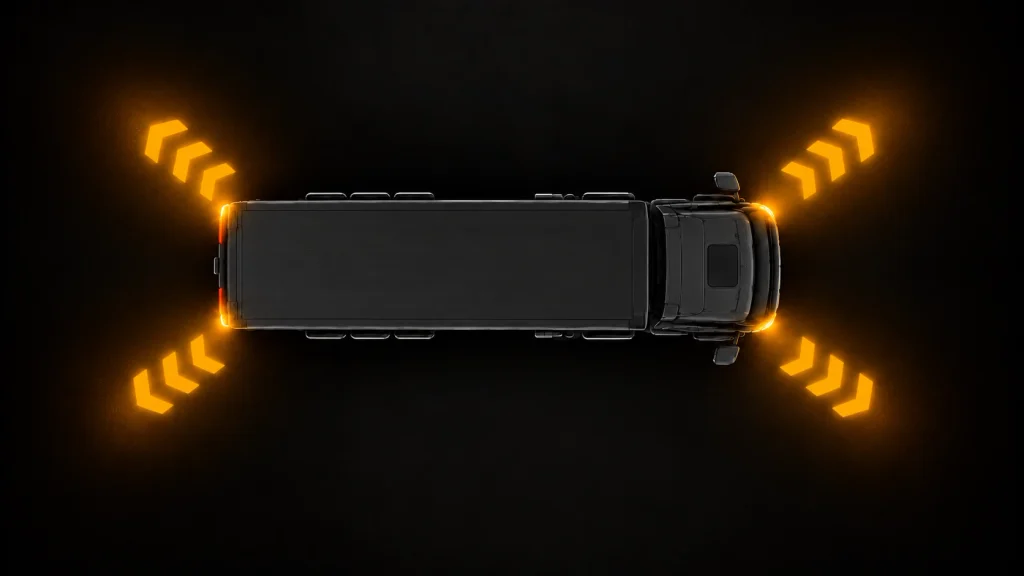
Visibility must be 45° forwards and 45° backwards, plus 10° upwards and 10° downwards. When mounted below 750 mm, the downward angle may be limited to 5°. In practice, this is particularly important on enclosed bodywork and bevelled mudguards, where marker lights can easily end up too low or too far inwards. If you use side marker lights that flash in unison or in sequence, please also read our article on side marker lights with indicator function on trailers.
Reversing lights
Reversing lights emit white light towards the rear and therefore require particularly careful positioning. Under R48 (paragraph 6.4), this feature is mandatory on trailers in categories O2, O3 and O4, and optional on O1. For vehicles up to and including 6 metres in length, one reverse light is mandatory and a second is permitted; for vehicles longer than 6 metres, two are mandatory. The mounting height must be between 250 mm and 1,200 mm above the road surface, measured at the rear of the vehicle.
As white light at the rear must not normally be visible outside the permitted functions, during mounting, please check not only the electrical connection but also that the positioning does not cause confusion with other rear light functions. If you are using a combined rear unit, check that the reverse light remains within the permitted height and is aligned symmetrically.
Installation errors to watch out for with 12V trailers
Just because a light is present and approved does not mean it has been fitted correctly. ECE R48 sets strict requirements in a number of areas regarding position, height and visibility, and it is precisely here that the margin for error is small: a few millimetres too far inwards, a light that is just a little too high, or a line of sight that is obscured by a body panel. Below are the mounting points where an installation may fail an R48 inspection.
Lights too far inwards
Rear lights or retroreflectors may end up too far towards the centre of the rear beam. For several rear components, the outer edge of the light or reflective surface must not be more than 400 mm from the outermost edge of the vehicle. If this is not adhered to, the arrangement no longer complies with the mounting requirements.
Mounting triangular retroreflectors incorrectly
Two triangular retroreflectors are mandatory on trailers. They must be fitted with the tip pointing upwards. The height and spacing between them must also be correct. In practice, these reflectors are still too often fitted too high, too far inwards or at an angle on the rear.
Losing visibility through body parts
A light can sit correctly in terms of dimensions and yet be incorrectly mounted as soon as a mudguard, flap, edge profile or body part limits the visibility angle. ECE R48 sets geometric visibility requirements for each lamp type. In addition, lights on movable components may not be more than 50% hidden by those components in any other fixed position.
Mounting multifunctional lights without checking the overall set-up
A multifunctional rear light saves space but does not automatically solve the mounting issue. Even with combined or grouped lights, the positioning, visibility and symmetry of the overall arrangement must remain correct. This is precisely where things often go wrong in practice.
Outside the scope of R48
Not every installation problem falls under ECE R48. Poor ground connection, oxidation in connectors, moisture in cable joints, pin sequence and CAN bus behaviour are not installation requirements under R48, but they are common causes of interference in 12V trailers. You should therefore treat these issues as installation and compatibility risks, not as inspection requirements. It is particularly worthwhile to truck the entire combination when retrofitting or when switching between different towing vehicles. If you encounter error messages or unusual switching behaviour, please also read our articles on CAN bus-compatible lighting and CAN bus interference in LED lighting. For practical wiring advice, our article on connecting trailer lighting will also be helpful.
Practical benefit: the most common mistake in practice is often not a missing light, but a perfectly functioning light in the wrong place. That is precisely why the fitting position is more often the deciding factor for compliance than the luminaire itself.
Inspection-proof checklist for 12V trailers
Use the checklist below before the trailer leaves the workshop or is presented for inspection. This will enable you to check not only that all lighting is present, but also that the mounting has been done correctly in practice. If you are preparing a vehicle for inspection, our article on trailer inspections and key considerations is a logical next step.
- Are all mandatory lights and retroreflectors present?
- are left and right lamps mounted symmetrically and at the same height?
- Are rear lights and retroreflectors within the maximum distance from the outer edge?
- does the spacing between the left and right side meet the minimum requirement?
- Are the mounting heights within the permissible bandwidth per lamp type?
- Have the required visibility angles been checked once the trailer has been fully assembled?
- Are triangular retroreflectors mounted correctly, pointing upwards?
- Does the licence plate light illuminate the entire number plate evenly and without any shadowing?
- Aren't lights partially blocked by wings, flaps or other body parts?
- Are connectors, mass connections and cable entries properly finished for interference-free operation?
Difference between ECE R48 and ECE R148
ECE R48 and ECE R148 are often mixed up in practice, even though they have different functions. ECE R48 deals with the installation of lighting on the vehicle. Consider placement, mounting height, spacing, visibility and electrical switching at vehicle level. ECE R148 is instead about the technical and photometric requirements on the light itself, such as light colour, light distribution and performance of the luminaire.
For fitters and engineers, that distinction is crucial. A light may be fully approved to R48, but it may still be incorrectly fitted if its position or visibility on the trailer does not comply with R48. Conversely, perfect mounting is of no use if the luminaire itself does not meet the component requirements. Consequently, in practice, you must always consider both the product and its mounting. Find out more about ECE regulations or how ECE R48 compares with ECE R148.
Frequently asked questions
Are triangular retroreflectors compulsory on a trailer?
Yes. Two triangular retroreflectors are mandatory on trailers. They must be fitted at the rear with the tip pointing upwards. Furthermore, specific requirements apply to these retroreflectors regarding position, spacing and mounting height, to ensure they are correctly and symmetrically positioned during inspection.
At what height should rear lights be fitted on a trailer?
According to ECE R48, rear lights must be positioned between 350 mm and 1,500 mm above the road surface. Only where the body shape makes this impossible may the height be increased to 2,100 mm. The outer edge of the light surface must remain no more than 400 mm from the outermost edge of the vehicle, ensuring that the light is clearly visible from the side as well.
Why might an approved light still be rejected?
An E-mark applies to the light itself, not to its installation on the vehicle. ECE R48 sets out additional requirements regarding the number, position, mounting height, spacing, symmetry and geometric visibility of lights. If an approved light is positioned too far inwards or is partially obscured by a body panel, the mounting will still not comply and will result in rejection.
How can you prevent trailer lighting from failing the roadworthiness truck?
Before delivery, check that all mandatory lights are present, symmetrical and at the same height; that the mounting heights and spacing are correct; and that no light is partially obscured by a mudguard or bodywork component. Only assess the visibility angles once the trailer has been fully assembled, as this is where the majority of rejections occur.
Trailer lighting guide for professionals
Proper mounting in accordance with ECE R48 is not merely a formality at the end of the manufacturing process. It is a practical quality control measure that determines whether a trailer immediately meets the requirements for visibility, symmetry and positioning. By ensuring the correct heights, distances and sight lines are maintained from the outset, you can avoid rejection, rework and unnecessary delays during inspection or delivery.
Do you want to be sure that your lighting configuration works in practice, or are you looking for components that fit within a reliable and efficient installation setup? Then please contact our technical support team. We’d be happy to advise you on the right lighting, positioning and connection for your project. For further tips on surface mounting, regulations and fitting, please refer to our article on trailer lighting.
Share this article:
ABOUT
TRALERT®
TRALERT® is the leading manufacturer and partner in high-quality LED lighting solutions for commercial vehicles. By taking care of everything from drawing board to realisation, you and your customers can hit the road safely, carefree and professionally lit.
VISIT
EXPERIENCE CENTRE
The TRALERT® Experience Centre is an interactive showroom with training and truck rooms. Experience TRALERT® LED vehicle lighting in practice and experience the lighting performance in different situations. Plan your Experience Centre visit.
PARTNER
TO BE
TRALERT® works closely with its B2B partners and does not supply end users directly. Are you a manufacturer, reseller or company active in first-fit installation? Then register as a partner. Are you an end user? Then please refer to a TRALERT® partner.
Author

Kevin van Mierlo
Lighting expert at TRALERT® - Kevin tests lighting and finds out everything about legislation. He can tell you all about it.
Featured lighting:
Stay up to date
ON THE LATEST NEWS
Discover the world of LED vehicle lighting through our informative blogs, useful tips and valuable insights, written by TRALERT® specialists.

Other Lighting Terms:
