Your specialised partner in LED vehicle lighting

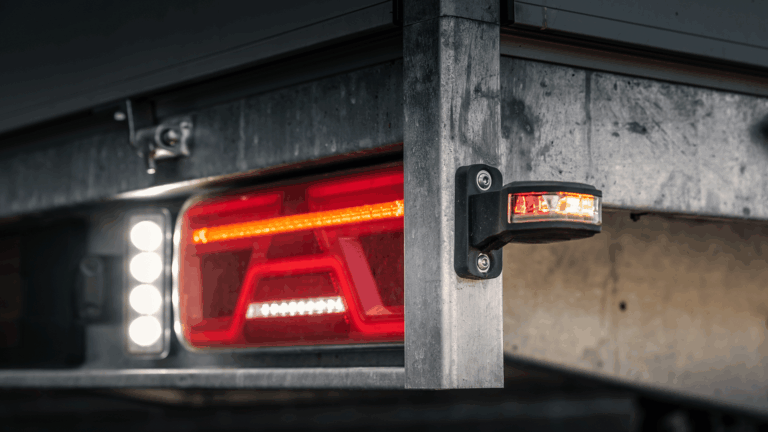
Whether side marker lights are compulsory on a trailer depends on the width, the year of manufacture and the light function you are referring to. The European regulations are clear: side marker lights are compulsory for trailers over 2.10 metres wide; for those between 1.80 and 2.10 metres, you are permitted to fit them. White lights shine forwards, red lights backwards, at the outermost points of the vehicle’s width. In addition, countries may set their own limits or transitional rules, particularly for older vehicles. In this article, by ‘width marking’ we mean active side marker lights and width markers, not reflective markings. You can read the rules for each country further on. If you would first like to see the full picture in terms of width and length, please consult our comprehensive overview of the compulsory lighting on a trailer.
The European installation standard ECE R48 links the requirement directly to the width of the vehicle. The wider the trailer, the more important it is that other road users can judge its actual external dimensions in the dark. The table below sets out the European requirements.
| Width of the trailer | Side marker lights (end marker lights) | Explanation |
|---|---|---|
| Trailer width: Up to 1.80 m | Side marker lights (end marker lights)Not required based on width | Note: The other mandatory lighting remains, of course, essential. |
| Trailer width: 1.80 m to 2.10 m | Side marker lights (end marker lights): Permitted, not compulsory | Note: You may fit side marker lights to improve visibility |
| Trailer width: Widerthan 2.10 m | Side marker lights (end marker lights)– Mandatory | Explanation: Whiteat the front, red at the rear, at the outermost points of the trailer’s width |
ECE R48 uses the term ‘end-marker light’ for this function. This installation requirement specifies, amongst other things, where the lights may be positioned and when they are mandatory or permitted. Important: this is the European standard. National regulations may impose additional requirements or set transition dates, particularly for older or non-standard vehicles. The additions specific to each target market are listed below under the regulations for each country.
TRALERT® has been a specialist in LED lighting for trailers since 2005. From modern rear lights and marker lights to complete, easy-to-fit plug-&-play sets.
A side marker light indicates the maximum width of the trailer. It emits a white light at the front and a red light at the rear. By positioning the lights at the outermost corners, oncoming or crossing traffic can immediately see how wide the vehicle actually is. The term ‘width marker’ is colloquial language for the same function, often referring to a design that combines the front and rear marker lights in a single unit. Functionally, it is the same light; only the design differs.
A side marker light indicates the width with white light at the front and red at the rear, at the outermost corners. A side marker light serves a different purpose: it indicates the length along the side and emits amber. This makes the side profile visible, particularly on longer trailers. You can read more about this in our article on marker lights on a trailer.
Many marker lights combine these functions in a single housing. A commonly used configuration is red-white-amber: white at the front, red at the rear and amber at the end. That amber section at the very end acts as a side marker, meaning a single light makes both the width and the side of the trailer visible.
Yes, under certain conditions. According to UN Regulation No. 148, paragraph 5.7.7, a side marker light must, in principle, be amber. Only the rear side marker light may be red if it is grouped, combined or reciprocally incorporated with a red rear function, such as the rear light, the rear side marker light (end-marker light), the rear fog light or the brake light, or where it shares part of the light-transmitting surface with the red rear reflector. This colour rule is laid down in the type approval of the signal light itself and therefore applies in all markets that apply UN ECE R148. The German national regulations contain the same rule in Section 51a(6) of the StVZO.
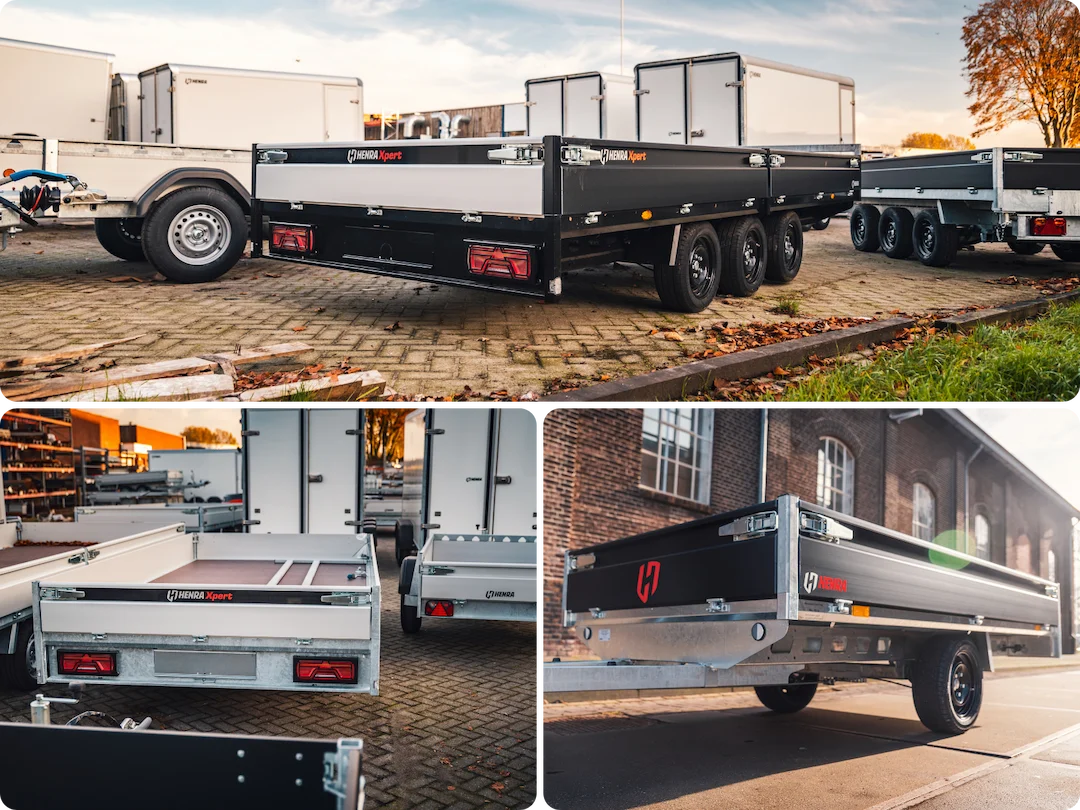
There is a clear logic to the positioning. The lights should be fitted as close as possible to the outermost edge, so that they indicate the actual width. On a closed surface mounting, you should also position them as high as possible, as the upper corners define the outline most sharply. The left and right sides must be symmetrical, and the colour rule is strictly adhered to: white only at the front, red only at the rear. These regulations are based on the installation requirements set out in ECE R48, which cover position, angle of visibility, height and distance from the outer edge. The exact mounting distances vary by country and are listed below.
Practical benefit: two light points at the outermost corners tell an approaching driver at a glance how wide and how high a vehicle is. Active light at the edges outlines the silhouette much more quickly than a reflector, which only lights up when light falls on it. This saves you precious reaction time, particularly in the dark and in the rain.
The European requirements outlined above apply universally. For each target market, there are additional national requirements, particularly for existing vehicles and older models. Below are the key points for each country.
In the Netherlands, marker lights – visible at the front and rear, white at the front and red at the rear – are compulsory for trailers wider than 2.10 metres that were put into service after 31 December 1997. For older trailers dating from before 1998, this limit is 2.60 metres. For mounting the side marker lights, the position of the widest point must be no more than 0.50 metres from the point of greatest width.
Germany has the same regulations regarding marker lights under § 51b of the StVZO. Above 2.10 metres, marker lights are compulsory; between 1.80 and 2.10 metres, they are permitted; and for vehicles up to 1.80 metres in width, they must not be fitted. The colour is white at the front and red at the rear. The distance between the side marker lights and the tail lights on the same side must be more than 200 millimetres.
France follows the European framework of UNECE R48. The limits are the same: mandatory above 2.10 metres, permitted between 1.80 and 2.10 metres, with white facing forwards and red facing backwards. Compliance is assessed, amongst other things, during the contrôle technique. If in doubt, always check the requirements for the specific vehicle.
Italy also applies the European UNECE R48 framework, with the same width limits and colour regulations. The periodic inspection (revisione) checks whether the lighting complies. For non-standard or older vehicles, it remains advisable to check the national implementing regulations.
In the United Kingdom, the RVLR 1989 regulates side marker lights. Trailers wider than 2.10 metres must be fitted with end-marker lights: white at the front, red at the rear, positioned as high as possible. The RVLR is largely equivalent to UNECE R48, and the UK may not refuse a vehicle approved in accordance with R48. Enforcement takes place through the annual MOT truck and inspections carried out by the DVSA.
When exporting, operating internationally or undergoing a specific vehicle inspection, always check the requirements that apply in the relevant country and for the vehicle in question.
The correct model depends on the mounting surface, the desired light colour and the style of the surface mounting. The most commonly used variants are:
Side marker lighting deserves attention early in the design phase, not just at the finishing stage. The mounting position determines which lamp shape is suitable and whether you need a left- or right-hand version. Take into account the cable routing and the choice of connector, so that the connection is neatly concealed later on. Also, ensure the correct E-mark and compliance with the electromagnetic compatibility requirements in accordance with ECE R10. A light that is functionally correct but incorrectly integrated will still cause delays during inspection and delivery.
Start with the mounting surface. A flat bar requires a straight stem, whilst a sloping angle calls for an angled or angled design. Next, decide whether you want to mark just the width or the side as well, as this will determine whether a red-white-amber model is required. Then consider the connection: a plug-and-play cable of 0.75 or 1.5 mm² saves installation time. Finally, take into account the lens type and the IP value, to ensure the light remains reliable even in wet and dusty conditions.
Side marker lights are compulsory if the trailer is wider than 2.10 metres. Between 1.80 and 2.10 metres, you may fit them, but it is not a requirement. The colour is specified as white at the front and red at the rear. National regulations may impose additional restrictions, so always check the requirements of the country in which you are driving.
At the front, side marker lights emit a white beam; at the rear, a red one. This colour division is not arbitrary, as the colour indicates to other road users which side of the trailer they are looking at. Amber is only used on combined models that provide both width marking and side marking, and then exclusively for that side.
A side marker light is an active light that indicates the width of the vehicle, emitting white light at the front and red light at the rear. Contour marking is a reflective marking that glows when light falls on it. Both increase visibility, but they are not interchangeable and are separate topics.
Functionally, they are the same: both indicate the extreme width with white at the front and red at the rear. ‘Width marker’ is primarily a term used in the industry to describe the design, often a version that combines the front and rear marker lights in a single unit. You choose the shape based on the mounting surface and the surface mounting; the legal function remains the same.
Are you unsure which model suits your surface mounting in terms of shape, colour or connection? Then take a look at our LED side marker lights for trailers or discuss your situation with our specialists. For a comprehensive solution with lighting, cabling and connectors all perfectly matched, see our full range for trailers below.
Go to trailer lightingDisclaimer:
At TRALERT®, we do our best to keep the information in this article as accurate and up-to-date as possible, including the regulations surrounding vehicle lighting. However, legislation can change regularly, and although we make every effort to implement these changes in a timely manner, it is possible that certain updates or adjustments have not yet been incorporated into this article. We therefore always advise our readers to check the current legislation with their local government or regulatory bodies, especially when it comes to exceptions or specific national regulations. TRALERT® is not liable for any damages or fines resulting from outdated or incomplete information in this article.
If in doubt, always contact the competent authority to ensure that your vehicle meets all legal requirements.

A selection of LED lighting for trucks and trailers.
A comprehensive overview of our LED vehicle lighting and accessories.
Plug-&-play lighting kits, cabling and lighting for bodybuilders.
What TRALERT® can do for you as a partner in LED vehicle lighting.
Plug-&-play kits, cabling and lighting for 24V semi-trailers.
A selection of high-quality LED driving lights and LED bars.
Lighting, wiring harnesses and accessories for trailers.
The TRALERT® DARK LED range.
Work lights, rear lights, driving lights, beacor bars and more for DAF Trucks.
Work lights, rear lights, driving lights, beacor bars and more for Ford Trucks.
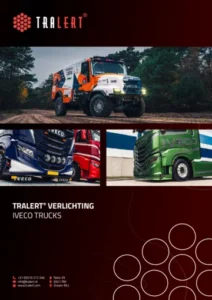
Work lights, rear lights, driving lights, beacon bars and more for Iveco.
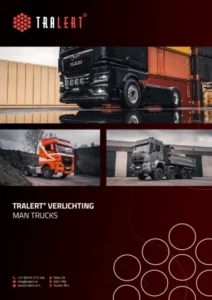
Work lights, rear lights, driving lights, beacon bars and more for MAN.
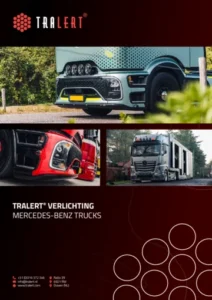
Work lights, rear lights, driving lights, beacon bars and more for Mercedes-Benz Trucks.
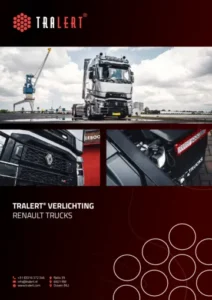
Work lights, rear lights, driving lights, beacor bars and more for Renault Trucks.
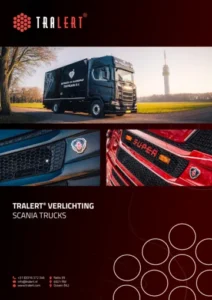
Work lights, rear lights, driving lights, beacor bars and more for Scania.
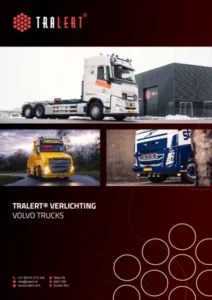
Work lights, rear lights, driving lights, beacon bars and more for Volvo Trucks.
The catalogue opens in a new tab. Can’t see it?
Open the catalogue (PDF)Two questions, in 30 seconds.
TRALERT® works with a dealer network. Dealers can view current stock levels, place orders online on account and receive a product feed for their online shop or system. We assess each enquiry internally and will let you know within 1 to 2 working days whether a partnership is possible.
You can purchase TRALERT® lighting through our partners, either locally or online. Simply provide your details, and we’ll find the partner best suited to help you.
Would you prefer to find a stockist yourself?We will assess your enquiry internally. You will hear from us within 1 to 2 working days to let you know whether a partnership is possible.
We’ll let you know within 1 to 2 working days which partner will be able to assist you further.