Specialised partner in LED vehicle lighting

The short answer
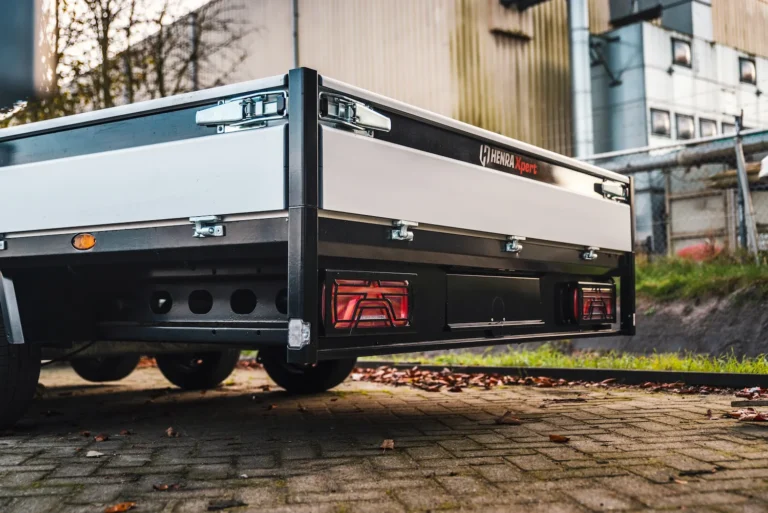
Side marker lights on a trailer may seem like a minor detail, but ECE R48 specifies, down to the millimetre, where and how each light must be positioned. This is also the regulation that causes many trailer builds to fail during inspection. Not because the light doesn’t work, but because the positioning is just slightly incorrect. TRALERT® is a supplier of ECE-certified side markings and translates the regulations into practical guidance for vehicle builders who wish to ensure their designs are correct in series production.
In this blog you will read:
ECE R48 makes side markings compulsory on all vehicles longer than 6 metres. For trailers, this length is calculated including the drawbar. This is an important detail: a trailer with a surface mounting length of 5.5 metres and a drawbar of 1 metre counts as 6.5 metres and is therefore subject to the requirement.
Side markings are not compulsory on shorter trailers, but they are permitted. Many vehicle builders voluntarily choose to fit side markings to shorter trailers that regularly travel at twilight or in poor weather conditions, as this significantly improves visibility from angled angles.
The 6-metre rule applies to all O categories (O1, O2, O3 and O4). However, additional requirements have been introduced for O3 and O4 since 1 January 2025: newly registered heavy trailers must have side marker lights that flash in synchronisation with the direction indicators, or a separate side indicator. You can read more about this specific requirement in our article on marker lights with indicator function on trailers. For the wider range of lighting regulations, please refer to our guide on trailer lighting regulations.
ECE R48 regulates four distance-related aspects for side markings on trailers: where the front light may be positioned, what the distance between them may be, where the rear light must be positioned, and what the minimum distribution across the vehicle must be. We will go through them in order.
The front side marker light must be positioned no more than 3 metres from the front of the vehicle. This limit prevents the trailer’s outline from ‘disappearing’ when another road user approaches the trailer from the front at an angled angle, for example at a junction or roundabout.
In the case of trailers with unusual front geometry, such as bevelled noses or surfaces with technical limitations, a deviation may occur. In such cases, the deviation must be substantiated in the type-approval dossier. Without such substantiation, the 3-metre limit applies in full.
The distance between two side marker lights positioned side by side must not exceed 3 metres. Where the trailer’s construction makes this distance impossible, an extension of up to 4 metres is permitted. Examples include surface mounting of welded sections, fuel tank positions or door hinges that technically preclude the installation of an intermediate light.
In practice, this is the requirement that vehicle builders most frequently encounter. A 13.6-metre semi-trailer requires at least five lights per side to remain within the 3-metre limit, unless structural necessity dictates otherwise. The decision to make use of the 4-metre exemption must be justified, not merely based on practical convenience.
The rear side marker light must be positioned within 1 metre of the rear of the vehicle. This requirement ensures that the side contour remains visible right to the end of the trailer, without a ‘gap’ between the last side marker and the rear.
For surface mounting with protruding tail lifts, hydraulic systems or rear structures, this 1 metre can become difficult. Again, constructive justification is required to deviate from the standard.
ECE R48 stipulates a less stringent requirement for trailers with a total length of 6 metres or shorter (including the drawbar). In such cases, a single side marker light per side is sufficient, positioned in either the first or the last third of the vehicle’s length. The requirement for ‘at least one light in the middle third’, which applies to longer trailers, does not apply here.
This makes the construction of compact trailers considerably simpler, particularly for box trailers, boat trailers, motorbike trailers and light commercial trailers. Vehicle builders can then comply with the regulations using just one light per side, provided it is positioned within the correct zone.
For trailers over 6 metres in length, the rule applies that there must be at least one side marker light on each side, positioned in the middle third of the vehicle. Together with the 3-metre rule for spacing between vehicles and the 1-metre limit at the rear, this automatically results in multiple lights on each side for longer trailers.
Symmetrical positioning on the left and right is not a strict R48 requirement, but is strongly recommended in practice to ensure compliance with inspection standards and a uniform beam pattern.
According to ECE R48, side markings must be mounted at a height between 250 mm and 1500 mm above the road surface. This range applies to the vast majority of standard semi-trailers and corresponds to the natural eye height of other road users.
For vehicles where this upper limit is not constructively feasible, R48 allows elevation up to a maximum of 2100 mm. This applies, for example, to high-mounted tank semi-trailers, horse transporters or special surface mountings where the side wall of the vehicle starts above 1500 mm. The underlying requirement remains that the light must remain realistically visible to other traffic.
Side markings are not permitted below 250 mm, not even on open trailers or low-loaders. The reason is practical: lights too close to the road surface are easily obscured by spray, mud, gravel and shadows cast by other road users. This lower limit is fixed.
For practical implementation on site and broader considerations regarding mounting, please refer to our article on mounting regulations for trailer lighting in accordance with ECE R48.
A side marking only does its job if other road users can actually see the light, even from angled viewing angles. ECE R48 quantifies this visibility in degrees.
Horizontally, the light must be visible within an angle of 45 degrees to the front and 45 degrees to the back, measured from the mounting position. Vertically, a visibility angle of 10 degrees up and 10 degrees down applies.
There is one official exception: for a mounting height below 750 mm, the downward visibility angle may be limited to 5 degrees. This makes sense, as a light sitting low simply has less physical space to beam downwards without the light being absorbed by the road surface.
In practice, visibility angles are most often restricted by the surroundings of the light: chamfered mudguards, closed surface mounting, protruding profiles or integrated light housings that are just too deep. A light can be correct according to the specifications and still not comply because the vehicle construction blocks the line of sight. Keeping a clear field of vision is at least as important as correct sizing.
Short for completeness: ECE R48 determines where and how a side marking is mounted. ECE R91 sets the technical requirements for the light itself, such as amber-coloured light output, minimum light output and reflectivity.
A side marker light that is ECE R91-certified but not fitted in accordance with R48 does not comply. The reverse is also true. During inspection, compliance with both standards is always checked. You can find more background information on the installation framework in our overview of ECE R48.
The distance requirements, mounting height and visibility angles must be taken into account in the design phase of the chassis and side body. Correcting things afterwards always costs more than getting them right the first time. This is especially true in series production, where every missed millimetre multiplies over the entire construction line.
As a supplier of ECE R91-certified side marker lights, our technical account managers assist vehicle builders and fitters with the lighting plan, the wiring harness, connectors and earth connection. This ensures that the design remains reproducible in series production and passes type approval without the need for corrective work. The actual installation choices remain with the production line.
Vehicle builders and fitters who install side marker lights correctly from the design stage save time and avoid the need for rectification work during inspection. TRALERT® supplies ECE R91-certified side marker lights, ranging from classic LED markers to marker lights with indicator function, and offers technical advice on lighting plans, wiring harnesses and connections. View our range of trailer lighting or contact our technical account managers for advice on your specific project.


Available on backorder
No. ECE R48 only makes side markings compulsory on vehicles longer than 6 metres, with the length of trailers calculated including the drawbar. On shorter trailers, side markings are permitted but not mandatory. However, additional side markings are recommended for improved visibility at dusk or in poor weather.
The distance between two side marker lights must not exceed 3 metres. If the trailer’s construction makes this distance impossible, for example due to welded sections, door hinges or fuel tank positions, an extension of up to 4 metres is permitted. This exception is explicitly stated in ECE R48 and must be justified on structural grounds.
The standard mounting height is between 250 mm and 1,500 mm above the road surface. For vehicles with high surfaces, such as tankers or horse boxers, a height of up to 2100 mm is permitted if 1500 mm is not structurally feasible. Mounting below 250 mm is not permitted, not even on open or low-loader trailers.
ECE R48 does not prescribe strict left-right symmetry for side markings. In practice, however, symmetrical positioning is strongly recommended. It produces a uniform beam pattern and prevents any issues of interpretation during vehicle inspections. Asymmetrical positioning is technically permitted provided that all other distance and height requirements are met.

A selection of LED lighting for trucks and trailers.
A comprehensive overview of our LED vehicle lighting and accessories.
Plug-&-play lighting kits, cabling and lighting for bodybuilders.
What TRALERT® can do for you as a partner in LED vehicle lighting.
Plug-&-play kits, cabling and lighting for 24V semi-trailers.
A selection of high-quality LED driving lights and LED bars.
Lighting, wiring harnesses and accessories for trailers.
The TRALERT® DARK LED range.
Work lights, rear lights, driving lights, beacor bars and more for DAF Trucks.
Work lights, rear lights, driving lights, beacor bars and more for Ford Trucks.
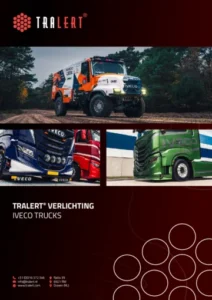
Work lights, rear lights, driving lights, beacon bars and more for Iveco.
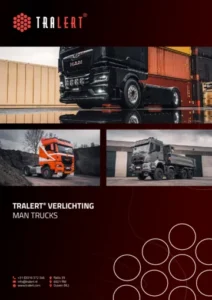
Work lights, rear lights, driving lights, beacon bars and more for MAN.
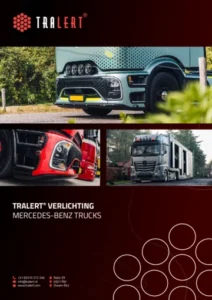
Work lights, rear lights, driving lights, beacon bars and more for Mercedes-Benz Trucks.
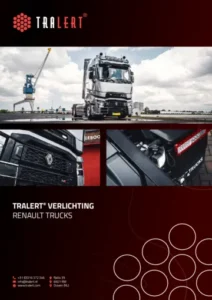
Work lights, rear lights, driving lights, beacor bars and more for Renault Trucks.
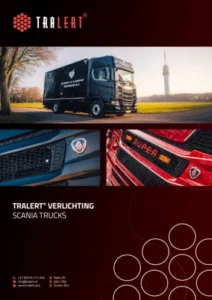
Work lights, rear lights, driving lights, beacor bars and more for Scania.
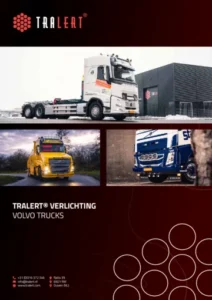
Work lights, rear lights, driving lights, beacon bars and more for Volvo Trucks.
The catalogue opens in a new tab. Can’t see it?
Open the catalogue (PDF)Two questions, in 30 seconds.
TRALERT® works with a dealer network. Dealers can view current stock levels, place orders online on account and receive a product feed for their online shop or system. We assess each enquiry internally and will let you know within 1 to 2 working days whether a partnership is possible.
You can purchase TRALERT® lighting through our partners, either locally or online. Simply provide your details, and we’ll find the partner best suited to help you.
Would you prefer to find a stockist yourself?We will assess your enquiry internally. You will hear from us within 1 to 2 working days to let you know whether a partnership is possible.
We’ll let you know within 1 to 2 working days which partner will be able to assist you further.
TRALERT® operates through a dealer network. Prices, stock levels and online ordering are therefore only available to business customers with an account.
We assess every enquiry internally and will let you know within 1 to 2 working days whether a partnership is possible.
For your own use?Find a stockist
Would you prefer a quote first?Add this product to your quotation request and send it off when you’re ready.