Your specialised partner in LED vehicle lighting

The short answer
Side markings on trucks are governed by two key UN/ECE regulations. UN Regulation No. 91 governs the approval of the side marker lamp itself; UN Regulation No. 48 specifies where and how it must be fitted to the vehicle. For trucks, semi-trailers and trailers longer than 6 metres, side marking is mandatory in many cases, with specific requirements regarding colour, spacing, mounting height and visibility.
This article was prepared on the basis of the current UN/ECE regulations for side marker lights. TRALERT® regularly checks regulations around vehicle lighting and updates knowledge articles when relevant changes affect practical application.
In this blog you will read:
The regulatory framework for side marking rests on three pillars. The ECE R91, which defines the technical requirements a side-marker lamp must meet to be approved. The ECE R48, which prescribes where lights should be located on the vehicle, at what height they are mounted and at what angles they should be visible. And finally, the vehicle class and vehicle length matter whether side marking is mandatory and what configuration is required.
For other truck and semi-trailer lighting besides side marker lights, please refer to our comprehensive guide to truck and semi-trailer lighting, which covers all light functions and their standards. In this article, we’ll take an in-depth look specifically at side marker lights.
CUSTOMER CASE
A great example of certified side marking nicely incorporated into the chassis of set sheet metal.

ECE R91 is the regulation governing side marker lamps as a product. It sets requirements for light output, colour, geometric visibility and stability under various conditions. A light that complies with R91 is awarded an E-mark with a type-approval number and may be sold within Europe for use on public roads.
Under R91, there are two categories of side marker lamps: type SM1 and type SM2. SM1 is used on all vehicle categories, including trucks (N2, N3) and semi-trailers (O3, O4). SM2 is a lighter variant that is only permitted on passenger cars (category M1). For your truck or semi-trailer, you should therefore always use SM1-approved lights.
Non-approved lighting leads to rejection during an inspection. In the EU Member States it is stipulated at national level that fixed vehicle components without EU type approval may not be used on public roads. Work lights aside, if switched separately. There is no exception for side-marking: without appropriate type approvals, lights may not be used as approved side-marker lamps for use on public roads.
Whilst R91 concerns the light itself, ECE R48 concerns its installation. This regulation specifies the vehicle categories for which side marker lights are mandatory, where the lights must be positioned, at what height they must be fitted and at what angles they must be visible. As such, R48 serves as the reference document for vehicle builders, bodybuilders and fitters.
ECE R48 is periodically updated through new revisions and amendments. This article is based on the current provisions for side marker lights within this regulation. TRALERT® monitors relevant changes for practical application on trucks, semi-trailers and trailers. If you would like to know more about lighting installation, please visit our ECE R48 page.
A light with the correct R91 approval can therefore still be fitted incorrectly. In that case, the vehicle does not comply with R48 and the inspection remains hanging on the installation, not on the product.
According to ECE R48, side marker lights are mandatory on all vehicles longer than 6 metres, with the exception of chassis cabs. For trailers, the drawbar is included in the length measurement for this requirement. For semi-trailers, the relevant length and reference points must be assessed on a per-vehicle-configuration basis. Below this 6-metre limit, side lighting is not compulsory, but is permitted.
Trucks fall under category N2 (3.5-12 tonnes) or N3 (>12 tonnes). For both classes, side marker lights are mandatory on both sides for vehicle lengths over 6 metres. A chassis cab without surface mounting is exempted from this, but as soon as there is a bodywork on it, the obligation applies in full.
Semi-trailers in categories O3 (3.5–10 tonnes) and O4 (>10 tonnes) are almost always longer than 6 metres and are therefore required to be fitted with side marker lights. This is where TRALERT® comes in: in operational use, semi-trailers sustain far more damage than tractor units, and for longer vehicles, multiple lights per side are required. Aftermarket replacement and upgrading of side lighting is the rule rather than the exception for this category.
Chassis cabs are exempt from side marking, regardless of their length. For vehicles put into service before 31 December 1997, different rules may apply based on the regulations that were in force at the time a point of interest in historic or long-term fleets.
This is the section where most inspection errors occur in practice. ECE R48 gives four concrete distance requirements.
The minimum number of side marker lamps does not follow from a fixed number per vehicle length, but from the prescribed positions. The front light must be within 3 metres from the front, the rear one within 1 metre from the rear and the distance between them must not normally exceed 3 metres. As a result, vehicles longer than 6 metres almost always require multiple lights per side in practice. Above 12 metres, multiple lights per side are automatically added because of the 3-metre rule.
Side marker lamps are amber (orange-yellow) as standard along the entire length of the vehicle. There is one exception to this: the rear side marker lamp may be red when grouped or combined with the rear light functions (rear light, rear fog light or brake light). Outside that specific combination, amber remains the norm.
Following an amendment to ECE R48.08, amber side marker lights may also serve as supplementary side indicators, provided they flash in synchronisation with the vehicle’s indicators. This is a technically interesting optimisation for bodybuilders: a single lamp type that fulfils two functions, requiring less wiring and installation time. Separate lights are still required for the standard mandatory side direction indicators (SDI); the synchronised flashing side lighting is an additional option, not a complete replacement.
For semi-trailers, the practical challenge often lies not in the initial mounting, but in replacement and expansion over the course of their service life. Three factors make aftermarket side markings crucial for this category.
In practice, a standard 13.6-metre semi-trailer requires several side marker lights on each side. The exact number depends on the chosen mounting positions and the vehicle’s design. The basic rule is a maximum of 3 metres between consecutive lights; only where the vehicle’s design makes this impossible may an exception be made, subject to certain conditions, to allow up to 4 metres. Specialist transport, flatbed configurations and extendable semi-trailers require even more. Every lost or damaged light poses a risk of failing the roadworthiness truck, and with multiple lights per side, the number of potential issues can quickly mount up.
Trucks and semi-trailers operate on 24V. A good LED side marker light for heavy goods vehicles must have a minimum IP67 rating, and for semi-trailers operating in harsh conditions (off-road, construction sites, agricultural transport), IP69K is no luxury. Vibration resistance is an underestimated criterion: a light that works electrically but comes loose mechanically will still result in a rejection. Take a look at our LED lighting for trucks and semi-trailers to see products selected on the basis of these criteria.
For 24V side lighting, in practice you will be using Deutsch-connectors (DT series) or SuperSeal connectors. Both provide waterproof connections; Deutsch is more robust and commonly used in heavy industry, whilst SuperSeal is more compact and quicker to fit when dealing with large quantities. Important: ensure that cable entries in the chassis are fitted with rubber grommets or waterproof grommets; otherwise, moisture will enter the luminaire via the cable. For further information on robust vehicle lighting, please also see our article on waterproof LED side marker lights.
The regulations for side marking do not stand still. UN Regulation No. 48 is periodically updated through new revisions and amendments. Especially relevant for this article are the current provisions round mounting position, spacing, mounting height, colour and visibility of side marker lights.
A key focus in current regulations is lateral visibility when indicating. UN Regulation No. 48 stipulates that side marker lights on vehicles in categories N2, N3, O3 and O4, amongst others, may flash in synchronisation with the indicators under certain conditions. This can, in particular for longer vehicles, semi-trailers and trailers, contribute to improved visibility when turning off or changing lanes. The exact application depends on the vehicle category, type approval and chosen lighting configuration.
For vehicle builders and bodybuilders, this means that side markings should not be viewed merely as passive contour lights, but are increasingly becoming part of the overall lighting scheme for visibility and signalling. When undertaking new vehicle projects, you should therefore always check that the chosen side marker lamps, side indicators and rear light functions collectively comply with the current UN/ECE requirements.
ECE R91 regulates the side marker lamp as a product: light output, colour, visibility angle and type approval. ECE R48 regulates the installation on the vehicle: where the light may sit, at what height, with what spacing. You need both. An approved light fitted incorrectly will still not comply.
Side marker lamps are amber as standard along the entire length of the vehicle. The rear side marker lamp may be red, if combined or grouped with the rear light functions such as rear lights or brake lights. White light on the side is not allowed and leads directly to rejection at inspection.
According to ECE R48, the front light is within 3 metres from the front, the rear within 1 metre from the rear. The maximum distance between them is 3 metres, or 4 metres if required by the structure. Mounting height is between 250 and 1,500 mm, outgoing to 2,100 mm with bodywork restriction.
Are you working on a semi-trailer with a special length, a flatbed or a non-standard body? In that case, the R48 exemptions and the correct choice of lights are the difference between a smooth roadworthiness truck and a second appointment with the testing authority. Contact us directly for advice on non-standard configurations; our technical advisers will work with you every step of the way, from design right through to the inspection.
Disclaimer:
TRALERT® makes every effort to keep the information in this article accurate and up-to-date. However, vehicle lighting regulations may change due to new amendments, national interpretations or additional regulations. Although we process relevant changes as carefully as possible, no rights may be derived from this article.
For type approvals, inspections or non-standard vehicle configurations, always check the current regulations and the requirements of the competent authority in the respective country. TRALERT® is not liable for damages, rejections or fines resulting from incomplete, outdated or misinterpreted information.

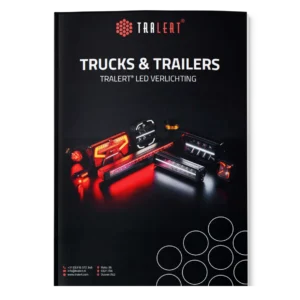
A selection of LED lighting for trucks and trailers.
A comprehensive overview of our LED vehicle lighting and accessories.
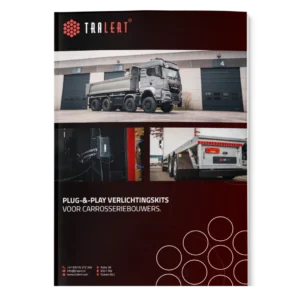
Plug-&-play lighting kits, cabling and lighting for bodybuilders.
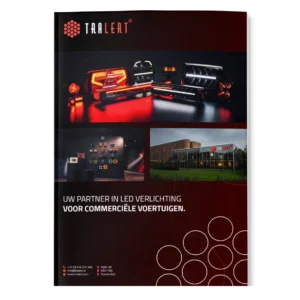
What TRALERT® can do for you as a partner in LED vehicle lighting.
Plug-&-play kits, cabling and lighting for 24V semi-trailers.
A selection of high-quality LED driving lights and LED bars.
Lighting, wiring harnesses and accessories for trailers.
The TRALERT® DARK LED range.
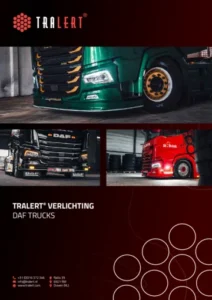
Work lights, rear lights, driving lights, beacor bars and more for DAF Trucks.
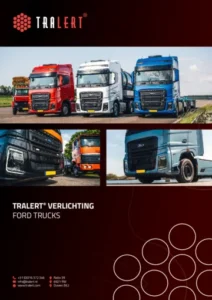
Work lights, rear lights, driving lights, beacor bars and more for Ford Trucks.
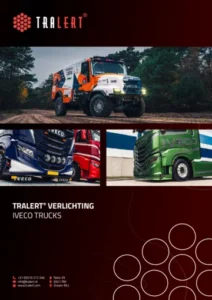
Work lights, rear lights, driving lights, beacon bars and more for Iveco.
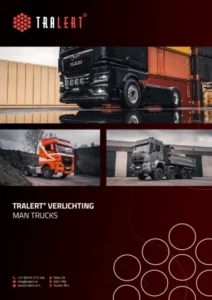
Work lights, rear lights, driving lights, beacon bars and more for MAN.
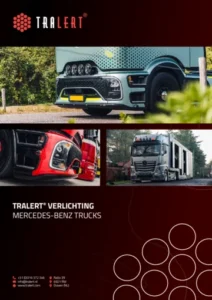
Work lights, rear lights, driving lights, beacon bars and more for Mercedes-Benz Trucks.
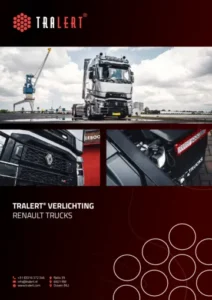
Work lights, rear lights, driving lights, beacor bars and more for Renault Trucks.
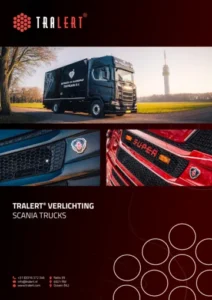
Work lights, rear lights, driving lights, beacor bars and more for Scania.
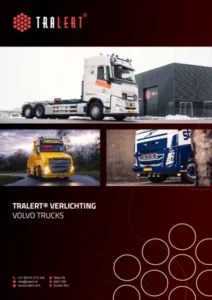
Work lights, rear lights, driving lights, beacon bars and more for Volvo Trucks.
The catalogue opens in a new tab. Can’t see it?
Open the catalogue (PDF)Two questions, in 30 seconds.
TRALERT® works with a dealer network. Dealers can view current stock levels, place orders online on account and receive a product feed for their online shop or system. We assess each enquiry internally and will let you know within 1 to 2 working days whether a partnership is possible.
You can purchase TRALERT® lighting through our partners, either locally or online. Simply provide your details, and we’ll find the partner best suited to help you.
Would you prefer to find a stockist yourself?We will assess your enquiry internally. You will hear from us within 1 to 2 working days to let you know whether a partnership is possible.
We’ll let you know within 1 to 2 working days which partner will be able to assist you further.