Specialised partner in LED vehicle lighting

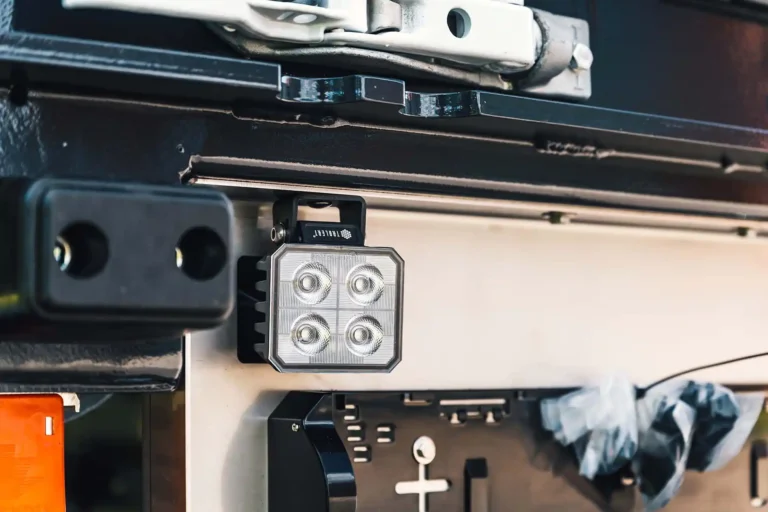
The short answer
When performing surface mounting on O3 trailers and semi-trailers, additional lighting is often required: for reversing, manoeuvring or loading and unloading. Since June 2023, UNECE R48 has also provided for manoeuvring lights on trailers and semi-trailers.
This article covers the technical regulations and distinguishes between European vehicle type-approval (WVTA) and retrofitting to existing vehicles. Are you dealing with a heavier semi-trailer? If so, please refer to the regulations for additional lighting on O4 semi-trailers (over 10 tonnes).
The O3 category includes, amongst others, city semi-trailers, curtain-sided semi-trailers, machine transporters, car transporters, tippers and heavy centre-axle or bogie trailers.
We distinguish between three light functions: additional reverse lights (AR), manoeuvring lights (ML) and work lights. The requirements for approval, number and connection vary depending on the function.
| Type of functional lighting | Legally required (O3) | Maximum permitted number | Required ECE approval | Switching conditions | Typical O3 vehicle application |
|---|---|---|---|---|---|
| Type of functional lightingAdditional reverse lights (AR) | Legally required (O3) Yes, basic lighting is mandatory. The number required depends on the vehicle’s length. | Maximum permitted number: For vehicles longer than 6 m, a maximum of 2 additional reversing lights, at the rear or on the sides. | Required ECE approval: ECE R23 or R148, with approval for function AR. | Activation conditions: Normally linked to reversing. For optional side reversing lights, a separate manoeuvring function is also available under certain conditions. | Typical O3 vehicle applications: Refrigerated trailer, enclosed trailer, flatbed trailer. |
| Type of functional lightingManoeuvring lights (ML) | Legally required (O3) No, optional. | Maximum permitted number: Up to and including 6 m: max. 2. More than 6 m up to and including 9 m: max. 4. Longer than 9 m: max. 6. | Required ECE approval: ECE R23 or R148, with approval for function ML. | Activation conditions: Only in accordance with the prescribed activation conditions. For trailers, these include switched-on position lights and automatic switch-off when travelling at speeds exceeding 15 km/h. | Typical O3 vehicle applications: City semi-trailers, curtain-sided semi-trailers, centre-axle trailers. |
| Type of functional lightingWork lights for loading and unloading | Legally required (O3) No, optional. | Maximum permitted number: There is no general numerical limit, as is the case with AR and ML lights. | Required ECE approval: No AR or ML function approval is required for work lights only. Assess relevant EMC requirements separately. | Operating conditions: Separate control recommended. Use in accordance with national regulations and local conditions. | Typical O3 vehicle applications: Machinery transporters, tipper trailers, car transporters. |
The vehicle types mentioned are examples of applications. The legal requirements apply to the relevant vehicle category and light function, not exclusively to these specific models. The applicability of specific UNECE provisions depends in part on the applicable series of amendments and the approval route.
The product name is not the deciding factor here. A lamp marketed as an LED work light is not automatically approved for use as a reverse light or manoeuvring light. For this, the relevant function must be clearly stated in the approval documentation and on the marking.
We do not cover the standard requirements for mandatory vehicle lighting here. For this, please refer to the TRALERT® overview of truck and semi-trailer lighting.
Reversing lights illuminate the area behind the vehicle and make reversing visible to other road users.
The relevant installation regulations are set out in UNECE R48.
| Vehicle length | Number of reverse lights |
|---|---|
| Vehicle length: Up to and including 6 metres | Number of reversing lights: 1 mandatory, a second optional |
| Vehicle length: Long er than 6 metres | Number of reversing lights: 2 mandatory, up to 2 additional optional |
For an O3 trailer longer than 6 metres, a maximum of four reverse lights are therefore permitted.
The two optional lights may be fitted at the rear or, subject to certain conditions, on the sides.
The maximum of two additional lights applies to the rear and sides combined.
Under UNECE R48, standard reverse lights must be fitted at a height of between 250 and 1,200 mm above the road surface. There are also requirements regarding horizontal and vertical visibility and the direction in which the light is mounted.
When mounting, take into account the surface mounting, rear bumper, tail lift and other vehicle components.
For vehicles longer than 6 metres, the two optional reverse lights may also be fitted to the sides.
Side lights provide extra visibility along the sides of the vehicle, for example when reversing into a loading bay.
Side mounting must comply with the applicable orientation and visibility regulations. A light that is approved solely for mounting directly to the right is not automatically suitable for every side position.
The Dutch RDW MOT handbook also explicitly states that additional reversing lights may be fitted to the side of a trailer.
Reversing lights are normally switched on automatically when reverse gear is selected.
For the two optional side reversing lights, UNECE R48 also provides a specific provision for their use during slow forward manoeuvres.
Additional conditions apply, including separate control and automatic switch-off when the forward speed exceeds 10 km/h.
In the case of retrofitting, it must also be checked whether the chosen wiring configuration is permitted in accordance with the national requirements for the vehicle in question.
The light itself must have a valid approval for the reversing function in accordance with ECE R23 or R148. A light used as a reverse light must be approved for the AR function.
When selecting products, check not only the ECE standard but also the function code, marking and technical documentation.
A general E-mark or ECE R10 approval does not automatically make a light suitable for use as a reverse light.
On O3 trailers, you can use these TRALERT® work lights as additional reversing lights, as well as extra work lights during loading and unloading. The WR-1829V is ECE R23-approved, the WR-4065V combines R23 with ADR, and the WR-2428.1 is an IP69K-resistant work light delivering 2,800 lumens. The WAC-40DTC and WAC-150DTC extension cables and the WAC-30100Y Y-cable are handy accessories for connecting the lights. In addition to these examples, we offer a wider selection of LED work lights, with a solution available for every situation.
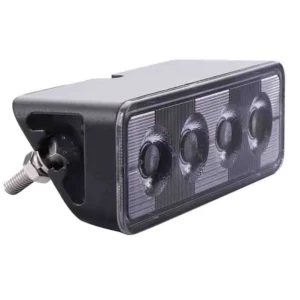


Manoeuvring lights are designed to illuminate the area immediately adjacent to the vehicle during low-speed manoeuvres.
Since June 2023, this light function has also been included within UNECE R48 for trailers and semi-trailers.
| Length of O3 vehicle | Maximum number of manoeuvring lights |
|---|---|
| O3 vehicle length: Up to and including 6 metres | Maximum number of manoeuvring lights²: 1 per side |
| O3 vehicle length: More than 6 metres up to and including 9 metres | Maximum number of manoeuvring lights: 4, maximum 2 per side |
| Length of O3 vehicle: Longer than 9 metres | Maximum number of manoeuvring lights: 6, maximum 3 per side |
The maximum of six applies exclusively to vehicles longer than 9 metres.
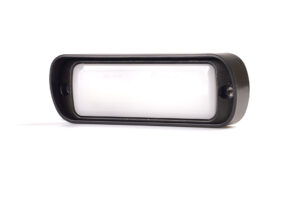
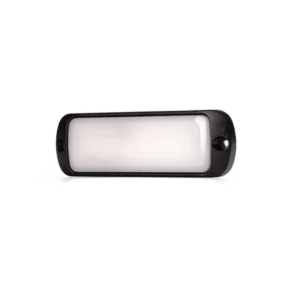
These manoeuvring lights from the TRALERT® range illuminate the side of the semi-trailer during manoeuvring, loading and unloading. Both models deliver 1,500 lumen at 16 watts, operate on 12–24 V and are IP69K-resistant. They have ECE R148 approval (plus R10 for EMC) and a 250 cm cable with an open wire end. The WML-1200 and WML-1210 differ in dimensions and centre distance, allowing you to match the light to the available space in the chassis.
The maximum mounting height is 1,500 mm above the road surface. There are also requirements regarding longitudinal positioning, spacing between lights and the area that must be visible from the light.
When integrating the lighting into the chassis, the vehicle’s construction must be taken into account. Components such as side guards, mudguards, axles and bodywork must not unduly restrict the required light distribution.
Since 2005, TRALERT® has specialised in ECE-approved, shock- and water-resistant LED lighting for semi-trailers, trailers and heavy goods vehicles.
See our lighting for heavy transport →
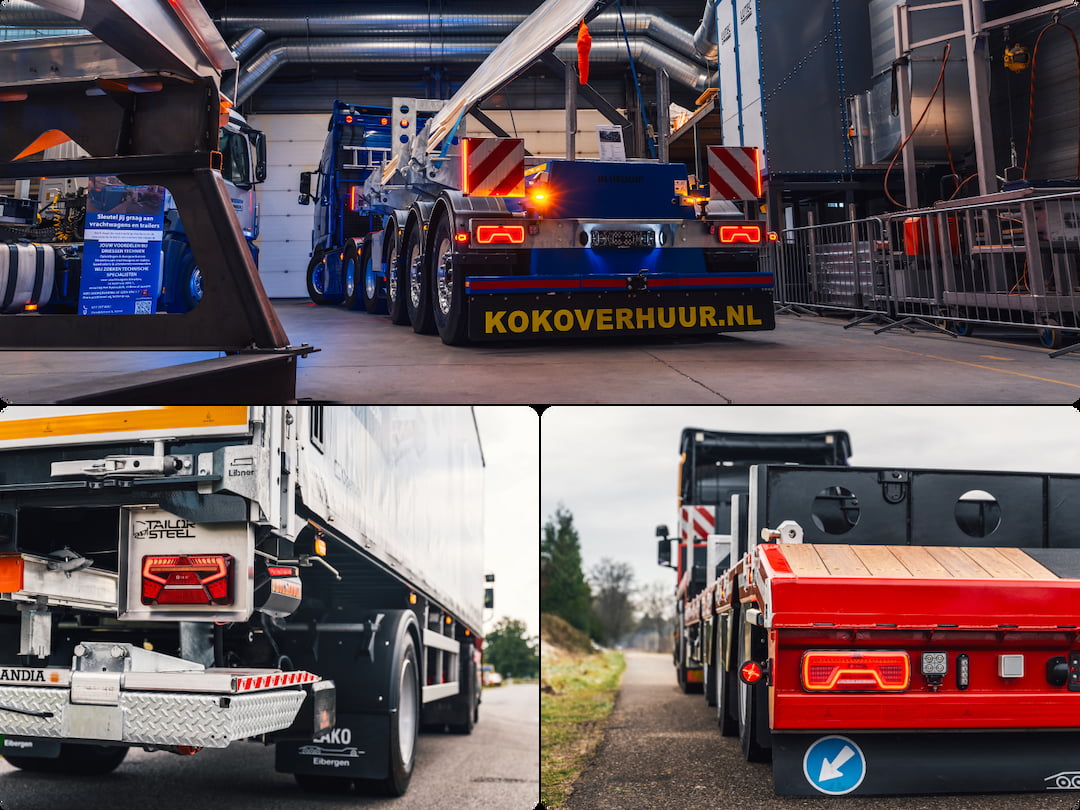
Manoeuvring lights must be specifically approved for the ML function in accordance with ECE R23 or R148.
The function code ML indicates that the light has been approved for manoeuvring lights. The light distribution and photometric requirements differ from those for an AR reverse light.
A light with only an AR approval must therefore not be used as a manoeuvring light without further consideration. The same applies the other way round.
An example of a manoeuvring light from the TRALERT® range. The light operates at 12–24 V and produces a light output of 900 lm with a power consumption of 25 W. With dimensions of 200.6 x 26.6 x 65.9 mm, the light can be easily integrated into a wide variety of vehicle configurations.

Available on backorder
The operation of manoeuvring lights is subject to certain conditions.
Under the regulations for trailers, the manoeuvring lights must not be able to be switched on when the trailer’s position lights are switched off.
Automatic activation is permitted under the conditions described in UNECE R48, for example in conjunction with the reversing function or a reversing camera system.
A key requirement is that the manoeuvring lights switch off automatically as soon as the trailer’s forward speed exceeds 15 km/h.
The speed data must be sourced directly from the trailer. Depending on the vehicle configuration, data from the electronic braking system (EBS) may be used for this purpose.
You should therefore decide during the design phase how the speed signal and control system will be integrated.
Connecting an ML light exclusively to the reverse circuit is therefore not sufficient to comply with all installation regulations.
Not all additional lighting needs to fulfil an AR or ML function.
Individually switchable work lights are often suitable for illuminating a work area.
This light function is used, amongst other things, for tail lifts, tool compartments, ramps and work carried out around the vehicle.
Examples of applications include:
For standard work lights, there is no comparable numerical limit as there is for AR and ML lights.
This does not mean that the use of lighting is unrestricted. Installation and use must continue to comply with the relevant national regulations and must not cause any danger or nuisance to other road users.
An underbody light can illuminate the area next to a tail lift; a higher-mounted work light typically covers a larger area.
For vehicles operating internationally, it is advisable to also take into account the regulations of the relevant countries when deciding on the fitting position.
A standard work light without AR approval must not be used as a replacement for a reverse light.
Where lighting is required to switch on automatically when reversing, an approved light function and a circuit that complies with the applicable regulations must be selected.
For work lights used exclusively whilst carrying out work, a separate control system is usually the clearest solution.
This can be achieved, for example, via a switch on the vehicle or a separate control from the cab.
The regulations vary from country to country.
In the Netherlands, work lights on trailers are permitted. However, their use must not pose a danger or cause a nuisance to other road users.
In Germany, Section 52(7) of the StVZO stipulates that work lights must not be used whilst the vehicle is in motion. Furthermore, other road users must not be dazzled.
When using the vehicle internationally, please take into account the regulations of the countries in which the vehicle is operated.
The assessment differs between new vehicles with European type approval and existing vehicles to which lighting is fitted as a retrofit.
For a new O3 trailer, the lighting can be included in the European type approval for the entire vehicle right from the design stage.
For AR and ML lighting, it must be demonstrated, amongst other things, that:
You should therefore finalise the lighting configuration early in the development process, particularly where there are multiple vehicle variants.
When retrofitting additional lighting to existing O3 vehicles, national regulations must be taken into account. This is a frequent source of confusion, as national regulations for vehicles in service do not always align directly with the latest amendments to UNECE R48.
A key example is manoeuvring lights (ML). Although this light function has been included for trailers and semi-trailers under UNECE R48 since June 2023, it is not always specifically listed as permitted lighting in national regulations. Consequently, retrofitting may result in the vehicle failing its roadworthiness truck, even if the light itself has the correct ML approval.
For applications where additional lighting is required during loading, unloading or other work carried out around the vehicle, separately switched work lights may be an alternative. Work lights are not subject to the same installation regulations as manoeuvring lights and are permitted in various countries, subject to certain conditions.
It is important to note that the lights must actually be used as work lights. Simply re-labelling a manoeuvring light does not automatically make an installation permissible. The mounting, electrical connection and use must comply with the applicable national regulations.
TRALERT® has been a specialist in certified LED vehicle lighting for bodywork and semi-trailer construction since 2005. From cable sets to plug-and-play solutions for professional 24V vehicle bodies.
See what we do for bodybuilding →
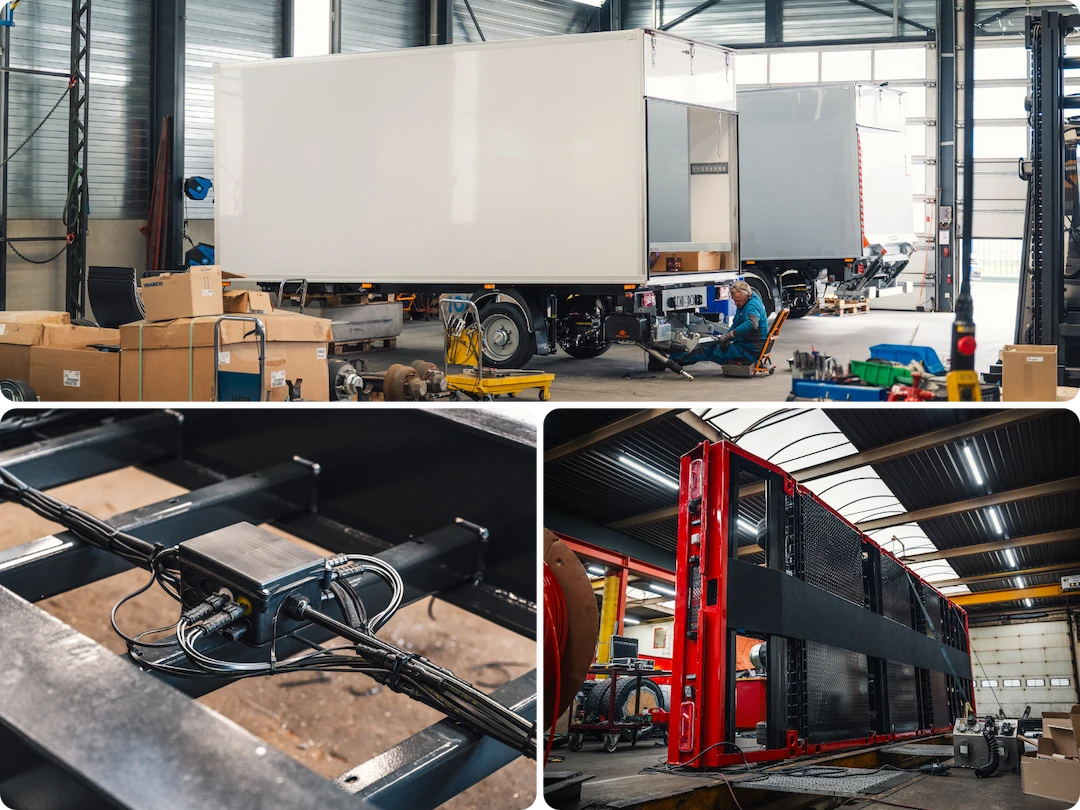
For an existing O3 trailer where additional light is required when reversing, approved AR reversing lights may be a suitable solution.
For loading and unloading, separately switched work lights are often the best choice. For intensive use or harsh conditions, TRALERT®’s heavy-duty work lights may be the right solution.
Watch the TRALERT® video on UN ECE standards and legislation for an explanation of how vehicle lighting regulations are developed and applied.
Modern vehicles can monitor the operation of lighting systems electronically. Connecting additional LED lights may affect the load on an electrical circuit or the signals monitored by the vehicle. Read more about the causes and possible solutions in our article on CAN bus faults with LED lighting.
ECE R10 relates to the electromagnetic compatibility (EMC) of vehicles and electrical or electronic components.
These regulations are relevant to the selection and integration of LED lighting, but are separate from the specific functional approval for reversing lights and manoeuvring lights.
An ECE R10 approval does not replace an AR or ML functional approval. Even for approved AR and ML lights, the applicable EMC requirements must be assessed.
Use the checklist below when selecting and integrating additional lighting.
Early consultation prevents unnecessary modifications to the structure or electrical installation.
For O3 trailers longer than 6 metres, UNECE R48 stipulates two mandatory and up to two optional reverse lights. The two additional lights may be fitted at the rear or, subject to the applicable conditions, on the sides.
An AR-approved reverse light is intended to provide lighting whilst reversing. An ML-approved manoeuvring light illuminates the area alongside the vehicle during low-speed manoeuvres. Both functions have their own specific requirements regarding light distribution, mounting and circuitry.
This depends on the vehicle length. Up to and including 6 metres, a maximum of two manoeuvring lights are permitted; for lengths of more than 6 metres up to and including 9 metres, a maximum of four; and for lengths of more than 9 metres, a maximum of six. These numbers apply within the relevant UNECE installation regulations.
A standard work light without AR approval must not be used as a reverse light. Where additional lighting is required to operate automatically when reversing, the light must be approved for that function and the installation must comply with the relevant regulations.
The approval of manoeuvring lights under UNECE R48 does not automatically mean that every existing O3 trailer may be retrofitted with this light function. National regulations and any implications for vehicle type-approval must be assessed on a case-by-case basis.
TRALERT® supplies LED vehicle lighting to trailer manufacturers, bodywork companies and professional workshops. In addition to individual reversing lights and work lights, we also offer cabling, connectors and complete lighting solutions.
From product selection to integration into a vehicle, our specialists work with you to explore the technical possibilities, mounting and electrical connections.
Would you like to fit additional lighting to a new O3 trailer or modify an existing vehicle configuration? Please contact TRALERT® to discuss the options for your application.
View our solutions for bodybuilding
Disclaimer:
At TRALERT®, we do our best to keep the information in this article as accurate and up-to-date as possible, including the regulations surrounding vehicle lighting. However, legislation can change regularly, and although we make every effort to implement these changes in a timely manner, it is possible that certain updates or adjustments have not yet been incorporated into this article. We therefore always advise our readers to check the current legislation with their local government or regulatory bodies, especially when it comes to exceptions or specific national regulations. TRALERT® is not liable for any damages or fines resulting from outdated or incomplete information in this article.
If in doubt, always contact the competent authority to ensure that your vehicle meets all legal requirements.

A selection of LED lighting for trucks and trailers.
A comprehensive overview of our LED vehicle lighting and accessories.
Plug-&-play lighting kits, cabling and lighting for bodybuilders.
What TRALERT® can do for you as a partner in LED vehicle lighting.
Plug-&-play kits, cabling and lighting for 24V semi-trailers.
A selection of high-quality LED driving lights and LED bars.
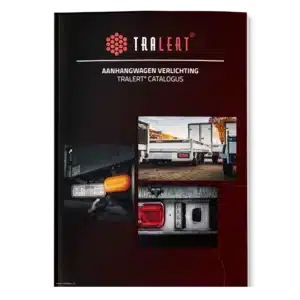
Lighting, wiring harnesses and accessories for trailers.
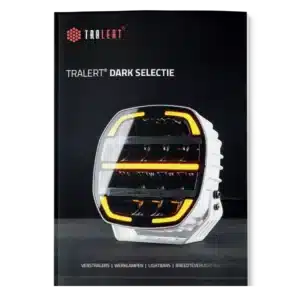
The TRALERT® DARK LED range.
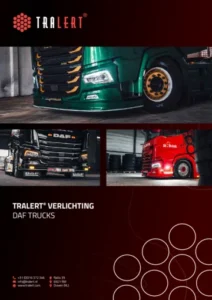
Work lights, rear lights, driving lights, beacor bars and more for DAF Trucks.
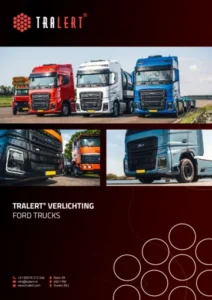
Work lights, rear lights, driving lights, beacor bars and more for Ford Trucks.
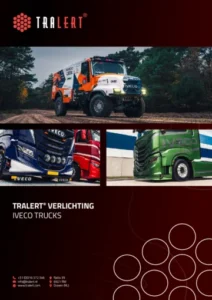
Work lights, rear lights, driving lights, beacon bars and more for Iveco.
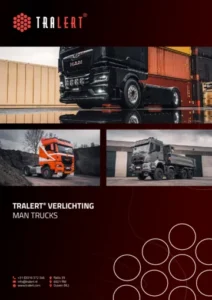
Work lights, rear lights, driving lights, beacon bars and more for MAN.
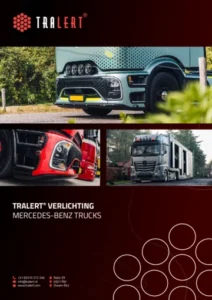
Work lights, rear lights, driving lights, beacon bars and more for Mercedes-Benz Trucks.
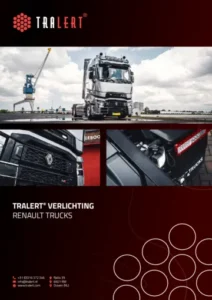
Work lights, rear lights, driving lights, beacor bars and more for Renault Trucks.
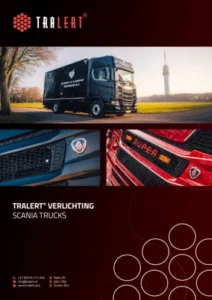
Work lights, rear lights, driving lights, beacor bars and more for Scania.
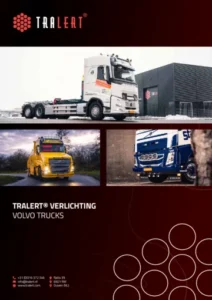
Work lights, rear lights, driving lights, beacon bars and more for Volvo Trucks.
The catalogue opens in a new tab. Can’t see it?
Open the catalogue (PDF)Two questions, in 30 seconds.
TRALERT® works with a dealer network. Dealers can view current stock levels, place orders online on account and receive a product feed for their online shop or system. We assess each enquiry internally and will let you know within 1 to 2 working days whether a partnership is possible.
You can purchase TRALERT® lighting through our partners, either locally or online. Simply provide your details, and we’ll find the partner best suited to help you.
Would you prefer to find a stockist yourself?We will assess your enquiry internally. You will hear from us within 1 to 2 working days to let you know whether a partnership is possible.
We’ll let you know within 1 to 2 working days which partner will be able to assist you further.
New
The Trailerkit Configurator is now live
Put together your ‘ trailer ’ and receive the complete lighting kit packaged as a single set: lighting, marker lights and wiring harnesses, all coordinated and ready for mounting. Includes a mounting diagram and mounting instructions.
Launch the configuratorTRALERT® operates through a dealer network. Prices, stock levels and online ordering are therefore only available to business customers with an account.
We assess every enquiry internally and will let you know within 1 to 2 working days whether a partnership is possible.
For your own use?Find a stockist
Would you prefer a quote first?Add this product to your quotation request and send it off when you’re ready.