

Blog
Various maximum vehicle lengths apply to long-haul transport in Germany. Standard lorry combinations may generally be up to 16.50 or 18.75 metres long. For ‘Lang-Lkw’, lengths of up to 25.25 metres are permitted under certain conditions.
The vehicle types, maximum lengths, permitted routes and additional technical requirements for long lorries are laid down in the German exemption regulation LKWÜberlStVAusnV. Long-Lkw may only be used if the combination meets these requirements and, depending on the vehicle type, utilises the official Positivnetz.
In this article, you will read:
- what the maximum vehicle lengths are in Germany;
- What are the five types of long-haul lorries?;
- when a vehicle needs to use the positive network;
- What lighting requirements apply to standard long vehicles?;
- What additional requirements apply to long lorries?
- what needs to be checked during a technical assessment.
A ‘Lang-Lkw’ is not the same as a vehicle with protruding loads or an exceptional load requiring a permit. Different regulations apply to these types of transport. This article therefore focuses on standard vehicle combinations and ‘Lang-Lkw’.
Long-load transport in Germany: lighting requirements explained in a short manner
Long-haul transport in Germany imposes requirements not only on the maximum length of a vehicle combination, but also on the lighting and markings along the vehicle. In this video, TRALERT® explains which rules apply to side markings on long vehicle combinations in Germany and when marker lights with an indicator function are permitted. This is useful if you are fitting out a truck, trailer or semi-trailer that must comply with German requirements.
Maximum truck length in Germany
In Germany, a standard motor vehicle or trailer may be a maximum of 12.00 metres long. For a tractor unit with a semi-trailer, a maximum length of 16.50 metres applies under the usual conditions. A truck with a trailer may be a maximum of 18.75 metres long.
Depending on the type, different maximum lengths apply to long lorries.
| Vehicle or combination | Maximum length |
|---|---|
| Standard motor vehicle or standard trailer | 12.00 m |
| Standard tractor unit with semi-trailer | 16.50 m |
| Standard truck with trailer | 18.75 m |
| Long lorry type 1 | 17.88 m |
| Long lorries types 2, 3 and 4 | 25.25 m |
| Long-Lkw type 5 | 24.00 m |
Standard vehicle lengths are laid down in Section 32 of the German Road Traffic Licensing Regulations (StVZO). Longer ‘Lang-Lkw’ combinations are permitted under a separate German exemption regulation.
Vehicles and combinations falling under the ‘Lang-LKW’ category
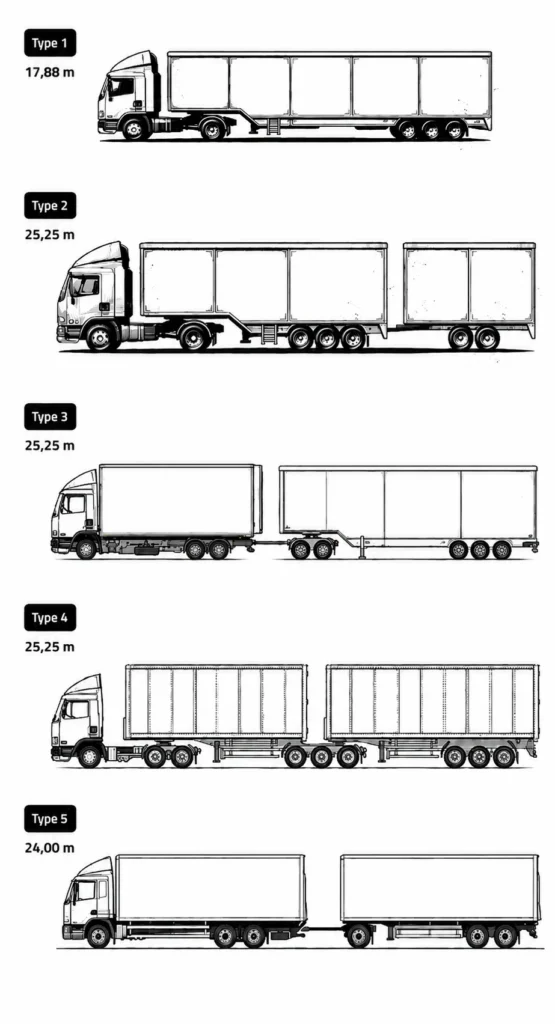
The different types of long-haul lorries
Germany distinguishes between five types of long lorries in the LKWÜberlStVAusnV:
- Type 1: an extended tractor-trailer combination up to a maximum of 17.88 metres.
- Type 2: a tractor unit with a semi-trailer and centre-axle trailer up to a maximum of 25.25 metres.
- Type 3: a truck with a dolly and semi-trailer up to a maximum of 25.25 metres.
- Type 4: a tractor unit with two semi-trailers up to a maximum of 25.25 metres.
- Type 5: a truck with a trailer up to a maximum of 24.00 metres.
Type 1 has temporary status and, under the current regulations, is permitted until 31 December 2026. Types 2 to 5 are subject to permanent authorisation on the relevant sections of the German road network. The maximum length for trucks in Germany is 25.25 m.
Lighting for long-load transport
Since 2005, TRALERT® has specialised in ECE-approved, shock- and water-resistant LED lighting for semi-trailers, trailers and heavy goods vehicles.
View our lighting for semi-trailers →
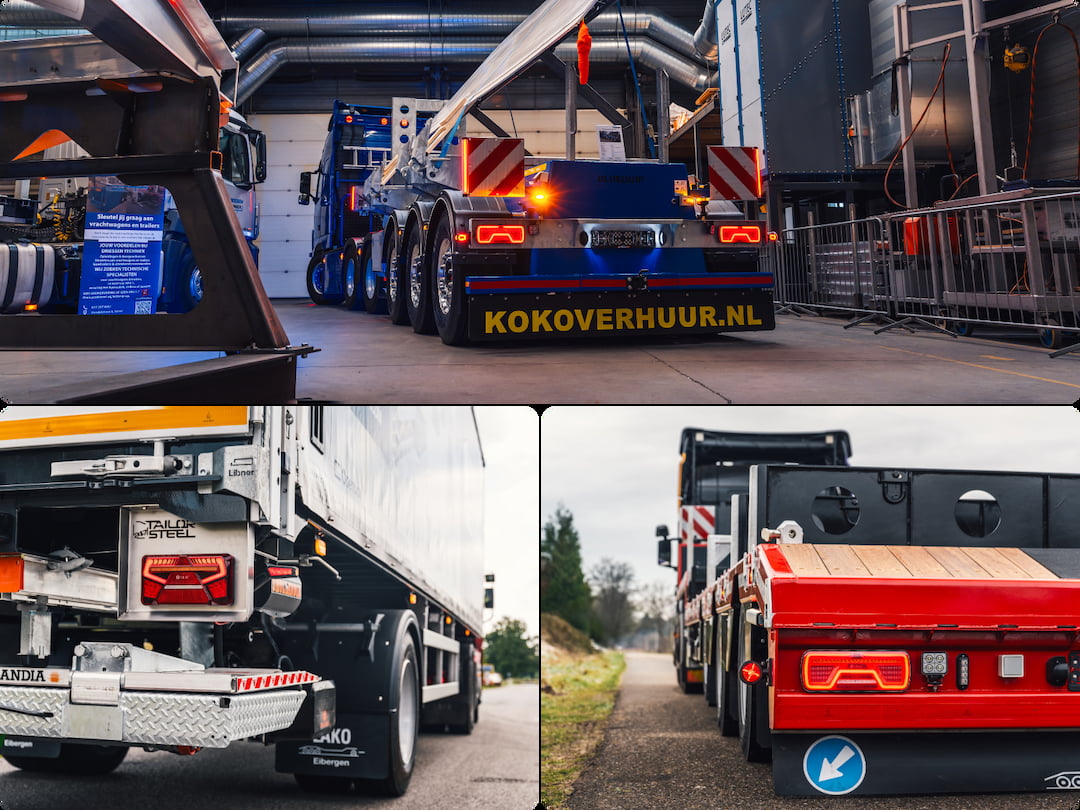
Lighting requirements for standard long vehicles
Standard trucks, semi-trailers and trailers must comply with the general regulations for the mounting and operation of vehicle lighting in accordance with ECE R48. The length of the vehicle influences, amongst other things, the number and positioning of side marker lights and side indicators. For vehicles and trailers longer than 6 metres, side marker lights are, in principle, compulsory. These must be positioned in such a way that the entire side of the vehicle is sufficiently visible. Regulations apply regarding the maximum distance from the front and rear and the spacing between the lights.
A comprehensive overview of light functions, colours, mounting positions and approvals can be found in our main article on regulations for trucks and semi-trailers.
The additional lighting requirements for long lorries
Additional side indicators
The additional technical requirements for German long lorries are set out in § 5 of the LKWÜberlStVAusnV. Two provisions are particularly relevant for lighting: the trailer must be fitted with track-following lights in accordance with § 51(4) StVZO, and both the towing vehicle and the trailer or semi-trailer must, regardless of the original approval date, comply with paragraph 6.5.3.1 of UNECE R48.
Where additional side indicators are required under this provision, they must be evenly distributed across the side of the vehicle. The required configuration may consist of additional Category 5 side direction indicators or of at least three mandatory amber coloured side marker lights that flash simultaneously and in phase with the indicators.
This requirement also applies to older long-haul lorries. For vehicles first registered before 1 July 2019, the requirement has been in force since 1 July 2022.
A standard amber coloured side marker light is not automatically suitable for use as marker lights with an indicator function. Check that the light has the required approval, is suitable for the flashing function, and is connected and fitted in accordance with UNECE R48. You can read more about this in our in-depth article on the rules for side marking for LZV transport in Germany.
Track-following lights mandatory for German long-haul lorries
A specific German requirement for long lorries is the use of so-called ‘Spurhalteleuchten’. These are two white, forward-facing lights fitted to the rear end of both sides of the trailer. They help the driver to assess the position and lane-keeping of the trailer in the dark. For standard O3 and O4 trailers, these lights are not generally mandatory under UNECE R48. The German StVZO does, however, permit them, whilst the German Long-Lkw Regulation makes them mandatory for the trailer of a Long-Lkw.
In which areas does Germany comply with UNECE R48, and where does it deviate from it?
Germany does not prescribe any different numbers or separate lamp categories for side direction indicators on long lorries. The technical specification complies with UNECE R48, paragraph 6.5.3.1.
The key German requirement is that, for a ‘Lang-Lkw’, this regulation always applies to both the towing vehicle and the trailer or semi-trailer, regardless of the original type-approval date. Consequently, older ‘Lang-Lkw’ must also be retrofitted where necessary.
| Topic | Standard O3/O4 trailer | Long lorries in Germany |
|---|---|---|
| Technical specifications | In accordance with the applicable UNECE R48 type approval | In accordance with UNECE R48 §6.5.3.1 |
| Retrofitting older vehicles | Not standard simply because of its age | What if §6.5.3.1 is not complied with? |
| Check the tractor unit and trailer separately | Depending on vehicle category and approval | Explicitly mandatory |
| Track-following lights on the trailer | Permitted | Mandatory |
What is the Positivnetz in Germany?
The Positivnetz is the official German road network on which Type 2 to 5 long lorries are permitted to travel. It consists of authorised motorways, Bundesstraßen and local access routes. Not only the main route, but also the route to the loading or unloading location must be included in the network.
A route suggested by a sat-nav system is therefore not automatically permitted. Even in the event of a road closure, a driver must not simply follow a diversion outside the Positivnetz. Before setting off, it must be checked whether the entire route is available and authorised.
You can find the current routes on the German Federal Ministry of Transport’s page on long-haul lorries and on the corresponding map provided by Positivnetz.
Exception for Type 1 long lorries
Under the current temporary regulations, Type 1 long lorries are also permitted to travel outside the Positivnetz on the entire road network of fifteen German federal states. Berlin is excluded from this. Under the current regulations, this exemption applies until 31 December 2026.
What documents are required for use in Germany?
Compliance with the prescribed sizes and technical requirements must be demonstrated by means of a report from an officially recognised expert or an authorised technical service. The report, or a copy thereof, must be carried whilst the vehicle is in use and must be available for inspection.
Checkpoints for vehicle manufacturers
- Determine which long-haul lorry type the combination falls under.
- Check the overall length and the relevant partial dimensions.
- Check that the entire route is authorised.
- Check the tractor unit and trailer separately for compliance with UNECE R48 §6.5.3.1.
- Check the approval, mounting and wiring of the side lighting.
- Check the track-following lights on the trailer.
- Check the mandatory contour marking and the ‘Lang-Lkw’ sign.
- Ensure that the required expert report is present in the vehicle.
Long-load transport between the Netherlands and Germany
A Dutch LZV combination may not be driven in Germany solely on the basis of its Dutch authorisation as a Lang-Lkw. The combination must also comply with German technical requirements and may only use the authorised routes.
When transporting goods across borders, you should therefore always check both the technical vehicle requirements and the current route conditions with the relevant authorities.
In addition to the length, please also check the vehicle width
Length and width are assessed separately. A vehicle may comply with the regulations in terms of length, but may still require additional lighting due to its width. Examples include end-outline marker lights or side marker lights.
So be sure to read our article on the maximum width of a truck to find out what the maximum vehicle widths are and when additional lighting is compulsory.
Disclaimer:
At TRALERT®, we do our best to keep the information in this article as accurate and up-to-date as possible, including the regulations surrounding vehicle lighting. However, legislation can change regularly, and although we make every effort to implement these changes in a timely manner, it is possible that certain updates or adjustments have not yet been incorporated into this article. We therefore always advise our readers to check the current legislation with their local government or regulatory bodies, especially when it comes to exceptions or specific national regulations. TRALERT® is not liable for any damages or fines resulting from outdated or incomplete information in this article.
If in doubt, always contact the competent authority to ensure that your vehicle meets all legal requirements.