Specialised partner in LED vehicle lighting

The short answer
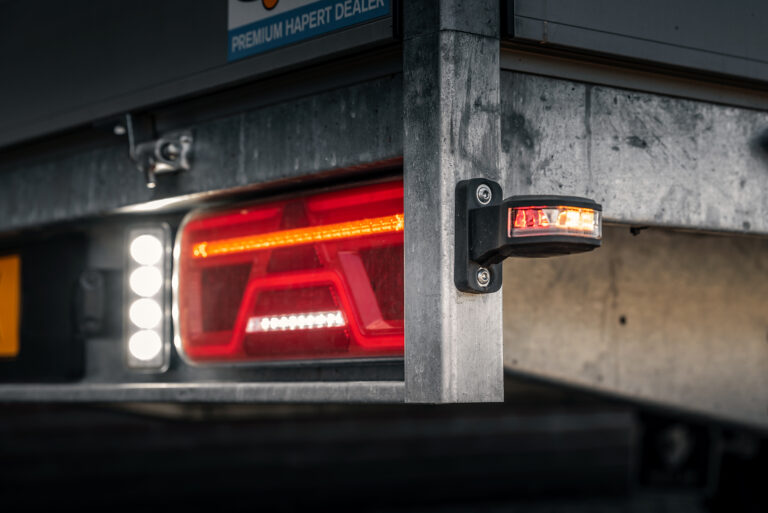
Are your trailer lights not working? In the workshop, this means immediate delays, additional diagnostics and possibly repair work before delivery. For vehicle builders, mechanics and service companies, interference with the trailer lighting is therefore not a minor issue, but a factor that affects planning, quality and customer satisfaction.
In practice, interference rarely occurs due to the luminaire itself. Much more often the cause lies in mass, cabling, connectors or the combination with the tow vehicle. Without targeted diagnosis, this quickly leads to unnecessary replacement of parts and recurring complaints.
In this article, you will read:
TRALERT® has been a specialist in LED lighting for trailers since 2005. From modern rear lights and marker lights to complete, easy-to-fit plug-&-play sets.
In most cases, the fault does not lie with the light itself, unless the lighting is uncertified – for example, lacking ECE R10 (EMC interference suppression). In practice, we find that most problems arise from a ground fault, corrosion or an issue with the combination of vehicle and trailer. In 12V systems in particular, interference occurs regularly due to wear and tear, moisture or poor connections.
That is why it is important to work systematically. Always start with the basics: power supply, mass and connection. In this article, we assume that the trailer lighting has been connected in accordance with the installation instructions for trailer lighting as per ECE R48.
A poor ground connection is by far the most common cause of interference with trailer lighting. This results in flashing lights, dim lighting or the complete failure of several functions at once.
Check that the mass connection is clean, solid and corrosion-free. Preferably use a fixed earth point and avoid mass via the tow bar.
Moisture and dirt in the plug connection often cause bad contacts. As a result, lights sometimes work and sometimes do not.
Clean the connector and socket thoroughly and check for oxidation. Is the connection consistently faulty? If so, read on to find out how to connect trailer lighting correctly.
Damaged cables are common in older trailers or where the trailer is used intensively. Breaks occur particularly at hinge points and moving parts.
Visually inspect the wiring harness and measure the voltage for each function. If in doubt, replace the wiring harness to prevent recurring interference. If you’re experiencing recurring problems, also check for common damage and interference in trailer lighting.
Although less often the cause, a defective light or LED unit can cause interference. With traditional lights, this often involves a burned-out bulb. With LED lighting, internal electronics can fail.
Are you considering stepping into the world of LED lighting for trailers? Then bear in mind compatibility and mounting. Read more about LED lighting for trailers.
Modern vehicles continuously check whether lighting is working correctly. Here, LED lighting can cause interference due to different power consumption.
In that case, a solution may be required. Take a look at our explanation of CANbus interference in LED lighting or read about what CANbus-compatible lighting means.
Use the official PIN configuration in accordance with ISO 11446 (most common for trailers):
| PIN | Function | Colour | Note |
|---|---|---|---|
| Pin1 | Function: Left indicator | Colour: Yellow | Note:L |
| Pin2 | Function: Rear fog light | Colour: Blue | Comment54g |
| Pin3 | Function Ground(for PINs 1 to 8) | Colour: White | Comment31 |
| Pin4 | Function: Right-hand indicator | Colour: Green | NoteR |
| Pin5 | Function: Rear light + number plate (right) | Colour: Brown | Note58R |
| Pin6 | Function: Brake Light | Colour: Red | Comment54 |
| Pin7 | Function: Rear light + number plate (left) | Colour: Black | Note58L |
| Pin8 | Function: Reversing light | Colour: Pink | NoteR |
| Pin9 | Function: Continuous +12V / +24V | Colour: Orange | Note: Battery power supply / fridge |
| Pin10 | Function: Switched+12V / +24V | Colour: Dark blue | Note: Additionalfeatures |
| Pin11 | Ground connectionfor PIN 10 | Colour: White | Note: Additionalmass |
| Pin12 | Trailer Presence / Detection function | Colour: Grey | Note: ECU signal |
| Pin13 | Groundfor PIN 9 | Colour: White | Note: Additionalmass |
Important tip: Double connection of licence plate lights (both PIN 5 and 7) causes short circuits or error messages.
Connect the trailer and switch on each function individually. Check at the lamp end or in the junction box:
Prevention is better than resolution. With the right mounting and component selection, you prevent most interference.
Correct installation prevents the vast majority of problems. So be sure to check the guidelines for trailer lighting and prevent interference before it occurs.
This is usually due to a poor mass connection or a broken cable. As a result, some lights receive power whilst others do not. Always check the mass connection and cabling first. More about trailer lighting.
Modern vehicles monitor power consumption. LED lighting uses less power, which causes the system to think that a light is faulty. A CAN bus solution can resolve this.

A selection of LED lighting for trucks and trailers.
A comprehensive overview of our LED vehicle lighting and accessories.
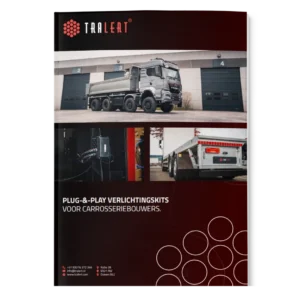
Plug-&-play lighting kits, cabling and lighting for bodybuilders.
What TRALERT® can do for you as a partner in LED vehicle lighting.
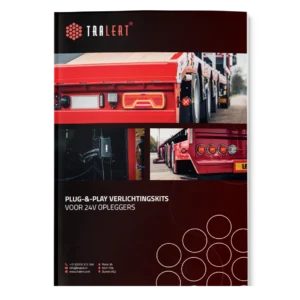
Plug-&-play kits, cabling and lighting for 24V semi-trailers.
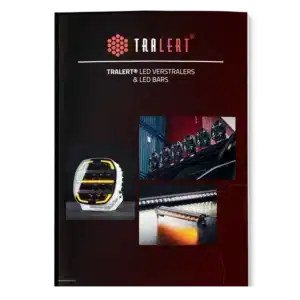
A selection of high-quality LED driving lights and LED bars.
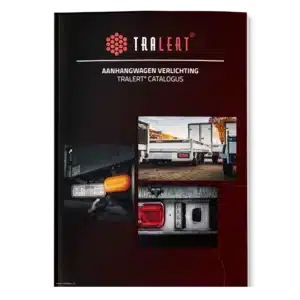
Lighting, wiring harnesses and accessories for trailers.
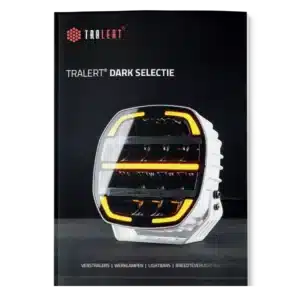
The TRALERT® DARK LED range.
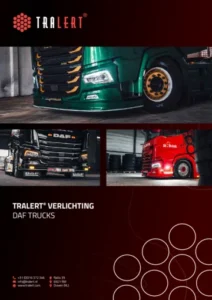
Work lights, rear lights, driving lights, beacor bars and more for DAF Trucks.
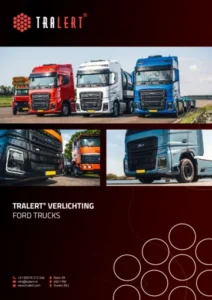
Work lights, rear lights, driving lights, beacor bars and more for Ford Trucks.
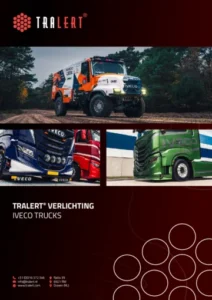
Work lights, rear lights, driving lights, beacon bars and more for Iveco.
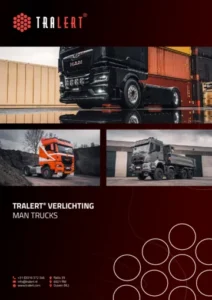
Work lights, rear lights, driving lights, beacon bars and more for MAN.
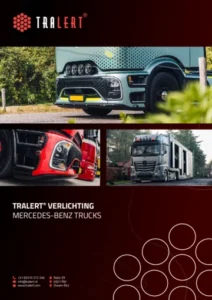
Work lights, rear lights, driving lights, beacon bars and more for Mercedes-Benz Trucks.
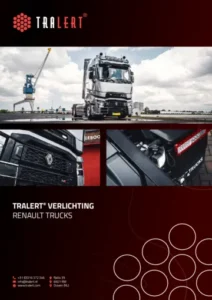
Work lights, rear lights, driving lights, beacor bars and more for Renault Trucks.
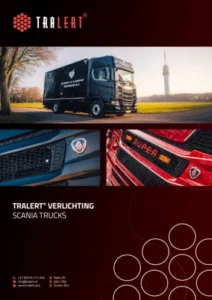
Work lights, rear lights, driving lights, beacor bars and more for Scania.
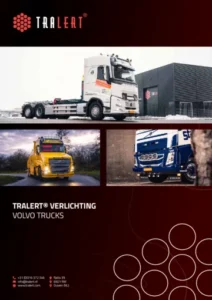
Work lights, rear lights, driving lights, beacon bars and more for Volvo Trucks.
The catalogue opens in a new tab. Can’t see it?
Open the catalogue (PDF)Two questions, in 30 seconds.
TRALERT® works with a dealer network. Dealers can view current stock levels, place orders online on account and receive a product feed for their online shop or system. We assess each enquiry internally and will let you know within 1 to 2 working days whether a partnership is possible.
You can purchase TRALERT® lighting through our partners, either locally or online. Simply provide your details, and we’ll find the partner best suited to help you.
Would you prefer to find a stockist yourself?We will assess your enquiry internally. You will hear from us within 1 to 2 working days to let you know whether a partnership is possible.
We’ll let you know within 1 to 2 working days which partner will be able to assist you further.