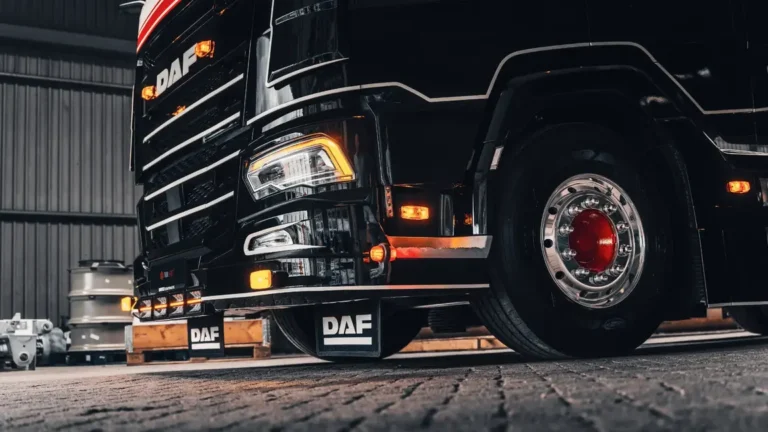
Amber lighting is used on trucks for various light functions, such as indicators and side marker lights. However, it is not just the colour that determines whether a light is permitted in a particular location. It is precisely the function of the lighting, its position on the vehicle, ECE approval and the intended use that make the difference. As a result, the same amber colour may be mandatory in one application, whilst in another situation it is not permitted. This overview therefore centres on one key question: when should amber lighting be fitted to a truck, and when should it not?
What does amber lighting mean on a truck?
Amber is the orange-yellow light colour you’ll see on trucks for various light functions. It is the signal colour used for warnings, changes of direction and side visibility. In practice, mechanics and bodybuilders often refer to orange or yellow lighting. However, the regulations specifically use the term amber’. You can read more about amber as a light colour on the page about the colour amber.
When is amber lighting on trucks mandatory?
Amber appears on a truck with different lighting:
indicators, front, rear and side
Side marker lights on the sides of truck, semi-trailers and trailers
side reflectors
signalling functions
Each function differs as to whether amber is mandatory, permitted or optional. The table below lists the most common applications.
Function
Colour
Application
Important focus
Function: Indicator
Colour: Amber
Application: Front, rear and side, depending on the vehicle
Important point to note: The lamp must be approved for use as a direction indicator.
Function: Side marker light
Colour: Amber
Application: Side of truck, semi-trailer or trailer
Important point to note: Installation in accordance with ECE R48; the rear light may be red when part of a cluster
Function: Side reflector
Colour: Amber-yellow
Application: Side of the vehicle
Important point to note: Position and height depend on the vehicle category
Function: Warning light
Colour: Amber
Applications: Work vehicles, special situations
Important note: Approved under ECE R65; usage varies by country
Function: Daytime Running Lights (DRL)
Colour: White, not amber
Application: Front of motor vehicle
Important note: Amber is not permitted for the DRL function on public roads
Function: Styling lights
KleurVaak amber
Application: Decorative appearance, no regulatory function
Important point to note: Only permitted if the light fulfils an approved light function
Amber side marker lights on trucks and semi-trailers
Side marker lights make the side of a long vehicle clearly visible to other road users, particularly in the dark and at junctions. On trucks, semi-trailers and trailers, they are therefore a core function, not just an extra.
The mounting position is fixed. Side marker lights are usually positioned between 0.25 and 1.50 metres above the road surface. If the vehicle’s design does not allow this, the mounting height may be increased to a maximum of 2.10 metres. For closed semi-trailers higher than 1.80 metres, it is important to take the full contour into account: depending on the vehicle category, length and surface mounting, lights may be required both at the bottom and at a higher position, so that the sides remain recognisable from both above and below. You should therefore always check the installation requirements for your vehicle type.
For regulatory purposes, you count two tracks. Installation on the vehicle is covered by ECE R48, the installation framework for lighting on vehicles in categories M, N and O. For new approvals, the type approval of the light itself is through UN Regulation R148, which merged previous separate regulations, including R91 for side marker lights. You may still come across references to R91 in older documentation or on existing products; those approvals remain valid during the transition.
Yes, but not with just any old marker light. ECE R48 permits amber side marker lights to flash, provided they flash in phase with the indicator on the same side. The light, the control unit and the installation must all be suitable for this function. Simply connecting a standard steady-beam light without the appropriate control unit to the indicator circuit is not a good solution.
This has also become a key consideration for newer vehicles. Since 1 January 2025, newly registered heavy semi-trailers in categories O3 and O4 must be fitted with side marker lights that flash in sync with the indicators, or with a separate side indicator. This measure improves the visibility of the vehicle’s flank when turning and changing lanes. Vehicles already in use remain permitted as they are. The exact application depends on the vehicle category, type approval and national implementation.
A nuance that saves money in practice: the rear side marker light may be red instead of amber, provided it is grouped or built together with, for example, the rear light, rear fog light or brake light. So a red rear side marker light is not automatically wrong, while many mechanics replace it as a precaution. Note that this is about the rear side marker lights, not the width or contour marker. The latter remains white to the front and red to the rear.
Amber lighting as an indicator
Amber is the standard signal colour for indicators. The condition is that the light must be specifically approved for the indicator function. New type approvals for indicators fall under UN Regulation R148. In older documentation or on older products, you may still come across references to R6.
Important distinction: a marker light is not automatically an indicator. Combination units that combine marker lights and indicators in a single housing do exist, but they should only be used in accordance with the manufacturer’s specifications. Otherwise, you run the risk of a function failing to meet the requirements for that specific type-approval.
Amber driving lights, LED driving lights and LED bars
Today, driving lights, LED driving lights and some headlight units often feature amber coloured position lights, sometimes advertised as "amber DRL" or "amber day running light". A nice touch to the eye, but as a daytime running light function on public roads, amber is not permitted. A position light must emit white light. This applies throughout the UNECE and EU framework and is reiterated in Dutch testing practice: position lights on commercial vehicles cannot be anything other than white.
The marketing name does not alter this. If a light fulfils the DRL function, the colour regulation for position lights applies, regardless of whether the packaging states amber DRL’. An amber position light on a driving light or LED bar must therefore not be used as a position light on the road. However, the same unit may emit amber light in another, approved function. Furthermore, position lights are a function intended for motor vehicles (categories M and N), not for trailers and semi-trailers (category O).
Practical advantage: Possibly this will change in time, but not yet. Within UNECE, a proposal to allow "selective yellow" in addition to white for position lights, among others, has been under discussion since 2026. This is currently not yet a valid law. Moreover, pay attention to the term: the proposal speaks of selective yellow, a specifically defined colour, which is not legally the same as "amber". So a future selective-yellow rule will not automatically make amber DRL permissible.
Amber beacons and warning lights on trucks
Amber flashing and strobe lights have another purpose: to warn and stand out during work or special situations. These lights are approved as special warning lights under ECE R65.
Usage varies greatly by country and application, for example for exceptional transport, auxiliary vehicles or roadside work. This is a separate issue and falls outside the scope of compulsory vehicle lighting. Therefore, do not confuse a warning lamp with a marking or signalling function.
Additional amber lighting and styling: what to look out for?
Not everything that is technically possible is permitted on public roads. Additional amber lights for appearance can pose an inspection or enforcement risk, especially if they mimic or interfere with mandatory light functions.
In doing so, keep three points in mind. The position and appearance to the front, side or rear determine whether a light can cause confusion with a mandatory function. A light should not emit red light to the front or white light to the rear. And additional lighting must have the correct ECE approval for the function you are using it for. Universal amber lights with no clear function approval are often a risk on the road.
Practical checklist for amber truck lighting
When in doubt, run through these points before fitting:
What is the function of the light: indicator, marker, reflector or warning light?
Which colour belongs to that function?
Does the light have the right ECE approval for that function?
Is the mounting position permitted for your vehicle category?
Should or may the light blink, and are light, control and installation suitable for this?
Is it a tractor unit, semi-trailer or trailer?
Does a national interpretation apply to your deployment area?
Frequently asked questions
Is orange lighting allowed on a truck?
Yes, provided the orange or amber coloured light is approved for the correct function and is fitted in an authorised position. Amber is the standard colour for indicators and side marker lights. Stricter requirements apply to additional styling lights, as these must not interfere with or mimic the mandatory light functions.
Can I mount additional amber lighting on my truck for styling purposes?
That depends on the position, function and appearance of the light. Additional amber lighting must not mimic, disturb or confuse mandatory light functions. Therefore, only use lighting with appropriate ECE approval and check whether the mounting position is permitted for your application.
Can amber position lights (DRL) be used on trucks?
No. A position light must emit white light, even when a product is offered as "amber DRL". An amber position light on an LED driving light or LED bar is therefore not allowed on public roads as a daytime driving light. The same light can, however, carry amber in another approved function.
Which ECE approval applies to amber side marker lights?
The light itself is approved as a light signalling device under UN Regulation R148, which merged the previous separate approval under R91. Installation on the vehicle is covered by ECE R48. So pay attention to two things: a valid type approval of the light and a mounting position that is permitted for your vehicle category.
Are you looking for amber lighting for a truck, surface mounting or semi-trailer? Take a look at TRALERT®’s range of LED lighting for trucks or get in touch for help in choosing the right light function, connection and product approval.
Disclaimer:
At TRALERT®, we do our best to keep the information in this article as accurate and up-to-date as possible, including the regulations surrounding vehicle lighting. However, legislation can change regularly, and although we make every effort to implement these changes in a timely manner, it is possible that certain updates or adjustments have not yet been incorporated into this article. We therefore always advise our readers to check the current legislation with their local government or regulatory bodies, especially when it comes to exceptions or specific national regulations. TRALERT® is not liable for any damages or fines resulting from outdated or incomplete information in this article.
If in doubt, always contact the competent authority to ensure that your vehicle meets all legal requirements.
Share this article:
ABOUT TRALERT®
TRALERT® is the leading manufacturer and partner in high-quality LED lighting solutions for commercial vehicles. By taking care of everything from drawing board to realisation, you and your customers can hit the road safely, carefree and professionally lit.
The TRALERT® Experience Centre is an interactive showroom with training and truck rooms. Experience TRALERT® LED vehicle lighting in practice and experience the lighting performance in different situations. Plan your Experience Centre visit.
Over 3,000 productsLighting and cabling for trucks, trailers, trailers and work vehicles
Fast delivery from our own stockOften delivered the next day; within 2 to 3 days across Europe
Advice from specialistsWe work with you to find the right lighting for your vehicle
Knowledge baseRegulations, connections and interference clearly explained
Two questions, in 30 seconds.
Question 1 of 2
Who is this lighting intended for?
Question 2 of 2
What suits your business best?
Dealer enquiry
Request access to our dealer portal
TRALERT® works with a dealer network. Dealers can view current stock levels, place orders online on account and receive a product feed for their online shop or system. We assess each enquiry internally and will let you know within 1 to 2 working days whether a partnership is possible.
Good to know
We’ll put you in touch with a partner
You can purchase TRALERT® lighting through our partners, either locally or online. Simply provide your details, and we’ll find the partner best suited to help you.
We will assess your enquiry internally. You will hear from us within 1 to 2 working days to let you know whether a partnership is possible.
Sent
Thank you!
We’ll let you know within 1 to 2 working days which partner will be able to assist you further.
New
The Trailerkit Configurator is now live
Put together your ‘ trailer ’ and receive the complete lighting kit packaged as a single set: lighting, marker lights and wiring harnesses, all coordinated and ready for mounting. Includes a mounting diagram and mounting instructions.