Specialised partner in LED vehicle lighting

The short answer
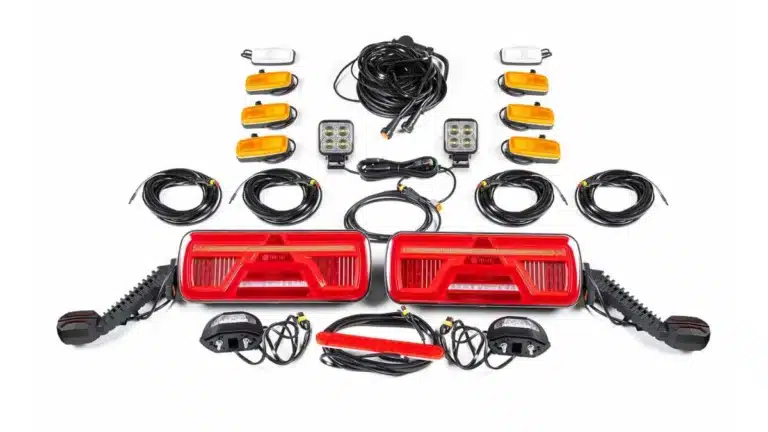
TRALERT® keeps a close eye on the market and shares the latest trends and innovations in lighting for trailer manufacturing. The key trends for 2026 therefore centre on a systems-based approach: ‘ plug-&-play ’ mounting, modular wiring harnesses, robust LED lighting and solutions that comply with current regulations. For trailer manufacturers, bodybuilders and purchasers, this means greater control over quality, mounting time and maintenance.
In this blog you will read:

The biggest shift is not in the lights themselves, but in how you bring them together. A modern lighting system consists of LED luminaires, a wiring harness, connectors, a distribution point and corresponding documentation. You no longer buy these parts separately, but rather coordinate them. This shifts the question from "which light fits here?" to "which system fits this vehicle type and production series?". It is precisely this system approach that reduces the risk of error and makes repeatable mounting possible.
This is where the greatest practical benefit lies. With plug-&-play lighting, a fitter connects pre-assembled components without cutting, stripping or soldering. This reduces installation time, lowers the risk of errors and ensures the result is reproducible across an entire production run. Particularly in series surface mounting, every minute per vehicle counts double. A standardised connector system also means that new staff can get up to speed more quickly and that field servicing is simpler. Take a look at the plug-&-play lighting kits for 24V trailers.
A modular wiring harness reduces wiring to fixed connection points and lengths. As a result, you deliver less customisation per vehicle and the routing in surface mounting remains the same. This affects the entire chain: work preparation is simpler, mounting faster and maintenance clearer. If anything ever breaks down, you replace a module instead of an entire line. A well thought-out design starts with professional cabling for vehicle lighting that is matched to the vehicle type.
Trailers and semi-trailers operate in harsh conditions: water, dirt, vibrations, temperature fluctuations and stone chips are all part and parcel of the job. Robust vehicle lighting copes with this thanks to a high IP rating, vibration-resistant housings and resistance to aggressive cleaning. For most trailer applications, IP67 is the standard. If you wash vehicles with a high-pressure washer or work in extreme conditions, you’re better off choosing IP69K. That choice makes the difference between years of trouble-free driving and premature breakdowns.
An IP69K rating means that a luminaire can withstand water jets at approximately 80 °C under pressures of 80 to 100 bar. This is precisely the level of stress a trailer is subjected to in a professional car wash.

However clever a solution may be, it must, of course, comply with the regulations. ECE regulations specify the position, function, colour and visibility of each light function, whilst ECE R10 ensures electromagnetic compatibility. You should therefore always opt for ECE-approved components and record the approvals in your documentation. A trend may speed up mounting, but never at the expense of homologation. You can read more about this in the article on the applicable regulations for truck and trailer lighting, or consult the official UNECE vehicle regulations.
Appearance has become a serious selling point. A dark "dark look", slim marker lights and a uniform light colour give a fleet a recognisable and professional face. For bodybuilders, uniformity is also practical: the same components on every vehicle mean fewer variants in our stock and a more consistent end result. Shape and function reinforce each other here.

The red thread running through these trends is standardisation. Specifically, this means:
This reduces failure costs and delivers predictable quality, vehicle after vehicle.
Trends are only valuable if they pay off in your workshop. TRALERT® combines LED lighting, modular cabling and plug-&-play solutions into a single system tailored to your vehicle type and production process. Would you like to speed up your mounting and reduce your failure costs? Then take a look at the page on TRALERT® lighting kits or ask our advisers for a bespoke lighting plan.
Plug-&-play lighting shortens installation time and reduces the risk of errors, as fitters connect pre-assembled components without cutting or soldering. In series surface mounting, this produces reproducible results and lower failure costs. In addition, field service is easier, as components are quickly interchangeable via fixed connectors.
For most trailer and semi-trailer applications, IP67 is the standard: dust- and waterproof, even during temporary immersion. If you clean vehicles with a high-pressure washer or work in extreme conditions, IP69K offers extra certainties against hot, powerful jets of water. Choose the rating that suits the intensity of your daily use.
Yes, provided you use ECE-approved components. ECE R48 determines the position and function of each light source, while ECE R10 ensures electromagnetic compatibility. Modular systems do not change this: the approval is in the components themselves. Record the homologation numbers in your documentation so that you can prove everything when inspected or delivered.

A selection of LED lighting for trucks and trailers.
A comprehensive overview of our LED vehicle lighting and accessories.
Plug-&-play lighting kits, cabling and lighting for bodybuilders.
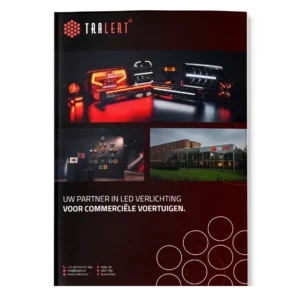
What TRALERT® can do for you as a partner in LED vehicle lighting.
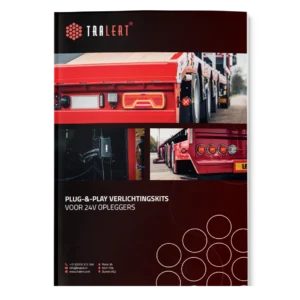
Plug-&-play kits, cabling and lighting for 24V semi-trailers.
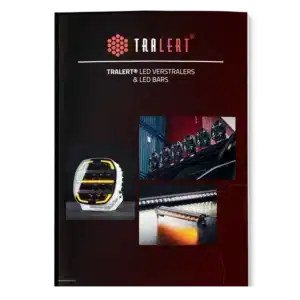
A selection of high-quality LED driving lights and LED bars.
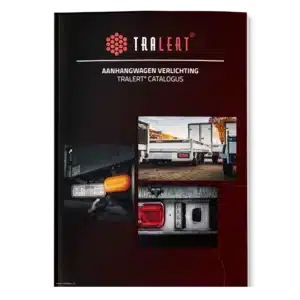
Lighting, wiring harnesses and accessories for trailers.
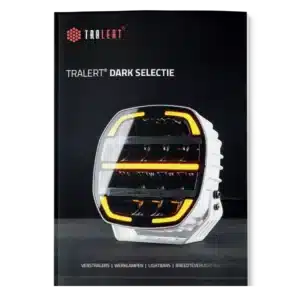
The TRALERT® DARK LED range.
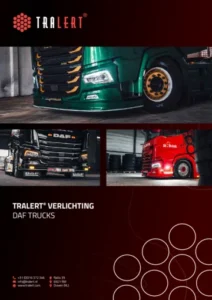
Work lights, rear lights, driving lights, beacor bars and more for DAF Trucks.
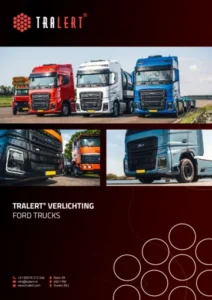
Work lights, rear lights, driving lights, beacor bars and more for Ford Trucks.
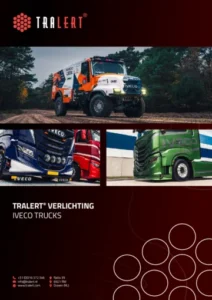
Work lights, rear lights, driving lights, beacon bars and more for Iveco.
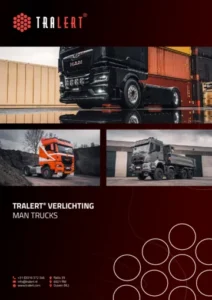
Work lights, rear lights, driving lights, beacon bars and more for MAN.
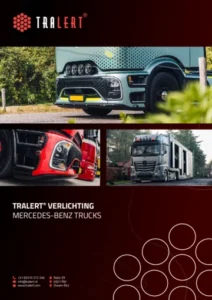
Work lights, rear lights, driving lights, beacon bars and more for Mercedes-Benz Trucks.
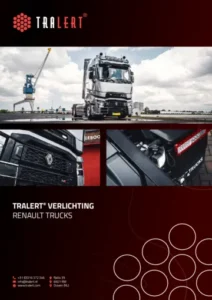
Work lights, rear lights, driving lights, beacor bars and more for Renault Trucks.
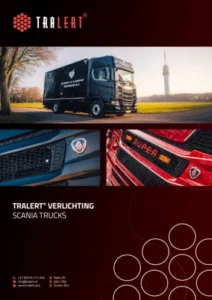
Work lights, rear lights, driving lights, beacor bars and more for Scania.
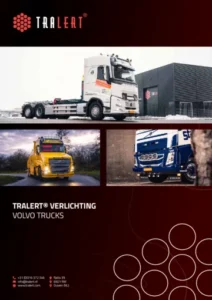
Work lights, rear lights, driving lights, beacon bars and more for Volvo Trucks.
The catalogue opens in a new tab. Can’t see it?
Open the catalogue (PDF)Two questions, in 30 seconds.
TRALERT® works with a dealer network. Dealers can view current stock levels, place orders online on account and receive a product feed for their online shop or system. We assess each enquiry internally and will let you know within 1 to 2 working days whether a partnership is possible.
You can purchase TRALERT® lighting through our partners, either locally or online. Simply provide your details, and we’ll find the partner best suited to help you.
Would you prefer to find a stockist yourself?We will assess your enquiry internally. You will hear from us within 1 to 2 working days to let you know whether a partnership is possible.
We’ll let you know within 1 to 2 working days which partner will be able to assist you further.
New
The Trailerkit Configurator is now live
Put together your ‘ trailer ’ and receive the complete lighting kit packaged as a single set: lighting, marker lights and wiring harnesses, all coordinated and ready for mounting. Includes a mounting diagram and mounting instructions.
Launch the configurator